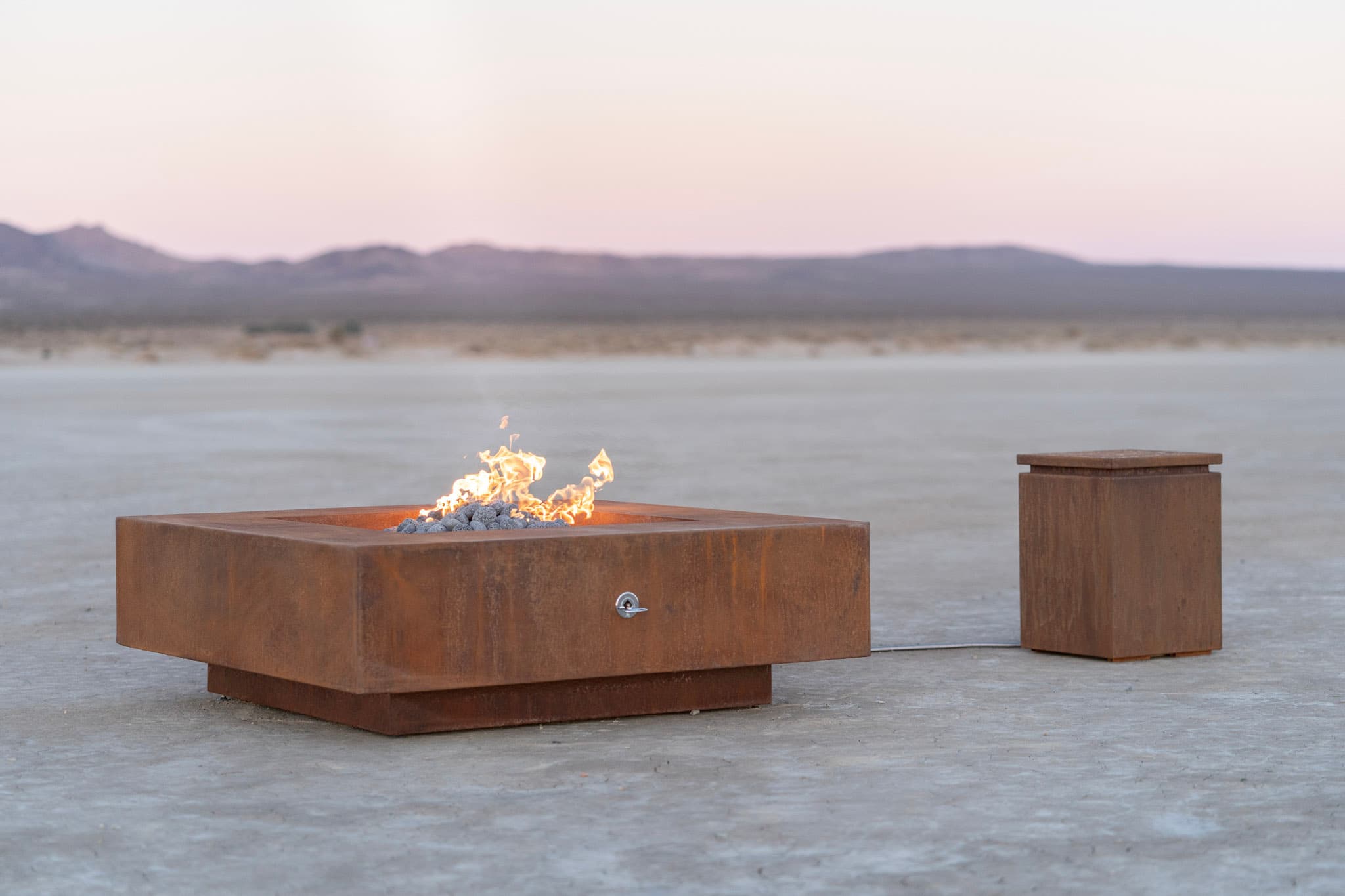
Corten Steel Fire Pits: The 2026 Guide (Rust Stains Included)
By Ash · Published October 2026 · Updated November 2026
Updated November 2026. This one page replaces our separate corten and corten-vs-stainless guides. It covers the patina timeline, the paver rust-staining problem most guides skip, corten against stainless, and real prices on The Outdoor Plus Cabo, Unity, Regal and Coronado pits.
Corten is the fire pit material that generates the most nervous calls to us, and the most relieved follow-ups two years later. The nervous question is always “isn’t rust bad?” The honest answer has two halves. The steel is fine. Your patio might not be.
Every “best corten fire pit” page we found shows the day-one studio shot and a price. None explains what the rust does to the pavers underneath. That is the part people regret, so it gets its own section below.
What is a corten steel fire pit?
Corten is a trade name for weathering steel, the family covered by standards like ASTM A588. A small amount of copper, chromium and nickel changes how the surface rusts. Plain steel grows a loose, flaky rust that lets water keep attacking the metal. Weathering steel grows a dense layer that bonds to the surface and slows everything after it. The rust is the finish. Nobody paints it.
The Outdoor Plus describes its corten pits the same way: a protective patina that matures into a weathered finish and is built to last for decades outdoors. That is the vendor’s claim, and we do not hold a mill test report for each sheet, so treat decades as the maker’s spec rather than a number we measured.
What does the patina look like year by year?
Timing swings with climate, shade and how often the pit gets wet. This is the sequence we see on installed pits.
Age
What the finish looks like
What is happening
Day 1
Dark, even mill-style finish
Little oxidation yet; surface is bare steel
Months 1–3
Orange blooms spread in patches
First wet-dry cycles; loose rust sheds the most now
Months 4–12
Bright, fairly uniform orange
Heaviest runoff window for staining nearby surfaces
Years 2–3
Darker chocolate-brown, orange highlights
Layer densifies; runoff drops sharply
Years 3–5
Settled brown-charcoal
Patina mostly stable; dry climates get here sooner
“The year-one orange scares buyers. By year three most owners stop noticing it. The pavers are what they remember.”
— Ash
Will corten rust stain my pavers and patio?
Yes, and this is the downside the top results skip. Rain, hose spray and even morning dew run over the steel, pick up iron oxide, and carry it down onto whatever the pit sits on. Porous, light material drinks it in: travertine, limestone, light concrete, and unsealed pavers. Dark, dense or sealed surfaces hide it or shed it.
Two corrections to what you will read elsewhere. First, the staining is front-loaded, but it is not guaranteed to hit zero after year one. Anywhere water still sheets off the steel, a faint orange tint can keep appearing. Second, stains are far easier to remove in the first weeks than after a full season of baking in. We learned that from customer calls: the ones who pressure-washed early were fine, and the ones who waited a summer were not.
How do you prevent and remove rust stains on pavers?
Four fixes, cheapest first. Put the pit on a dark, non-porous base such as dark pavers, a steel pad, or crushed gravel in a defined bed. Seal light pavers with a penetrating sealer before installation so the oxide has less to grab. Add a plinth or pad slightly larger than the footprint so drips land on something you do not mind. Or choose a different material for that spot; the stainless section below covers when that makes sense.
Before you buy, ask what the pit will sit on. If the answer is light travertine or limestone you cannot replace, corten is the wrong pick for that spot. Stainless or GFRC concrete is the honest recommendation.
Is corten or stainless steel better for a fire pit?
Neither lasts longer in a normal yard. They age differently and they behave differently around the surfaces next to them.
Corten
304 / 316 stainless
Look over time
Orange to brown, changes for years
Stays bright; never changes
Stains pavers
Yes, mostly year one, can linger
No
Salt air / pool chemistry
Poor; keeps corroding
316 handles it; 304 can pit
Chipped finish
Self-heals as it re-rusts
Scratches stay visible
Best fit
Modern, rustic, dark hardscape
Light pavers, pools, coastal
Grade matters more than people think. 304 is right for most inland yards. 316 adds molybdenum for chloride resistance and earns its premium near the coast or a salt pool. Be wary of unbranded stainless pits that will not state a grade, because cheap 201 or 202 alloys look identical when new and pit within a few years. For a deeper look at stainless against concrete, see ourconcrete vs stainless fire pit tables guide. For the third metal option, thebest copper fire pit bowls round-upcovers copper, which also develops a patina but does not bleed orange rust onto stone.
The Outdoor Plus lists its Cabo collection in GFRC concrete, stainless, powder-coated metals and copper as well as corten, so you can match the shape you like to the material your patio tolerates. Browse everything in theOutdoor Plus brand hub. If you like hand-welded American steel in Corten, theOhio Flame hub is the other place to look.
Does climate change which material you should pick?
Arid (Phoenix, Denver, Las Vegas). Close to ideal. Long dry stretches let the patina lock in faster, and there is less rain to carry rust onto the patio.
Humid inland (Houston, Atlanta, the Carolinas).Fine. Expect a slower, blotchier patina and more runoff because it rains often. Keep the pit on a free-draining base.
Coastal, within about 500 feet of salt water. Skip corten. Chloride keeps the steel corroding instead of settling. Ourpool fire bowls guidecovers siting near salt and chlorine.
Freeze-thaw (Chicago, Minneapolis). The steel is fine. Standing water inside the pit is what causes trouble, so cover it or drain it in deep winter.
Which Outdoor Plus corten fire pit should you buy?
All seven below ship in natural gas or propane and are listed with match-lit ignition. Prices are the live natural gas prices as of this update.
Pit
Shape
Size
BTU
NG price
Cabo 48
Square table
48"
65,000
$3,264
Cabo 60
Square table
60"
65,000
$4,156
Unity 48
Round table
48"
65,000
$3,518
Unity 60
Round table
60"
160,000
$4,494
Unity 72
Round table
72"
190,000
$4,950
Regal 60
Rectangular
60"
65,000
$3,206
Coronado 72
Low rectangular
72"
70,000
$3,358
Best square: Cabo. TheCabo 48-inch ($3,264) is the mid-size pick for a normal patio, and theCabo 60-inch ($4,156) is the large-format version for big decks. Both use the same 65,000 BTU rating, so the bigger one buys you footprint and a wider seating ring, not more heat. Square pairs well with straight-line hardscape.
Best round: Unity. TheUnity 48-inch ($3,518) suits courtyards and smaller patios. Step up to theUnity 60-inch ($4,494, 160,000 BTU) for a six-person circle with a flame that holds in a breeze, or theUnity 72-inch ($4,950, 190,000 BTU) when the pit is the centerpiece.
Not sure how big to go? Ourfire pit sizing guidewalks through clearances and seating.
Natural gas or propane for a corten pit?
Natural gas when a stub-up sits near the pit: no tank, no refills. Propane for decks, detached spaces and rentals. Cold nights favor natural gas because propane vaporizes slowly in deep cold and the flame shortens. Ournatural gas vs propane guidecovers install cost and refills.
What is corten not good at?
Salt air. Covered above.
Light stone you cannot replace. This is the paver problem again, and it is the main reason we steer buyers to stainless or concrete.
Instant results. You are buying a finish that takes years. If you want the final look on day one, choose a material that is already finished.
One upside worth naming. A gouge through the patina re-rusts and blends back within months, where a chip in powder coat stays a permanent mark.
Frequently Asked Questions
Does corten steel stain pavers and concrete?+
Yes. Rain running over fresh corten carries iron oxide onto whatever sits below, and porous light surfaces (travertine, limestone, light concrete, unsealed pavers) soak it up. Staining is heaviest in the first one to two years, then tapers. It does not always stop completely, because any water that runs over the steel can still pick up a little rust. Plan the base before the pit arrives, not after the first storm.
How do you get corten rust stains off pavers?+
Act early. Fresh stains lift with a rust remover built for masonry (oxalic-acid products are the usual choice) plus a stiff brush. Test a hidden corner first, because acid can etch limestone and travertine. Old, set-in stains on soft stone may only fade. The cheaper fix is prevention: a penetrating sealer on the pavers before the pit goes down, or a dark non-porous base under it.
Does corten steel rust forever?+
No, that is the point of the alloy. Weathering steel is built so the first rust layer turns dense and tightly bonded, which slows further corrosion far below the rate of plain carbon steel. It needs repeated wet-and-dry cycles to get there. Constant standing water or salt exposure keeps the rust active instead.
How long does a corten fire pit take to patina?+
Expect bright orange rust within the first few months, a darker brown by year two or three, and a settled finish somewhere around year three to five. Dry climates settle faster. Humid, shaded installs run slower and look blotchy longer. Fire heat does not stop the process, though the burner area can darken and flake differently from the sides.
Is corten steel better than stainless steel for a fire pit?+
Neither lasts longer in a normal yard. They fail differently. Corten changes color on purpose and stains what it touches early on. Stainless (304 inland, 316 near salt or chlorine) stays bright and leaves no stains. Pick corten for the weathered look and a base that tolerates rust. Pick stainless for pavers you care about, pools, or coastal air.
Can you use a corten fire pit near the ocean?+
We would not. Chloride from salt air keeps corten corroding instead of stabilizing, and it never settles into the stable patina. Within roughly 500 feet of salt water, go with 316 stainless or GFRC concrete. Humid inland climates like Houston or Atlanta are fine as long as the pit drains and is not sitting in a puddle.
Ash — Ash writes the buying guides at FirePits.com — years of specifying fire features on residential installs, from urban patios to mountain properties.