The 48-Inch Fire Pit Buying Guide: Why This Size Wins Most Backyards
By Ash · Published July 2026
We've spent a lot of afternoons walking clients through fire pit sizing, and the same pattern keeps showing up: people either overshoot to a 60-inch and regret it, or hedge with a 36-inch and wish they'd gone bigger. A 48-inch fire pit lands in the middle for a reason.
At 48 inches you get roughly 1,800 square inches of top surface on a rectangular unit, or a hair over 1,800 square inches on a round one. That's enough for a wide burner pan, a generous bed of lava rock or fire glass, and a flame footprint you can actually see from across the patio. It's also the largest size that still fits comfortably on most standard patios and decks without pushing seating past the practical clearance zones. If you're deciding between sizes and don't have a clear reason to go bigger or smaller, a 48-inch fire pit is almost always the right call.
Why 48 Inches Is the Sweet Spot Size
Standard patio dimensions in most builds are 12x12 or 14x16 feet. Once you account for the 3-foot clearance most manufacturers ask for around a gas fire feature, plus a 24-inch chair pull-back zone, you have a usable seating radius of about 8-9 feet from the center of the pit. A 60-inch unit eats into that radius aggressively and starts to make the space feel cluttered. A 36-inch unit leaves so much dead space that groups drift into pods and lose the “gathered around the fire” effect entirely.
At 48 inches, the flame reads as the focal point from anywhere on the patio, but chairs still pull back to a natural conversation distance without anyone feeling crowded. It's also the largest footprint that fits through most standard gate openings and side-yard access paths.
How Many People Fit Around a 48-Inch Fire Pit
Here's the seating math we use:
Round 48-inch:6 chairs comfortably, 8 if you're okay with knees close to neighbors.
Rectangular 48-inch (roughly 48x28): 6 chairs on the long sides plus 1-2 at the ends, so 6-8 total.
Rectangular vs Round at 48"
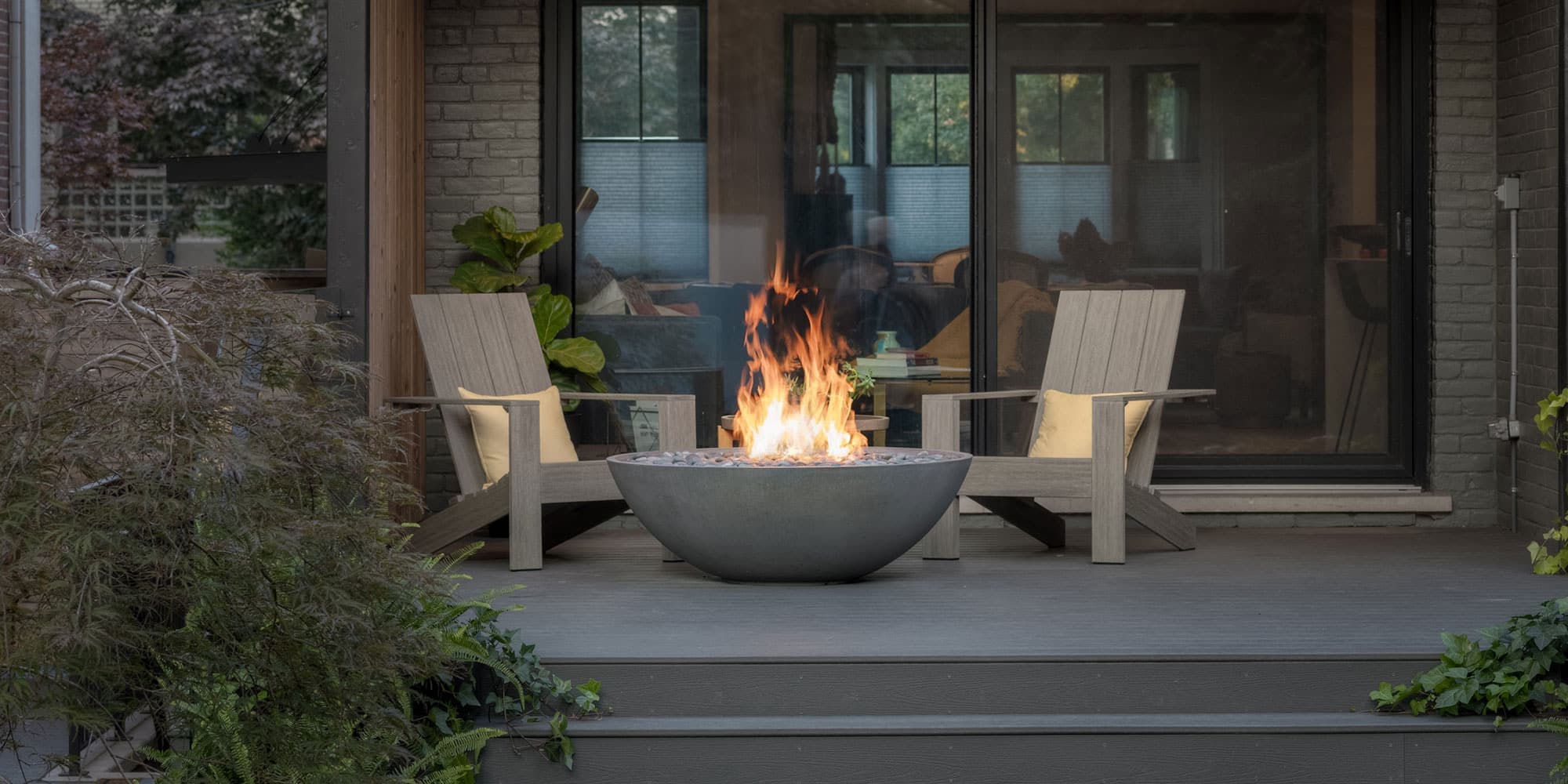
Round reads calmer. It has no orientation, so it works in any placement and looks intentional from every angle. If your patio is already busy with square pavers, straight fences, and rectangular furniture, a round 48-inch unit like the Unity 48" round in gloss black provides visual relief.
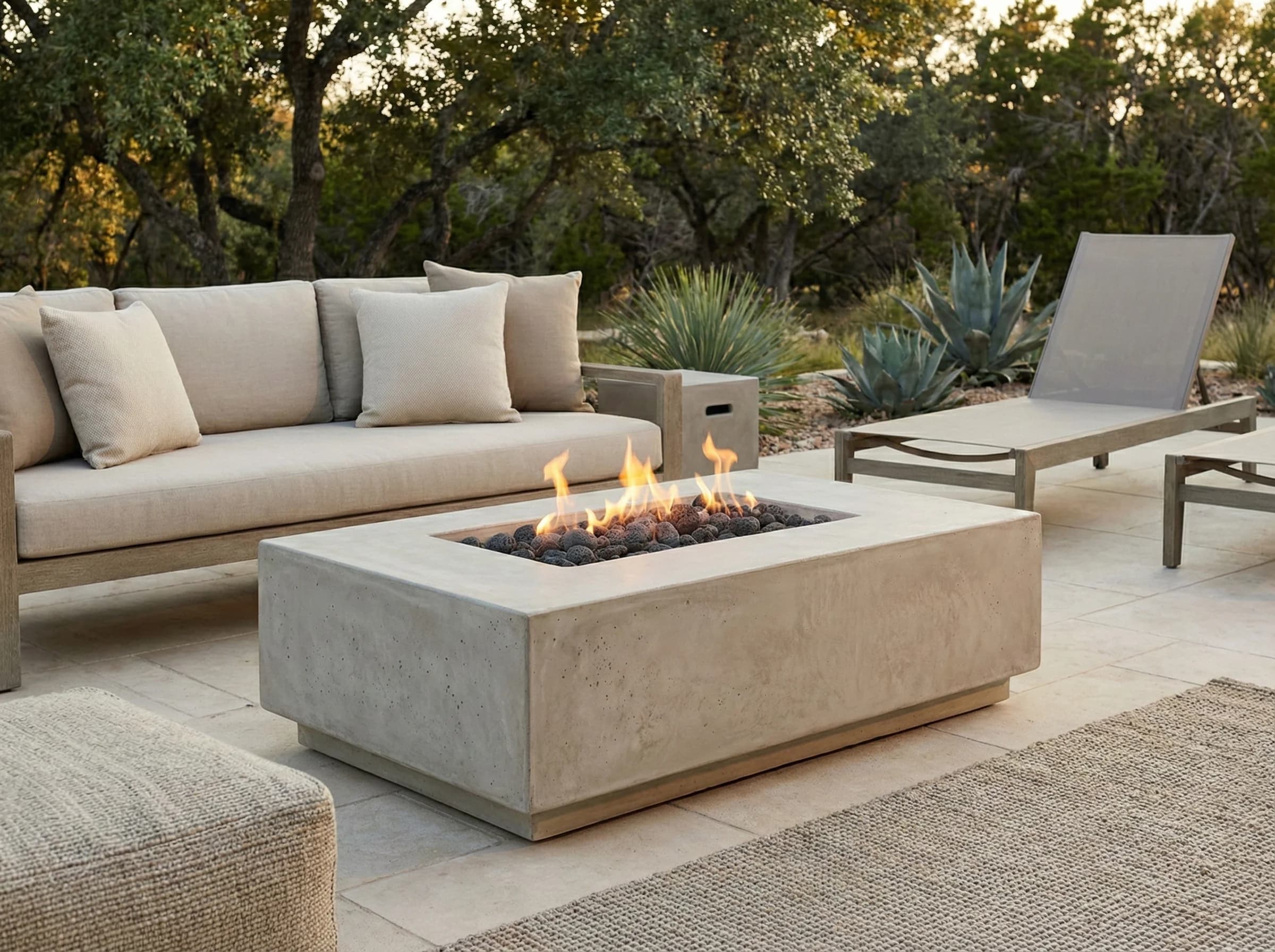
Rectangular reads more architectural. It anchors seating arrangements with clear front-and-back axes and generally looks more expensive at a glance. Rectangular units also handle wind better — the burner pan is longer and the flame pattern is more resistant to being blown flat.
Materials: Corten, GFRC, Powder-Coated Steel, Hammered Copper
Corten steel develops a rust patina over the first 6-12 months and then stabilizes into a warm, orange-brown finish. The Regal 48" corten is the cleanest example in our lineup.
GFRC concrete gives you the mass of concrete without the crack risk of poured units. The Regal 48" GFRC in natural gray and the Del Mar 48" in black show both ends of the concrete palette.
Powder-coated steel is the workhorse. The Coronado 48" in gray is our go-to recommendation for people who want a fire pit that just works.
Hammered copper is the specialty option — warmer flame reflection, hand-worked surface, ambered patina.
Fuel Options at 48"
Natural gas is our recommendation whenever a hookup is possible. A 48-inch fire pit in the 40,000-65,000 BTU range will burn continuously with no tank swap, and the per-hour cost of natural gas is roughly a third of propane.
Propane at 48 inches means either an integrated tank compartment or an external tank routed underground. A standard 20-lb propane tank runs a 45,000 BTU pit for roughly 6-7 hours of continuous use.
Ignition Systems
Match-lit is the simplest and most reliable. We like match-lit on the Coronado for exactly this reason: fewer things to go wrong.
Electronic ignition (EI) adds a push-button spark and flame-sensing safety shutoff. The main failure mode is the ignition module getting damp over winter, so a good cover matters more with EI.
Plug-and-play systems come pre-wired. The Regal 48" corten with plug-and-play and the Del Mar 48" concrete table are both plug-and-play.
Deck vs Patio vs Yard: Placement + Clearances at 48"
Patios are the ideal home. Concrete pavers, flagstone, and poured concrete all handle radiant heat without issue. Keep at least 36 inches of clearance from any structure.
Decks need more scrutiny. Composite decking generally handles a 48-inch gas fire pit fine with a deck protector mat. Wood decks are more variable — check the spec sheet before you commit.
Yards require a level, non-combustible pad underneath. Never place a gas fire pit directly on grass.
Best 48-Inch Fire Pits We Currently Sell
Four picks that cover most use cases:
Best all-around: The Coronado 48" powder-coated steel. Clean lines, match-lit simplicity, 40,000 BTU natural gas.
Best for modern-industrial architecture: The Regal 48" corten steel. Plug-and-play ignition, 45,000 BTU.
Best for entertaining: The Del Mar 48" GFRC concrete table. Table-height surface, 65,000 BTU.
Best round option: The Unity 48" round in gloss black. Integrated propane tank compartment, 65,000 BTU.
Care, Cover, and Off-Season Storage
Buy the manufacturer's fitted cover the same day you buy the pit. Universal covers leak at the corners and trap moisture against the burner pan.
Empty and dry the burner pan before the first freeze. Fire glass and lava rock don't need to come inside, but standing water in the pan will freeze and stress welds.
Run the pit for 10 minutes at least once a month during the off-season if you can. It burns off condensation and catches any issue early.
Frequently Asked Questions
Is a 48-inch fire pit too big for a small patio?+
Can I run natural gas to a 48-inch fire pit?+
What BTU should a 48-inch fire pit have?+
Round or rectangular for entertaining?+
How much heat does a 48-inch fire pit put out at 45k BTU?+
Ash — Ash writes the buying guides at FirePits.com — years of specifying fire features on residential installs, from urban patios to mountain properties.