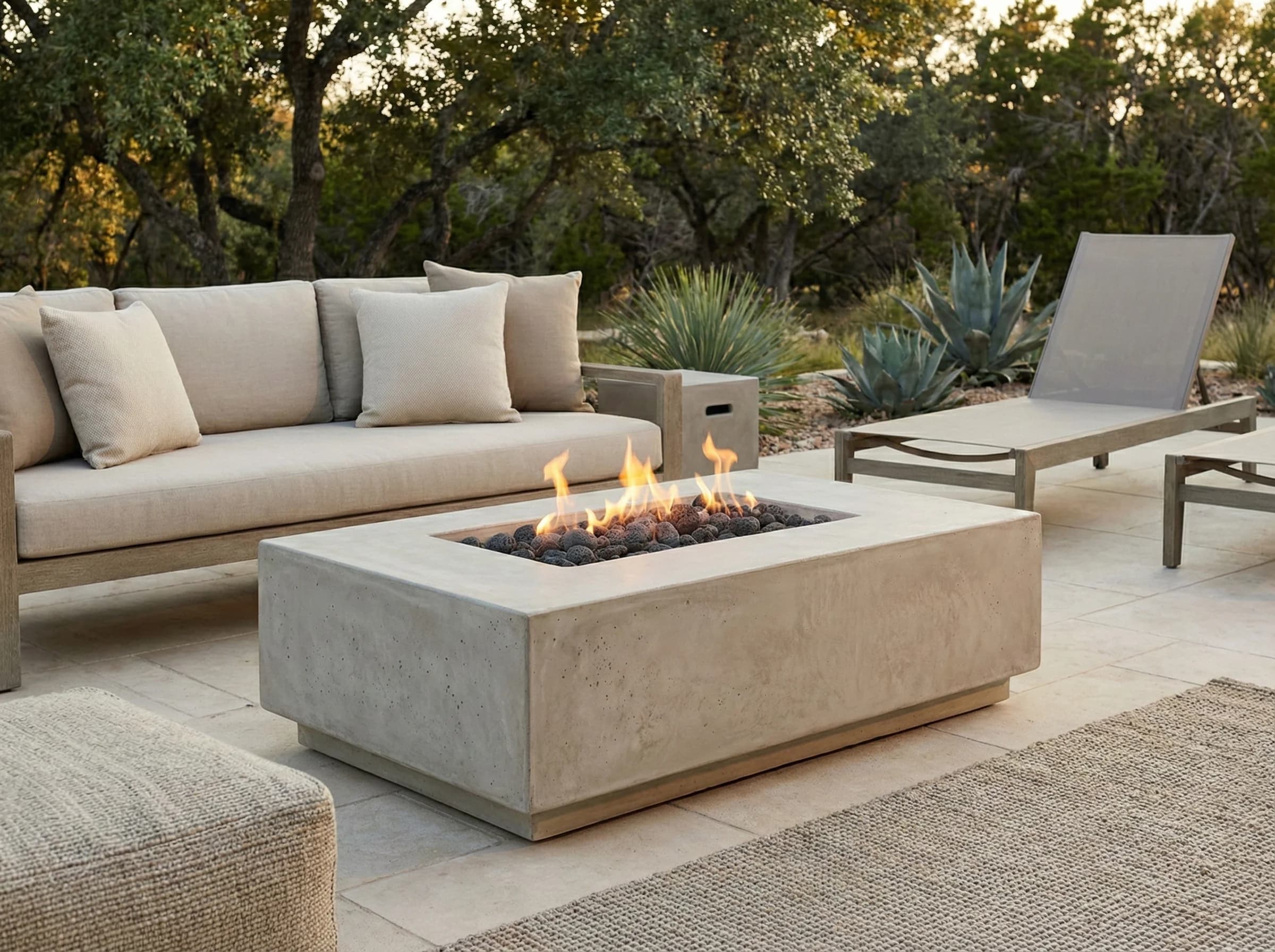
Fire Pit BTU Explained: What 45,000 to 190,000 BTU Actually Means
By Ash · Published July 2026
We get asked about BTU more than almost any other spec — and honestly, more than it deserves. BTU is the number manufacturers put on the box because it's easy to compare. But after selling and installing hundreds of gas fire pits, we can tell you that BTU alone is a lousy predictor of whether you'll actually be warm on your patio in October.
The number matters. It just doesn't matter the way most buying guides pretend. A 45,000 BTU bowl in a sheltered courtyard will out-warm a 90,000 BTU rectangle on an exposed bluff. A 65,000 BTU table at sea level puts out noticeably more felt heat than the same table at 7,000 feet in Park City. And a 190,000 BTU commercial-grade pit run at full tilt for four hours will burn through a 20-lb propane tank in a single sitting.
What Is BTU, Actually
BTU stands for British Thermal Unit. One BTU is the energy required to raise one pound of water by one degree Fahrenheit. On a gas fire pit, the BTU rating you see is the maximum gas-consumption rate of the burner, expressed as BTU per hour.
The energy in gas is remarkably consistent: natural gas averages about 1,030 BTU per cubic foot, propane about 2,516 BTU per cubic foot. Every certified burner is tested against those constants. What varies is where the heat goes after combustion — up into the sky, sideways into the wind, or radiated outward to the seating around the pit.
The BTU Range for Outdoor Fire Pits
Almost every residential gas fire pit lives between 30,000 and 200,000 BTU. Here's how the range breaks down:
30,000-40,000 BTU:Small bowls, tabletop features, décor-first pieces. Typically 20-30" round.
45,000-65,000 BTU:The residential sweet spot — bowls, tables, small rectangles. Typically 27-48" round or rectangle.
65,000-95,000 BTU:Larger tables, exposed patios, entertaining spaces. 48-72" rectangle.
130,000-200,000+ BTU:Commercial patios, high-altitude, oversized centerpieces. 72"+ round or long rectangle.
Why Size Drives BTU
BTU tracks burner size, and burner size tracks bowl size. A larger fire pit has a larger burner ring, which means more ports, which means more gas flowing through the flame pattern.
Here's the pattern across The Outdoor Plus lineup we carry:
Sedona bowl 27": 45,000 BTU. Coronado rectangle 48": 40,000 BTU. Cazo fire+water bowl 36": 65,000 BTU. Del Mar table 48": 65,000 BTU. Coronado rectangle 84": 90,000 BTU. Unity table 72": 190,000 BTU.
45,000-65,000 BTU — The Right-Sized Range for Most Backyards
If you have a covered patio, a courtyard, a deck with any wind protection, or a lounge area seating four to six people, you almost certainly want something in this range.
At 45,000 BTU, a 27" Sedona bowl throws comfortable felt warmth to about 4-5 feet at 60°F ambient — enough for two Adirondacks pulled close, or a small semicircle of chairs at conversational distance.
Step up to 65,000 BTU and the character changes. The 36" Cazo fire + water bowl throws felt heat to about 6 feet at ambient 65°F — and roughly 4 feet at 45°F. That's the difference between a fire pit that works from Memorial Day to Labor Day and one that carries you into shoulder season.
The 48" Del Mar table at the same 65k BTU behaves slightly differently because the heat is distributed along a longer, narrower flame — better for a rectangular seating arrangement.
80,000-95,000 BTU — When You Actually Need It
You need it when:
Your patio is exposed to prevailing wind on at least one side. You're seating 6-10 people at conversational distance from the flame. Your shoulder-season use case is October in Denver, not October in San Diego. Your pit is oversized — anything past 60" of flame length benefits from higher BTU to look proportional.
The 84" Coronado rectangular pit at 90,000 BTU is our go-to for large entertaining patios. The heat radius holds around 8 feet at ambient 60°F.
130,000-200,000 BTU — Serious Heat Territory
This is where residential blurs into commercial. The 72" Unity round table at 190,000 BTU is genuinely commercial-grade. At full throttle, you get comfortable felt heat past 12 feet — but you also burn through natural gas at about 185 cubic feet per hour, or a 20-lb propane tank in roughly 4.5 hours of continuous use.
The other reason to buy in this tier: altitude. Every 1,000 feet of elevation reduces atmospheric oxygen density by roughly 3%, which reduces combustion efficiency proportionally.
Altitude, Wind, and Ambient Temperature
Altitude. At 5,000 feet, a 65k BTU pit effectively behaves like a 55k pit. At 8,000 feet, closer to 51k.
Wind. Sustained 10 mph wind can cut felt heat radius by 40-50%. This is why sheltered courtyards feel warmer at 45k BTU than open patios at 65k.
Ambient temperature. Every 20°F drop in ambient air roughly halves the effective heat radius.
The practical rule: for every environmental factor working against you, consider stepping up one BTU tier.
Propane vs Natural Gas: Same BTU, Different Behavior
A 65,000 BTU rating means 65,000 BTU per hour whether the pit runs on natural gas or propane. The thermal output is identical. But the behavior differs.
Flame character: Propane burns hotter per cubic foot and produces a slightly taller, more yellow-orange flame. Natural gas produces a shorter, bluer flame at the base.
Fuel consumption rate: At 65,000 BTU/hour, natural gas consumes about 63 cubic feet per hour. Propane consumes about 26 cubic feet per hour — but a 20-lb tank holds about 430,000 BTU of usable energy, running a 65k pit about 6.6 hours at maximum output.
Cold-weather performance: Propane vaporizes poorly below about 20°F. Natural gas is unaffected by ambient temperature.
BTU vs Heat Radius: What You Actually Feel
Rough numbers we measured on our showroom pits at ambient 65°F, calm air, sea level:
45,000 BTU: Comfortable warmth at 3-4 ft, notable at 5-6 ft. Sheltered environments only.
65,000 BTU: Comfortable at 5-6 ft, notable at 8-9 ft. Handles moderate open patio.
90,000 BTU: Comfortable at 7-8 ft, notable at 10-11 ft. Handles exposed patio.
190,000 BTU: Comfortable at 11-12 ft, notable at 15+ ft. Handles altitude, wind, deep cold.
Right BTU for Your Use Case
Intimate courtyard, 2-4 people, mostly décor: 40,000-45,000 BTU.
Standard suburban patio, 4-6 people, three-season use: 55,000-65,000 BTU.
Large entertaining patio, 6-10 people, exposed to some wind: 80,000-95,000 BTU.
Cold-climate deck or high-altitude patio (5,000+ ft): Bump up one full tier.
Commercial patio, resort setting, or oversized centerpiece: 130,000-200,000 BTU.
Rectangular pit longer than 60": 65,000 BTU minimum for flame proportion.
Frequently Asked Questions
Is 65,000 BTU enough for a 4-person patio?+
What BTU do I need at 6,500 ft elevation?+
Is more BTU always better?+
Does natural gas produce different heat than propane at the same BTU?+
How long does a 65,000 BTU fire pit run on a 20-lb propane tank?+
Can I dim a 190,000 BTU fire pit for ambient use?+
Ash — Ash writes the buying guides at FirePits.com — years of specifying fire features on residential installs, from urban patios to mountain properties.