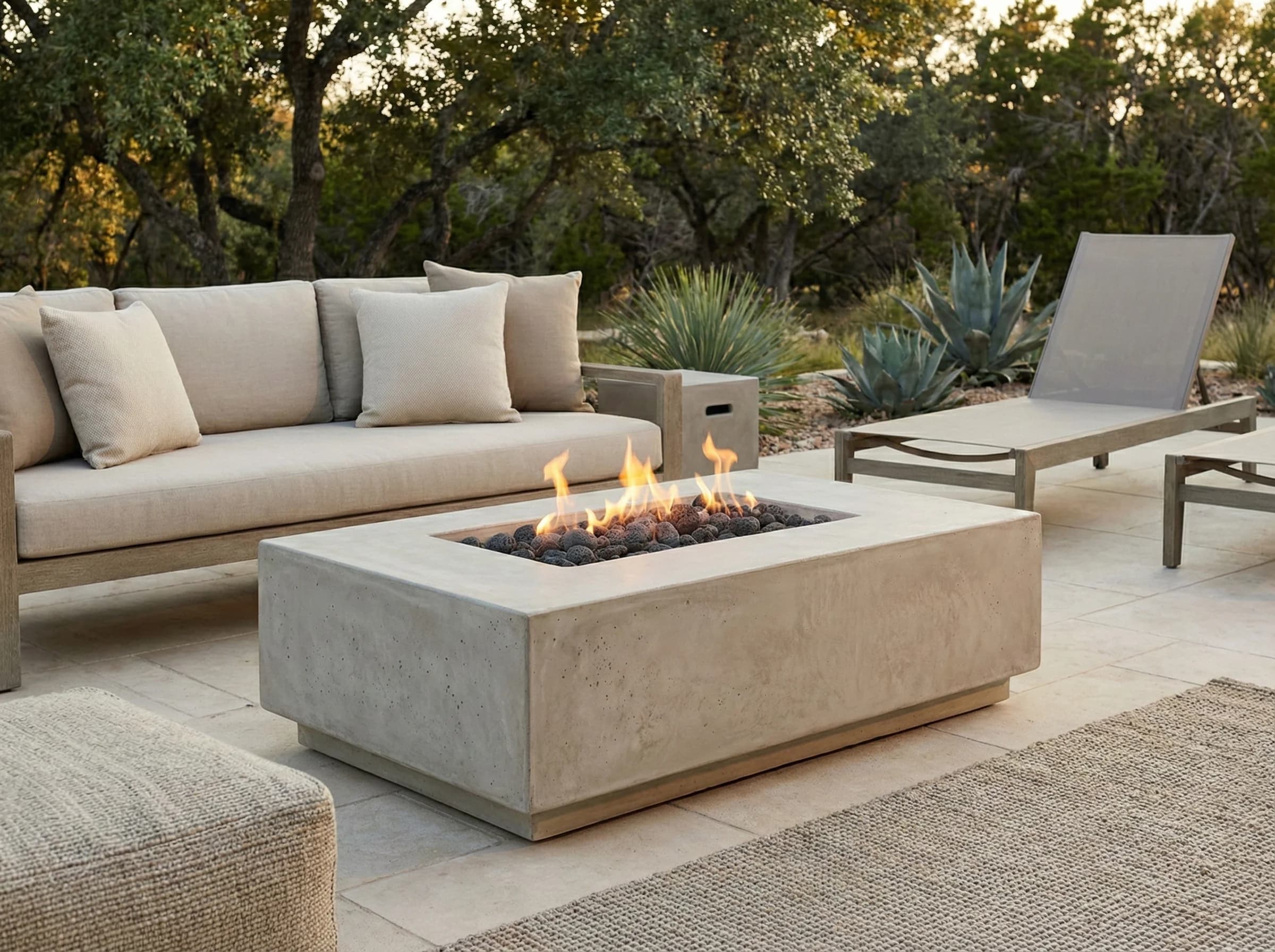
Pool Fire Bowl Buying Guide: Choosing Fire Features That Belong Poolside
By Ash · Published July 2026
The first time we set a pair of GFRC concrete bowls on the raised bond beam of a 20x40 gunite pool and watched them fire up at dusk, we understood why this category has quietly taken over luxury pool builds.
A pool fire bowl is not a decorative afterthought. It is architectural lighting that also happens to heat the space, throw a reflection across still water, and pull the eye toward the deep end after the sun drops.
We have specced, sold, and installed enough of these to have opinions. Some materials survive a pool environment for a decade. Others chalk out in three seasons. Some ignition systems make sense five feet from chlorinated water. Others we would not put near a splash zone under any circumstance.
This is the guide we wish existed when a customer first calls asking for “those fire bowls I saw on Instagram” — the ones flanking an infinity edge or perched on pool coping. We will cover what actually defines the category, the fuel and material tradeoffs, how to size and space them, what installation really looks like, and the four bowls we would put on our own pool this year.
What Actually Defines a Pool Fire Bowl
A pool fire bowl is a self-contained gas fire feature designed to sit on or beside a pool structure — typically on the raised bond beam, on pool coping, on a pedestal at the deep end, or integrated into a spillway that returns water to the pool. What separates a pool fire bowl from a standard patio fire bowl is not the bowl itself. It is the intended siting: within a few feet of chlorinated water, often in a splash zone, frequently paired symmetrically with a second bowl across the pool.
The category splits three ways. Pure fire bowls burn gas through a stainless or brass burner ring surrounded by fire glass or lava rock. Fire + water bowls add a scupper that lets pool water cascade out of the same vessel while flame burns above. And fire pit tables — larger, seated features — sit poolside as a gathering point rather than a sculptural accent. All three can work. Which one belongs on your pool depends on how the deck is built and how you use the space at night.
Fuel Options: Propane, Natural Gas, or Fire+Water
Ninety percent of the pool fire bowls we ship run on natural gas. It is the right answer for a permanent installation. A dedicated gas line means no tanks to hide, no propane runs to remember, no 20-lb cylinder sitting inside a decorative bowl base. Natural gas also runs cleaner over long burn sessions — a two- or three-hour dinner poolside does not leave the residue that propane can.
Propane still makes sense in two scenarios: retrofit installs where trenching for a gas line is not on the table, and vacation homes where the pool deck sees seasonal use. A propane fire bowl needs a hidden enclosure for the tank, usually under the pool deck or in an adjacent equipment vault. Budget for it early.
Fire + water bowls are their own conversation. These require both a gas supply and a plumbing tie-in to the pool's return line. The water flow is driven by the pool pump, not a dedicated pump inside the bowl, which means your pool builder needs to size the plumbing during construction. Retrofitting fire + water bowls to an existing pool is possible but expensive — you are cutting into the deck to run new returns.
Materials: GFRC Concrete vs Copper vs Steel
Material choice determines how the bowl looks at night, how it ages, and whether it survives twenty pool seasons or three.
GFRC concrete — glass-fiber-reinforced concrete — is the material we recommend most often for poolside. It handles chlorine splash, UV exposure, and freeze-thaw cycles better than any other option in this category when the sealer is maintained. GFRC also lets manufacturers hit shapes that would be impossible in metal: tapered lips, thin walls, cast textures that read as natural stone. Prism Hardscapes and The Outdoor Plus both do GFRC extremely well, and the finish options — limestone, ash, natural, pewter — pull directly from the same palette pool builders use for coping and waterline tile.
Hammered copper is the aesthetic play. Copper reflects flame differently than any other material — the hammered dimples catch the fire from underneath and throw a warmer, more variable light across the water than a smooth surface would. That said, copper needs annual attention around chlorine. A wax sealer once a season keeps the patina where you want it. Without it, chlorine will accelerate the patina into a chalky green nobody asked for.
Powder-coated steel is the workhorse. Steel fire pit tables and larger bowls survive poolside without the finish work copper demands. The Outdoor Plus does a copper vein powder-coat finish that reads like real hammered copper from ten feet away — which, honestly, is the viewing distance that matters at a pool.
Sizing: 27", 36", 48" and Spacing
Bowl diameter drives everything downstream — burner BTU, gas line size, visual weight on the deck. Our rules of thumb after specifying dozens of these:
27-inch bowls are the accent size. Perfect for flanking a set of stairs, marking the corners of a spa, or lining a narrow bond beam where a 36-inch bowl would overpower the geometry. Typical burn is around 45,000 BTU — enough to throw real flame without dominating conversation.
36-inch bowls are the standard for most pool installs. Around 65,000 BTU, big enough to read as a fire feature from across a 40-foot pool, small enough that a pair does not crowd a raised bond beam. If a customer asks us for one size, this is where we start.
48-inch bowls and fire tables are gathering features, not accents. Put these where people sit — a lounge grouping at the shallow end, a corner of the deck built out for seating.
Installation and Placement
Three placement patterns cover most installs.
Bond-beam mounted is the classic. The bowl sits directly on the raised bond beam of the pool, gas line run through the beam during construction. This is the cleanest look because the bowl reads as part of the pool structure. It also requires coordination with the pool builder before shotcrete or gunite goes down.
Deck-mounted freestanding is the retrofit-friendly option. The bowl sits on the pool deck a few feet back from coping, gas line run under the deck to a stub-up under the bowl. This works for existing pools where the bond beam was never designed to carry a fire feature.
Pool-coping-integrated is the highest-end install, typical for fire + water bowls where the vessel cantilevers slightly over the water and the scupper returns pool water directly to the pool. This has to be designed with the pool from day one.
Safety, Code, and Ignition
Three ignition options, three different use cases.
Match-lit is simplest — turn the gas valve, drop a long lighter or match. Fewest failure points, cheapest to install. We spec match-lit for customers who enjoy the ritual and for propane bowls at vacation homes.
Electronic ignition uses a control board, hot surface igniter, and flame sensor. Push a button, the bowl lights, safety cutoff kicks in if the flame blows out. This is our default recommendation for daily-use pools. Safe next to chlorinated water — the electronics live in a sealed junction box.
Plug-and-play systems ship pre-assembled with the electronic ignition already wired to a low-voltage transformer. Plug the transformer into a GFCI outlet, connect gas, and the bowl works. This is the right answer for retrofit installs.
Fire + Water Bowls Explained
The fire + water bowl is the feature that turns a pool into a hotel lobby. Water cascades from a scupper on the front of the bowl, flame burns above the water, and the reflection in the pool doubles the visual weight of the feature.
The trick is water flow. Too little and the scupper drools instead of pouring. Too much and the water noise drowns out conversation. The Cazo 36" fire + water bowl from The Outdoor Plus is calibrated for around 25-30 GPM through the scupper — enough to produce a solid, quiet sheet of water. Your pool builder needs to size the plumbing accordingly.
Care and Maintenance Through Pool Seasons
Opening the pool: Inspect the burner ring for insect nests. Clear any debris, verify the pilot lights, run the bowl for 15 minutes to burn off any moisture in the gas line.
Mid-season: Rinse GFRC bowls with clean water after any chlorine splash event. Reseal GFRC every two to three years depending on sun exposure. For copper, wax annually.
Closing: Cover the bowl. Every quality manufacturer sells a fitted cover, and it is worth the money. A $150 cover extends the finish life by years.
What We'd Actually Buy Right Now
Four specific bowls we would put on our own pool this season, depending on the install:
For the sculptural install on a raised bond beam: the Prism Hardscapes Elevate 80. A tall, tapered GFRC bowl that reads as a piece of architecture. Best-in-class GFRC finish work.
For a matched pair flanking a spa or shallow-end steps: the Prism Hardscapes Porto 60. Lower profile than the Elevate, still substantial enough to read from across the pool.
For the fire + water statement: the Cazo 36" GFRC fire + water bowl from The Outdoor Plus. GFRC construction, 65,000 BTU burner, and a scupper designed for real pool return integration.
For a smaller pool or a spa surround: the Sedona 27" GFRC bowl with electronic ignition. Right-sized for narrower bond beams.
For a poolside gathering feature rather than a bowl pair: the Unity 48" powder-coated steel fire pit table in copper vein. Plug-and-play ignition makes retrofit straightforward.
Frequently Asked Questions
Can I use a fire bowl over a pool without support?+
Do pool fire bowls need gas run to them?+
What BTU is right for a fire bowl by a pool?+
Do fire + water bowls actually produce enough water flow to look like a fountain?+
Are electronic ignition systems safe by chlorinated water?+
Ash — Ash writes the buying guides at FirePits.com — years of specifying fire features on residential installs, from urban patios to mountain properties.