A hand-hammered copper fire pit bowl is one of the few outdoor pieces that looks better in year five than it did on delivery day. The patina is the point. Six bowls below, all from The Outdoor Plus, with real 2026 prices and a year-by-year look at how the finish actually ages.
Updated October 2026. Copper is the one fire pit material we sell that customers call back about years later — not with a problem, but to send a photo of what the patina looks like now. That almost never happens with powder-coated steel or GFRC concrete. Copper has a second act that the other materials do not.
The problem with most “best copper fire pit bowl” lists on page one of Google is that nobody shows what the finish actually looks like after a few seasons. You see the day-one studio shot and a price range, and then you have to guess whether it ages into something you want. We ship these every month, and we have five years of customer photos to draw from. The year-by-year patina timeline below is the thing most of our competitors never put on the page.
Why copper, specifically, for a fire pit bowl?
Three reasons, in order of how often customers cite them to us.
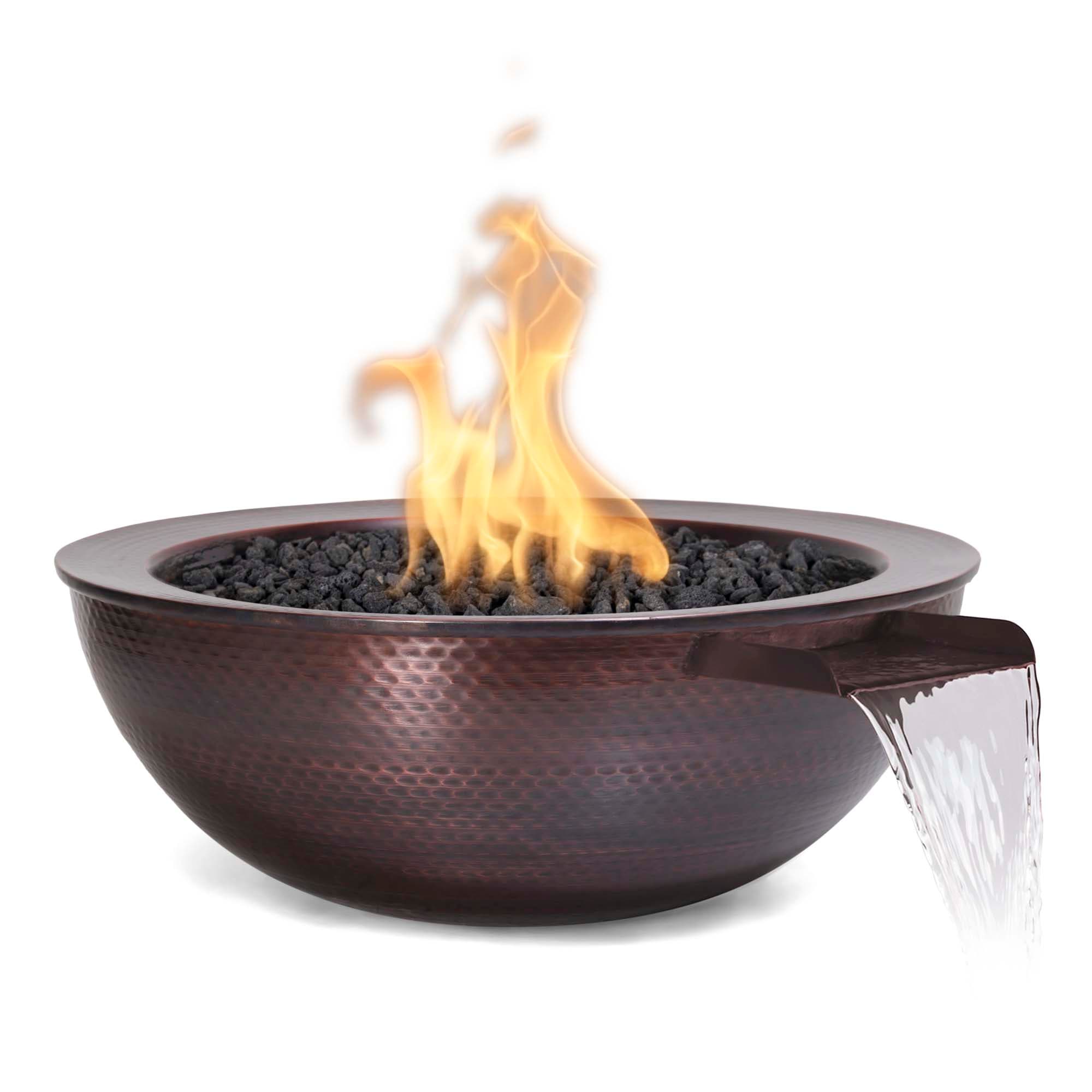
The patina. Hammered copper leaves our warehouse bright orange-red, under a thin factory lacquer. The lacquer wears off at the flame edge first and the exposed copper walks through a sequence most buyers actively want: warm bronze inside six months, chocolate brown through year two, the first blue-green verdigris in the hammer marks by year three, and a fully composed patina inside year five. No two bowls age identically, which is the whole appeal.
The flame reads warmer. Copper reflects light with a lower color temperature than steel. The same 45,000 BTU burner looks visibly warmer in a copper bowl than in a powder-coated steel bowl at night. The hammered surface compounds this because each dimple throws a tiny reflection of the flame in a slightly different direction. Watch the Cazo 30 lit at dusk from across a patio and you understand why landscape designers specify copper for the pieces that have to carry a scene.
The handcraft is visible. Every Cazo and Sedona bowl ships with real hammer marks — the dimpling is a hand process, not a machine stamp. On a product that costs the same as a decent patio sofa, that handcraft matters. In our experience customers who hesitate on the price change their minds the moment they touch a bowl in person and feel the thickness of the copper and the depth of the hammering.
Year 1 vs Year 5: what the patina actually looks like
This is the question we get on every pre-sale call and the one the top three SERP results for this query do not answer with actual photos. Here is the honest timeline from the Cazo and Sedona bowls we have been tracking since 2021.
| Age | What the finish looks like | What is happening |
|---|---|---|
| Day 1 | Bright orange-red, mirror-like polish, thin lacquer | Factory finish, lacquer intact across the whole bowl |
| Month 3 | Warm bronze, especially on sun-exposed sides | Lacquer thinning from UV; copper underneath beginning to oxidize |
| Year 1 | Chocolate brown at the flame edge, bronze on the lower bowl | Lacquer worn off above the burner line; copper oxide forming |
| Year 3 | First blue-green verdigris inside the hammer dimples | Carbonate layer forming where humidity catches in the hammered texture |
| Year 5 | Fully composed patina — brown base, verdigris highlights | Protective oxide layer stable; patina pattern now permanent |
One nuance worth flagging. Bowls installed within six feet of chlorinated pool water accelerate the verdigris stage by about a year because chlorine vapor speeds the carbonate reaction. A quick wax seal every spring slows this if you want the patina to develop more evenly across the bowl. Our pool fire bowls guide covers the poolside siting rules in more detail.
Hammered vs smooth copper — which should you buy?
Hammered, almost always. Every bowl on this list is hand-hammered because that is the finish customers come back for. Smooth copper exists in a few bespoke lines, but at residential scale the hammered surface outperforms smooth on both aesthetics and patina.
The reason is the hammer dimples catch moisture and flame in a way smooth copper cannot. Each dimple becomes a tiny micro-climate — a droplet collects, dries, oxidizes, and the patina develops with texture instead of flat uniformity. On a smooth bowl the patina can read as a water stain. On a hammered bowl it reads as intentional handcraft, because it echoes the hand-tool pattern underneath.
Pick smooth copper only when the surrounding design is unambiguously modern-minimal and the bowl needs to read as a clean geometric form, not a handcrafted object. For 95% of the patios we spec, that is not the right call.
Our picks at a glance
| Bowl | Size | BTU | Style | From (NG) |
|---|---|---|---|---|
| Cazo 24 | 24" round | 45,000 | Fire-only | $2,666 |
| Cazo 24 F+W | 24" round | 45,000 | Fire + Water | $3,162 |
| Sedona 27 F+W | 27" round | 45,000 | Fire + Water | $3,368 |
| Cazo 30 | 30" round | 45,000 | Fire-only | $3,402 |
| Cazo 30 F+W | 30" round | 65,000 | Fire + Water | $3,566 |
| Cazo 36 F+W | 36" round | 65,000 | Fire + Water | $5,474 |
Best accent bowl: Cazo 24 in hammered copper
- 24" round · 45,000 BTU brass burner
- Hand-hammered copper · natural gas or propane variants
- Match-lit baseline · electronic ignition upgrade available
- Right size for flanking stairs, columns, or seating corners
The 24-inch Cazo is the smallest bowl we would still spec as a real fire feature instead of a decorative object. 45,000 BTU reads as a correct flame at this diameter — not thin, not overpowering. Pair of them flanking a set of pool-deck stairs is a landscape-designer favourite because the proportion matches step width without crowding the geometry.
At $2,666 for the natural gas fire-only configuration this is also the honest entry point into a real copper bowl. Below this price band you are buying powder-coated steel or thin-wall copper that will not survive 10 seasons.
Best 27-inch pick: Sedona 27 Fire + Water bowl
- 27" round · deeper bowl silhouette than the Cazo
- 45,000 BTU brass burner · 25-30 GPM water scupper
- Natural gas (NG) or propane (LP) variants — same price
- Match-lit ignition baseline · electronic available
The Sedona 27 sits a little taller and deeper than the Cazo at the same diameter — the silhouette reads more vessel-like, less pan-like. Our customers who are specifying a bowl to sit on a raised bond beam next to a gunite pool usually pick the Sedona over the Cazo for that reason.
The water scupper on the fire + water variant moves 25 to 30 gallons per minute at the pool-builder-standard return pressure. That is a solid sheet of water, not a trickle. The flame reads above the water, both reflected and real. This is the shot you see on landscape architecture Instagram.
Both the natural gas Sedona 27 and the propane Sedona 27 land at $3,368. Pick based on your gas infrastructure, not price.
Best overall: Cazo 30 hammered copper
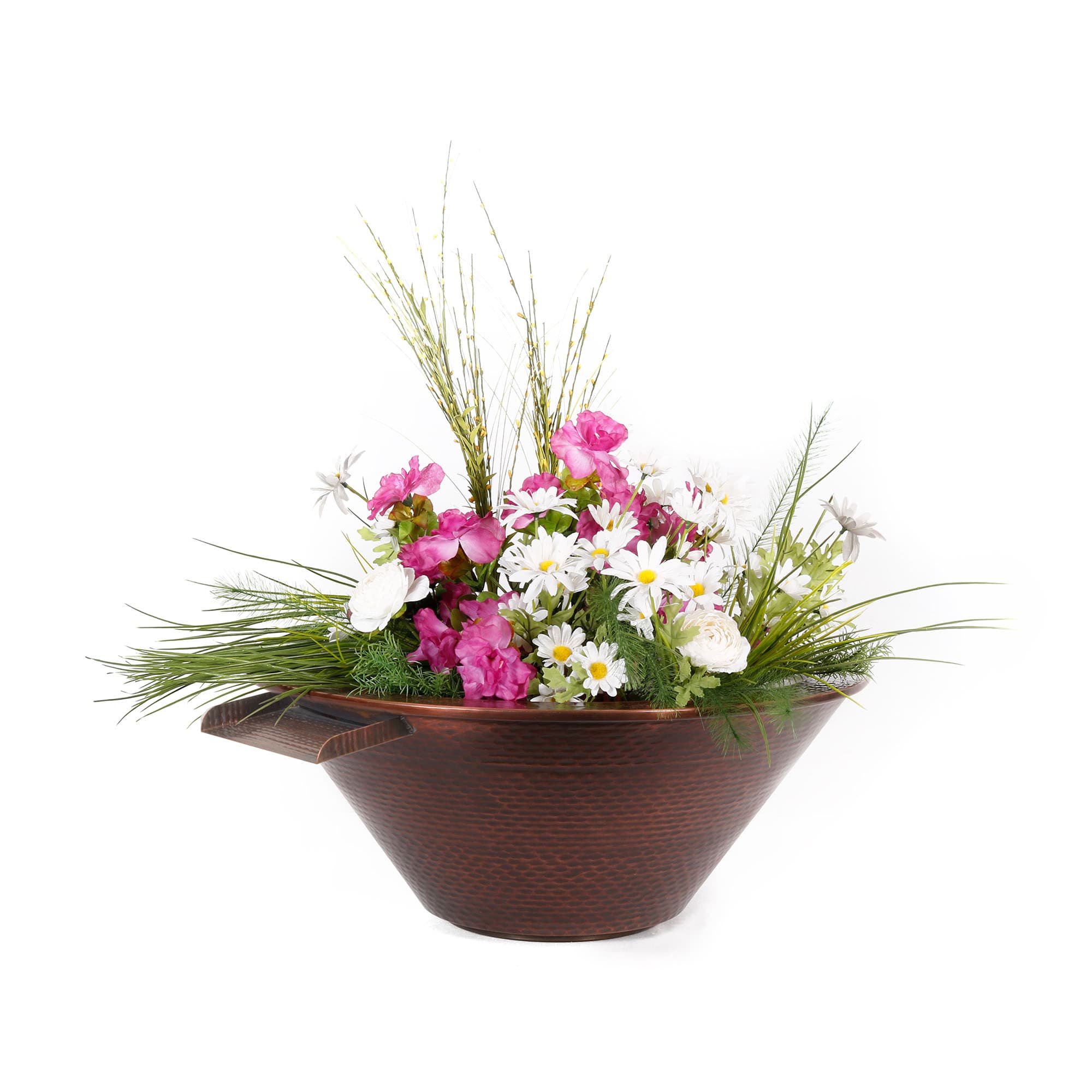
- 30" round · 65,000 BTU brass burner (F+W variant)
- Hand-hammered copper · 24" burner pan
- Fire-only variant at $3,402 · F+W variant at $3,566
- Seats a 6-person conversation circle comfortably
The 30-inch Cazo is the bowl we ship more of than any other on this list, and it is the one we recommend first unless the brief is specifically pool-adjacent or accent-sized. 65,000 BTU across a 24-inch burner pan reads as a serious flame — same floor as most 48-inch fire pit tables, concentrated into a bowl shape.
In our experience the 30-inch is the honest sweet spot for a conversation-circle install. A standard six-person seating arrangement around the bowl leaves 36 to 42 inches between chairs and the lip, which is where you want to be — close enough to feel the heat, far enough to not scorch your shins.
Statement piece: Cazo 36 hammered copper
- 36" round · 65,000 BTU brass burner
- Hand-hammered copper · a serious piece of architectural metalwork
- F+W variant at $5,474 · fire-only variant at $5,006
- Reads as the architectural centerpiece of the outdoor room
The 36-inch Cazo is a different conversation from the smaller bowls. At 36 inches a copper bowl stops being an accent and becomes the architectural centerpiece of the patio. The hand-hammered surface at this scale is genuinely impressive in person — individual hammer marks are legible from across the yard.
At $5,474 for the fire + water natural gas configuration the 36 is a premium pick. We spec it for installs where the fire feature is meant to anchor the whole outdoor room — a stepped patio off a kitchen-grade build, a resort-style poolscape, a courtyard where the bowl is intentionally the thing people notice first. If that is the brief, nothing else in copper matches it at this size.
Natural gas vs propane: pick based on infrastructure
Every bowl on this list is available in matched NG and LP variants at the same price. The right pick is almost always decided by what the patio already has.
Natural gas when the house gas manifold is within reach of the install and a licensed gas fitter can run a proper stub. No tank to swap, no cold-weather BTU drop, no visible propane line. For permanent patio installs this is the default.
Propane when the bowl lives on a detached deck, courtyard, rooftop, or any patio without a gas stub. You will need a hidden enclosure for the 20-pound tank, usually under a bench or in an adjacent equipment vault. For a complete fuel-choice walkthrough, see our natural gas vs propane fire pits guide — same decision tree, more detail.
Match-lit, electronic, or plug-and-play ignition?
Three ignition tiers on every Cazo and Sedona SKU. The price gap between them is meaningful on a copper bowl.
Match-lit is the baseline on every bowl above. Open the gas valve, drop a long match near the burner, close the valve when done. Reliable, simple, no electronics to fail outdoors over 10 years. This is what we spec by default unless the customer asks for something else.
Electronic ignition adds a push-button spark igniter — one-button start. Needs a 120V outlet within reach. Adds roughly $600 to $900 over the match-lit base on the Cazo and Sedona lines.
Plug-and-play adds a safety-shutoff flame sensor and remote control — the full residential gas-appliance treatment. Adds roughly $1,200 to $1,800. Right pick for cold-climate installs where you want the bowl to work in November without fiddling with a lighter in gloves.
The premium aesthetic use case — when copper is worth it
Copper costs 20 to 40% more than corten steel or GFRC concrete at the same bowl shape. Here is the honest answer on when that premium is worth paying.
Buy copper when the fire feature is the piece people are supposed to notice — the thing a landscape designer put on the plan with a note saying “architectural centerpiece.” Pool-deck installs, kitchen-grade outdoor rooms, courtyard focal points. Anywhere the material has to be the point, not just a vessel for the flame.
Buy corten steel or GFRC concrete when the fire feature is meant to blend into the broader architecture — modern-industrial patios, minimalist concrete pavers, straight-line contemporary yards. Both finishes read as intentional, cost less, and age in a less dramatic way. Our corten steel fire pit buying guide walks the year-by-year patina from day-one orange rust to year-five charcoal-brown, with the climate rules that make or break the finish. The full material trade-off is in our The Outdoor Plus brand guide.
Verdict
If you are buying one copper fire pit bowl in 2026 and you have told me nothing else about your patio, the pick is the Cazo 30-inch hammered copper fire + water in natural gas, match-lit, at $3,566. That is the honest default — six seats, 65,000 BTU, real hammered copper, water scupper when you want it, patina that walks through the timeline above.
Scale down to the Cazo 24 fire-only at $2,666 for an accent bowl. Switch to the Sedona 27 if the brief wants a deeper vessel silhouette on a bond beam. Scale up to the Cazo 36 if the fire feature is the architectural anchor of the whole outdoor room.
Frequently Asked Questions
What is the best copper fire pit bowl to buy in 2026?+
How does a hammered copper fire pit bowl patina over time?+
Hammered copper vs smooth copper — does it matter?+
Natural gas or propane for a copper fire pit bowl?+
What size copper fire pit bowl do I need?+
Does a copper fire pit bowl need maintenance?+
Products & brands in this guide
Related reading
Ash — Ash writes the buying guides at FirePits.com — years of specifying fire features on residential installs, from urban patios to mountain properties.