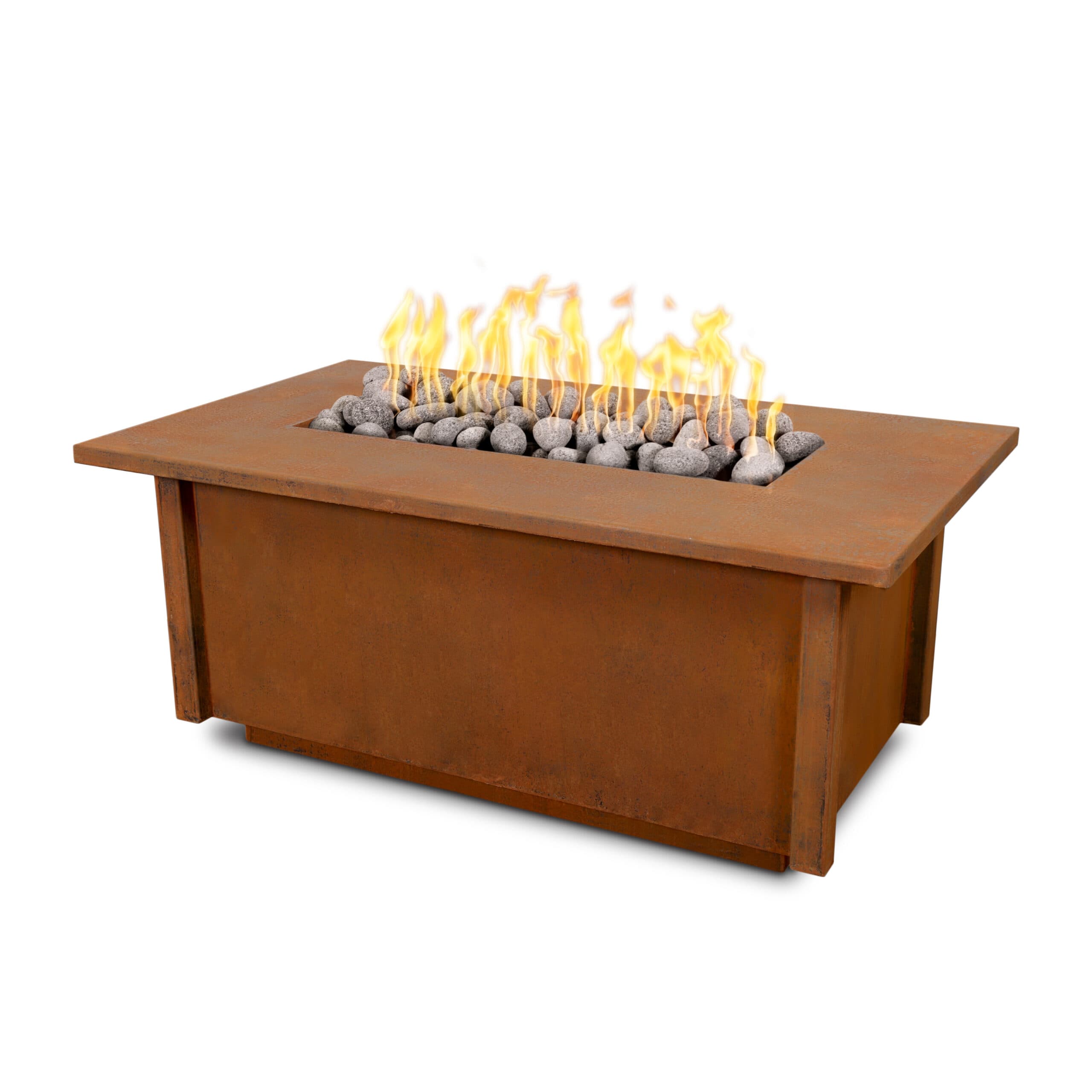
Corten steel is the one fire pit material that gets better with age. It ships gray, rusts orange through year one, darkens to chocolate-brown through year three, and settles into a composed charcoal-and-rust patina by year five that lasts 20+ years without a drop of paint. Here are the real picks from The Outdoor Plus, with climate rules and sizing math.
Updated October 2026. Corten is the fire pit material we get the most hesitant calls about, and the most grateful follow-up emails. The hesitation is always the same question — “isn’t rust bad?” — and the grateful emails come two years later with a photo attached. That gap, from the day-one anxiety to the year-two satisfaction, is the entire story of weathering steel.
The problem with every “best corten fire pit” list on page one of Google is that nobody shows you what the finish actually looks like at year 5 or year 10. You see the day-one studio shot — bright orange, almost unreal — and a price range, and you have to guess whether it reads as handsome or neglected five seasons later. We ship these pits every month and we have tracked customer photos since 2020. The year-by-year patina timeline below is the thing the top results on this query will not tell you.
What is corten steel, exactly?
Corten is a trade name for weathering steel, specified under ASTM A588 and ASTM A606. The alloy sits roughly 0.3% copper, 0.5% chromium, and 0.4% nickel over a mild steel base. Those three additions change how the steel rusts. Standard carbon steel oxidizes into a loose, flaky layer that lets air and water keep attacking the metal underneath. Corten oxidizes into a dense, tightly adhered layer that physically blocks oxygen and water from reaching deeper steel.
The practical outcome, verified in bridge-engineering literature going back to the 1960s: corten corrodes at roughly a fifth the rate of plain carbon steel once the patina has formed. On a fire pit with 1/4-inch wall thickness, that is a projected 40-plus-year service life before the structural steel is at risk. That is the reason architects started specifying corten for landscape walls, bridges, and sculpture in the 1970s, and the reason fire feature makers like The Outdoor Plus started offering it as a finish in the mid-2010s.
The look is the second reason. Corten is the only common fire pit material that reads as a landscape element and a fire feature at the same time. A powder-coated steel pit always reads as a product — a thing someone shipped to the yard. A corten pit at year three reads as part of the architecture, in the same way a stone wall or a copper gutter does. Landscape designers specify it for exactly that reason.
The year-by-year patina timeline
This is the section the top three SERP results for this query do not answer with a real timeline. Here is the honest sequence from the Outdoor Plus Unity and Regal pits we have been tracking across customer installs since the first corten SKUs shipped.
| Age | What the finish looks like | What is happening |
|---|---|---|
| Day 1 | Dark mill-finish gray with faint blue cast | Factory finish, no oxidation yet, surface is unprotected steel |
| Weeks 2–8 | Rust blooms appear in uneven patches, mostly orange | First wet-dry cycle oxidation; blooms spread with each rainfall |
| Month 6 | Full orange-rust coverage across the whole pit | Loose first-stage oxide; expect some runoff staining on concrete nearby |
| Year 1 | Bright orange, uniform, still a little flaky if touched | Second-stage oxide forming underneath the surface rust |
| Year 2–3 | Darker, chocolate-brown base with orange highlights | Protective oxide layer densifying; runoff staining stops |
| Year 5 | Composed brown-and-charcoal patina, no active shedding | Oxide-layer chemistry locked in; corrosion rate drops to baseline |
| Year 10+ | Dark weathered iron with orange only in sheltered seams | Patina effectively permanent; pit will look the same at year 15 |
“The year-one orange is the stage that scares buyers. By year three nobody notices the orange anymore. By year five the pit looks like it has always been there.”
One operational note that saves phone calls. The first six months of orange rust will stain porous surfaces directly under the pit — light concrete, limestone pavers, white travertine. Lay a corten pit on a base pad of flagstone, dark-tone pavers, or crushed gravel for the first year, or expect to pressure-wash the staining off once the pit stabilizes.
Climate matters more than people think
Corten was engineered for a specific weather pattern: alternating wet and dry cycles with no sustained chloride exposure. Hit that pattern and the patina stabilizes exactly as the metallurgy promises. Miss it and the finish misbehaves.
Arid climates — Phoenix, Denver, Albuquerque, Las Vegas, inland Southern California. Close to ideal. The patina stabilizes fast — often by month 18 instead of year three — and the finish holds a warmer orange-brown tone for longer because the oxide layer stays thinner. This is the territory where corten looks best longest.
Humid non-coastal — Houston, Atlanta, Nashville, the Carolinas, Mid-Atlantic. Standard behavior. The patina follows the year-by-year timeline above. Keep the pit on a free- draining base so it is not sitting in puddled water, and the corten performs exactly as designed.
Coastal and salt-spray — within 500 feet of the ocean. The one place we do not spec corten. Chloride ions in salt aerosol interrupt the oxide-layer chemistry, so the steel keeps rusting instead of stabilizing. For those installs, route to a 316 stainless steel pit or a GFRC concrete pit from the same brand. The pool fire bowls guide covers the saltwater-chlorine siting rules in more detail.
Cold-winter climates — Chicago, Boston, Minneapolis, Denver foothills. Freeze-thaw does not hurt corten itself, but any standing water pooling inside the pit can crack the burner pan. Cover the pit when it is not in use through the coldest months, or route the burner drain to daylight.
Our picks at a glance
| Pit | Shape | Size | BTU | From (NG) |
|---|---|---|---|---|
| Unity 48 | Round table | 48" | 65,000 | $3,518 |
| Unity 60 | Round table | 60" | 160,000 | $4,494 |
| Unity 72 | Round table | 72" | 190,000 | $4,950 |
| Regal 48 | Rectangular | 48" | 45,000 | $2,558 |
| Regal 60 | Rectangular | 60" | 65,000 | $3,206 |
| Coronado 72 | Low rectangular | 72" | 70,000 | $3,358 |
| Coronado 84 | Low rectangular | 84" | 90,000 | $3,632 |
Best six-person round: Unity 60
- 60" round · 160,000 BTU brass burner
- Weathering steel body · stabilizes to charcoal-brown by year 5
- Match-lit baseline · electronic + plug-and-play ignition options
- Matched NG and LP variants · same price either fuel
The Unity 60 is the honest default. A 60-inch round reads as a communal object instead of an architectural one — six chairs pull around it with room for a bottle on the top band, and the flame is tall enough to carry a conversation from across the circle. 160,000 BTU is more heat than you need for comfort, which is the point: the extra output means a visible flame even in a 15-mph patio breeze.
At $4,494 for the natural gas variant this is also where the price math starts to work. Below 60 inches a corten pit reads a bit lean for the material cost; above 60 inches the price climbs faster than the usefulness. The Unity 60 is the sweet spot.
Best smaller round: Unity 48
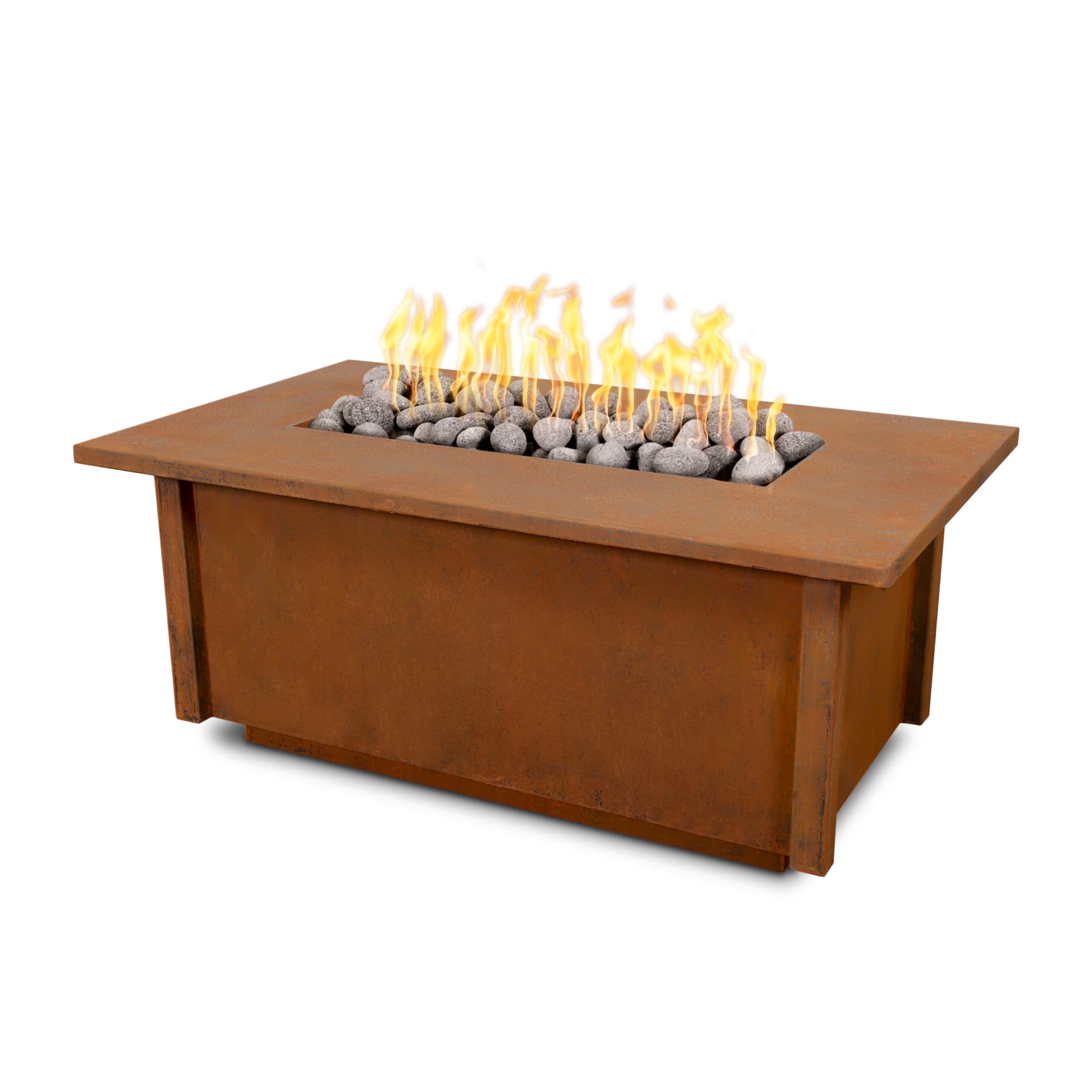
- 48" round · 65,000 BTU brass burner
- Four-chair conversation circle · fits mid-size patios
- Natural gas or propane · match-lit, electronic, or plug-and-play
- Same corten alloy as the Unity 60 — same patina timeline
The Unity 48 is what we spec when the yard is tight or the courtyard is walled. It is the smallest Unity we would still call a real fire feature instead of an accent — 65,000 BTU keeps the flame reading proportional at 48 inches, and the shorter diameter means a four-chair ring fits inside a 12-by-12 patio.
Best modern rectangular: Regal 60
For modern-architectural patios, the Regal 60 reads better than any of the round options. The silhouette is a crisp rectangular trough — flat top band, clean vertical sides, no visible fasteners — and the proportions sit well against straight-line hardscape like board-formed concrete walls, horizontal cedar fencing, or a linear pool.
At $3,206 for the natural gas Regal 60, this is also the price- per-square-inch leader of the whole corten line. If the aesthetic brief is modern and the budget is tight, the Regal 60 is the honest pick. For the full material-by-material breakdown of the Regal series — corten vs copper vs GFRC vs stainless vs powder-coat, with 2026 pricing and install considerations — see our Outdoor Plus Regal collection review. For a lower-profile take on the same rectangular silhouette, the Coronado 72 sits closer to the ground and reads as a long trough instead of a table — ideal for lounging seating heights rather than dining heights.
Modern vs rustic — the aesthetic call
Corten lives in both design languages, but the shape determines which. The round Outdoor Plus Unity tables sit comfortably in traditional yards — flagstone patios, Adirondack chairs, mixed perennial beds — because the round silhouette echoes a classic bonfire geometry. The patina does the rest; it reads as weathered iron, which is the right tone for rustic.
The rectangular Regal and Coronado lines belong in modern- architectural settings. The clean trough geometry pairs with board-formed concrete, horizontal cedar, linear pools, and the kind of flat-roof outdoor room that most high-end residential work is building in 2026. In that context the corten patina reads as intentional material honesty — the same move a good architect makes with raw concrete or exposed steel beams.
For denser masonry-forward designs, the GFRC concrete pits from our Prism Hardscapes brand guide are the other pick worth considering in the same price band. Corten and GFRC are the two materials that most reliably age into their surroundings instead of away from them.
Natural gas vs propane
Every pit on this list ships in matched NG and LP variants at the same price. The decision is about your gas infrastructure, not the pit. Natural gas when the patio has a stub-up — no tank, no swap, no cold-weather BTU drop. Propane for detached decks, rental properties, or any install without plumbed gas.
One climate-specific note. In temperatures below 20°F, propane tanks lose roughly 20% of their vaporization rate, which shows up as a shorter flame on cold nights. Natural gas does not have this problem because it is distributed as vapor already. For cold-climate installs where the pit is meant to be used in deep winter, prefer NG. Our natural gas vs propane fire pits guide covers the install cost and refill economics in more depth.
What corten is not good at
We only sell pits we would put in our own yards, so this list is short, but it is honest.
Not for salt-air coastal. Covered above. Pick 316 stainless instead.
Not for over light-colored pavers unless you plan for year-one runoff. The first six months of orange rust will stain travertine, limestone, and light concrete under the pit. Lay a dark base, lift the pit on a stand, or pressure-wash at month 12.
Not a “chip and repaint” material.If a corten pit takes an impact that gouges through the patina — a dropped log, a shovel head — the exposed metal re-rusts and blends back into the finish within a few months. Nothing to do but wait. Compared with powder-coated steel, where the same chip becomes a permanent eyesore, corten’s self-healing finish is a real advantage.
Shop the full lineup
All corten SKUs on this list live in the Outdoor Plus brand hub. Pricing is current for October 2026, every variant ships in matched natural gas and propane configurations, and every pit is available in match-lit, electronic, or plug-and-play ignition. Lead times from the factory in Corona, California run 4 to 8 weeks for stock corten; add 2 weeks for electronic ignition builds.
Frequently Asked Questions
What is a corten steel fire pit?+
How does a corten steel fire pit patina over time?+
Will corten steel keep rusting forever?+
Is corten steel good for coastal or wet climates?+
Natural gas or propane for a corten steel fire pit?+
What size corten fire pit do I need?+
Products & brands in this guide
Related reading
Ash — Ash writes the buying guides at FirePits.com — years of specifying fire features on residential installs, from urban patios to mountain properties.