The Outdoor Plus Regal Collection Review: Materials, BTU, and Install Reality
By Ash · Published October 2026
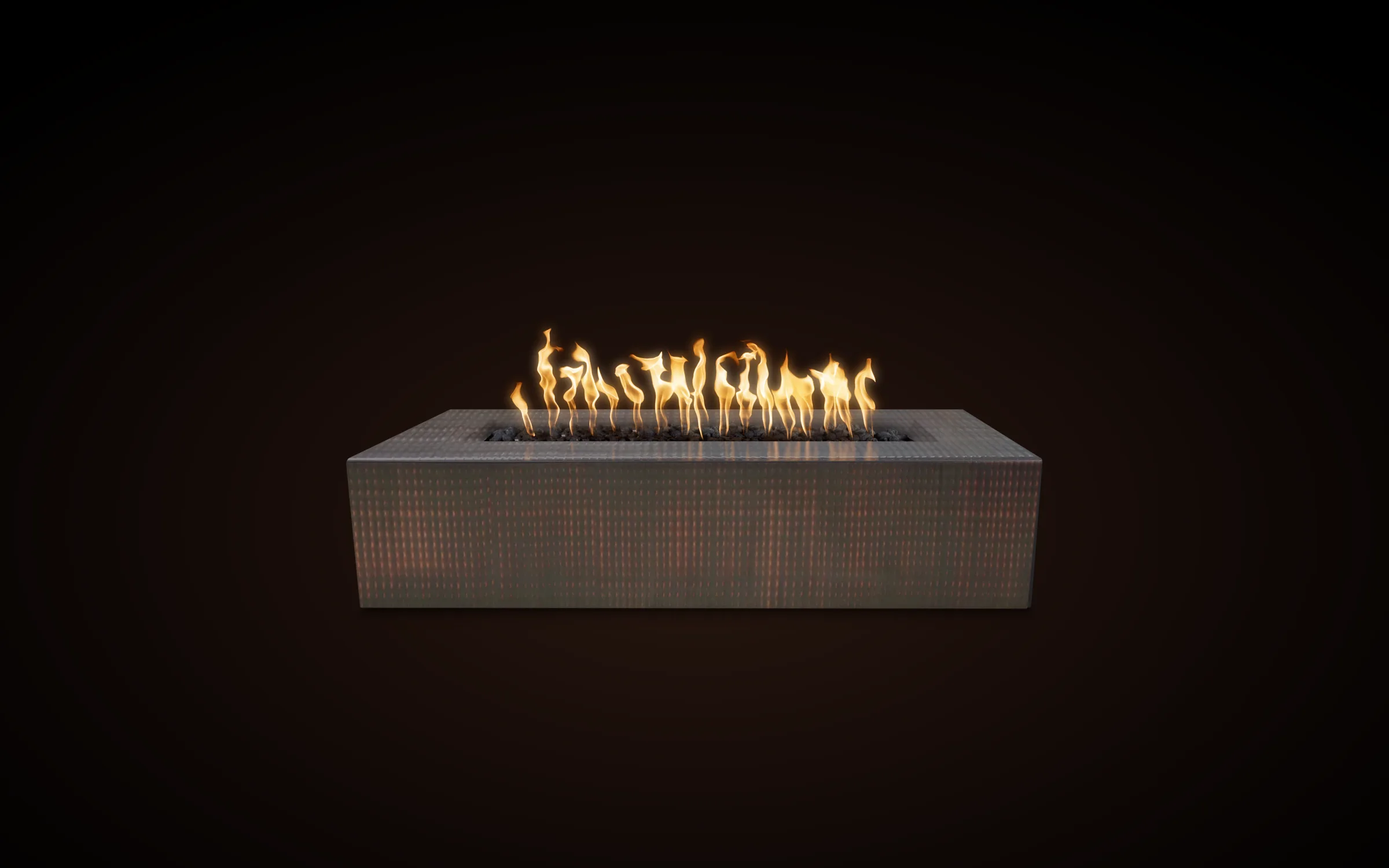
Updated October 2026. The Outdoor Plus Regal is the rectangular trough fire pit that sits at the center of most of the custom outdoor-kitchen projects we specify. Here is the honest, dealer-floor review across every material TOP builds it in, with 2026 pricing, BTU math for real seating, and the install details we wish every buyer knew before the gas fitter arrived.
What is the Regal, and where does it sit in the TOP catalog?
The Regal is The Outdoor Plus’s flagship rectangular trough fire pit — a long, low, open-topped vessel built on the modular TOP platform where you pick a size, pick a material, pick an ignition tier, and the factory builds that exact combination to order. In the TOP catalog hierarchy, the Regal sits between the smaller square fire bowls (Cazo, Maya, Sedona at 24-30 inches) and the full fire tables (Cabo, Grand Colonial at 66-72 inches with a usable tabletop surface around the burner opening).
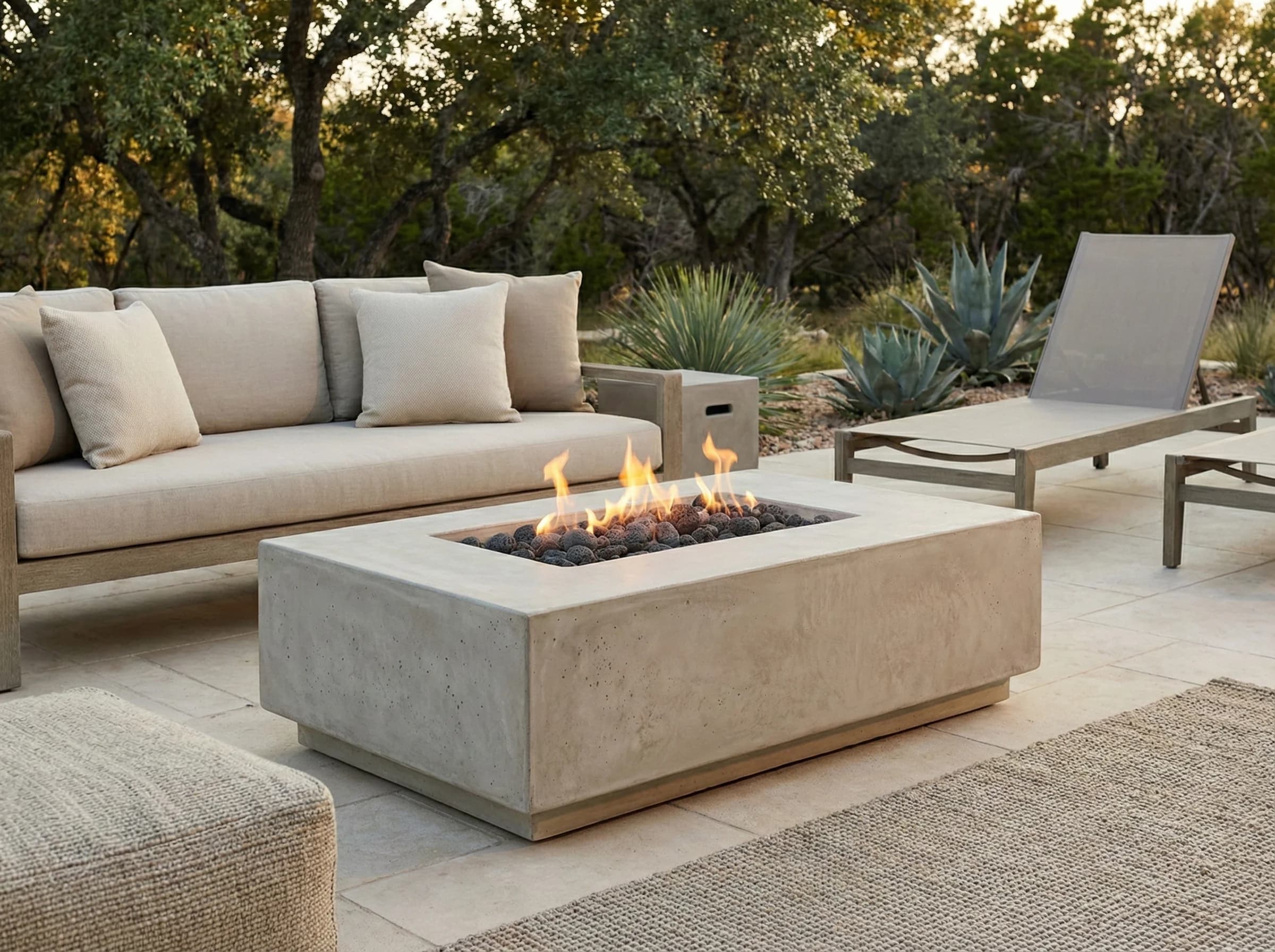
The design brief for the Regal is straightforward. You want a fire feature that reads as the architectural anchor of a seating arrangement — sectional lounges, L-shape conversation setups, two facing sofas — without the full fire-table commitment to a tabletop surface. The 15-inch overall height matches typical patio sectional seat height, so people seated on either long edge are looking directly across the flame plume at the person opposite them. That geometry is what makes the Regal feel like one piece of furniture with the seating, not a fire pit floating next to it.
In our own stocking inventory the 60-inch rectangular corten natural-gas Match Lit SKU is the volume winner. We have shipped more of that one configuration than every other Regal variant combined in the last twelve months.
Which materials does the Regal come in, and how do they weather?
The Regal is built in five materials. Each one changes the look of the finished pit and the way it ages in weather. Here is the honest read on each from stocking the SKUs and seeing them come back after a year or three on real patios.
Corten steel is the modern-industrial pick and the volume seller. Ships pre-rusted at the factory, continues deepening for 10-14 months on your patio, then stabilizes to a chocolate-brown-and-charcoal patina that holds for a decade. Corten was engineered for outdoor architectural use precisely because the surface rust becomes protective and the metal underneath never corrodes through. The downside: during the first season, light rain carries a trace of orange rust off the pit onto the paver immediately below. Travertine and limestone will show that staining. On dark basalt or concrete, you will never notice.
Hammered copper is the premium pick for pool decks and warm-climate installs. Ships polished and bright, moves through orange-rust and blue-green over 18-30 months, settles into a mottled brown-and-verdigris patina that most buyers actively want. Copper reads as warm and sculptural next to water features — the hammered texture catches candlelight and flame reflection in a way the smoother materials cannot. The cost is roughly 50% over corten at the same size: a 60-inch Regal in copper runs about $4,900 vs $3,200 in corten.
GFRC concrete (glass fiber reinforced concrete) is the contemporary-minimal pick and the right call for salt-air coastal homes. Six base colors — black, chestnut, gray, ash, natural gray, limestone — and the color on day one is the color at year ten. GFRC does not patina, does not rust, does not discolor from flame heat near the opening. Weighs more than corten or copper — plan for four people at delivery for the 60-inch GFRC. Also the only Regal material we recommend for direct installations on travertine or limestone, since there is no runoff to stain the stone.
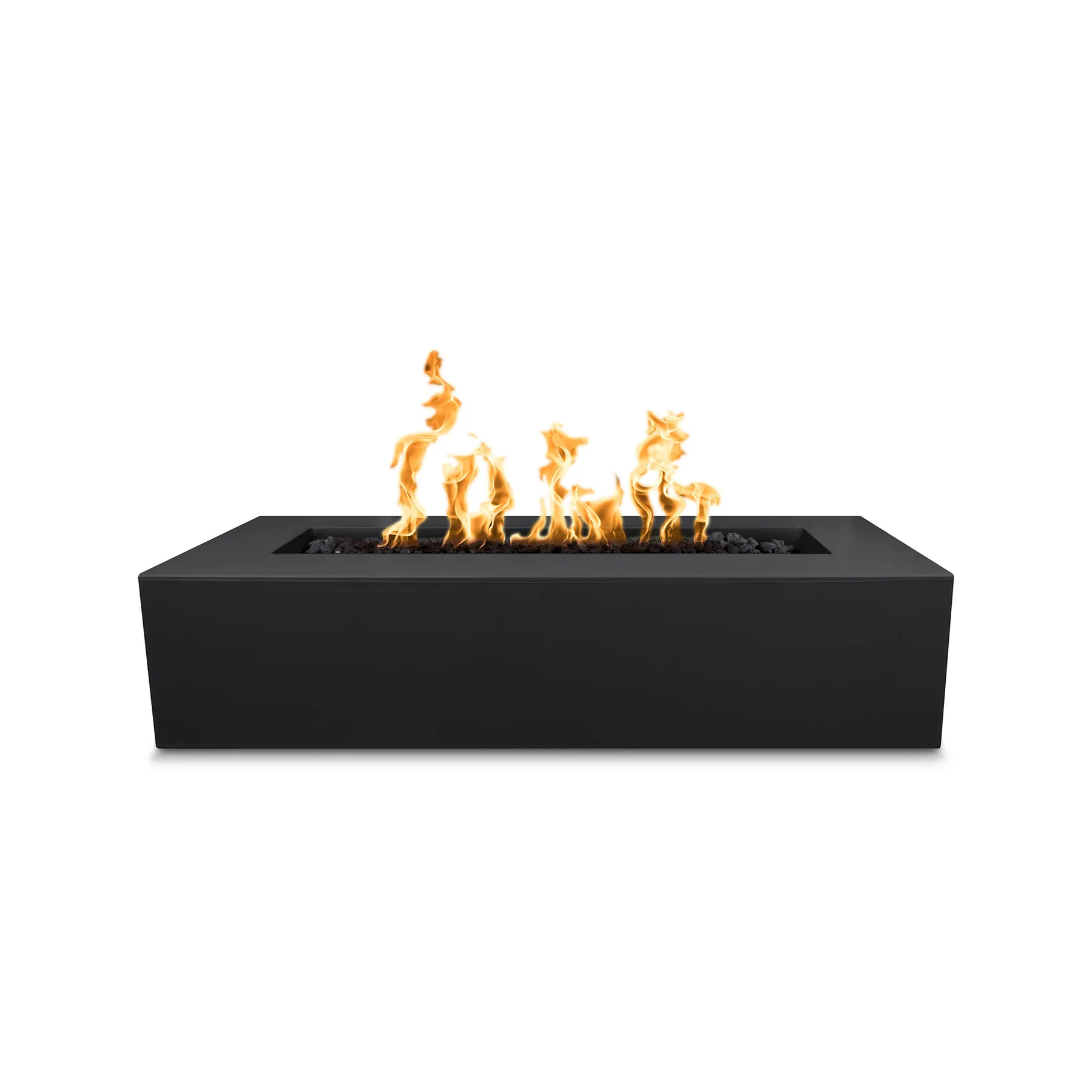
Powder-coated steel in gloss black is the budget-and-maintenance-free pick. 304 stainless substrate with a UV-stable gloss-black powder coating fired on at the factory. Runs $200-$400 under corten at the same size, holds the gloss finish for 8-10 years before the first UV fade shows. No patina, no rust, no runoff. Right for buyers who want a modern dark-metal silhouette without committing to an evolving finish.
304 stainless steel is the coastal pick. Brushed stainless that holds its satin finish indefinitely and will not shed rust onto adjacent pavers or stone. Pricing sits between corten and copper. We specify this one most often for Florida, Southern California, and Gulf Coast installs where salt air would accelerate the corten patina past the stable charcoal stage into pitting.
What BTU and size pairing is correct for my seating?
Regal BTU scales with size in a step function, not a linear curve. Two numbers are worth knowing before you commit.
The 48-inch Regal runs 45,000 BTU on the standard H-burner. In a covered or semi-covered installation, that burner comfortably warms a 6-8-foot conversation circle — four to six people seated at typical patio distances. In a fully exposed open-air install, drop that effective coverage by about 30% to account for wind and convection loss. The 48-inch is correct for compact patios, courtyard spaces, and secondary entertaining zones.
The 54-inch and 60-inch Regal both run 65,000 BTU. The burner length is longer on the 60-inch, which spreads the same gas volume across a wider flame plume for a more visually impressive fire without changing the overall heat output. In covered or semi-covered installations, the 65k BTU burner handles 10-12 feet of seating — a full L-shape sectional, a rectangular table with 8-10 chairs, or two facing three-seat sofas. In fully exposed installs, plan for 7-9 feet of comfortable warmth.
The choice between 54 and 60 is almost always about patio footprint, not about heat. If you have the room, the 60-inch reads as more intentional and anchors the seating arrangement more convincingly. If the available space is tight — a 10-foot wide covered pavilion, a narrow balcony — the 54 gives you the same heat and flame depth in a 6-inch shorter footprint.
Match Lit vs Plug & Play: which ignition should I spec?
The Regal ships with two ignition tiers. The pick between them is less about preference than about where the pit will live.
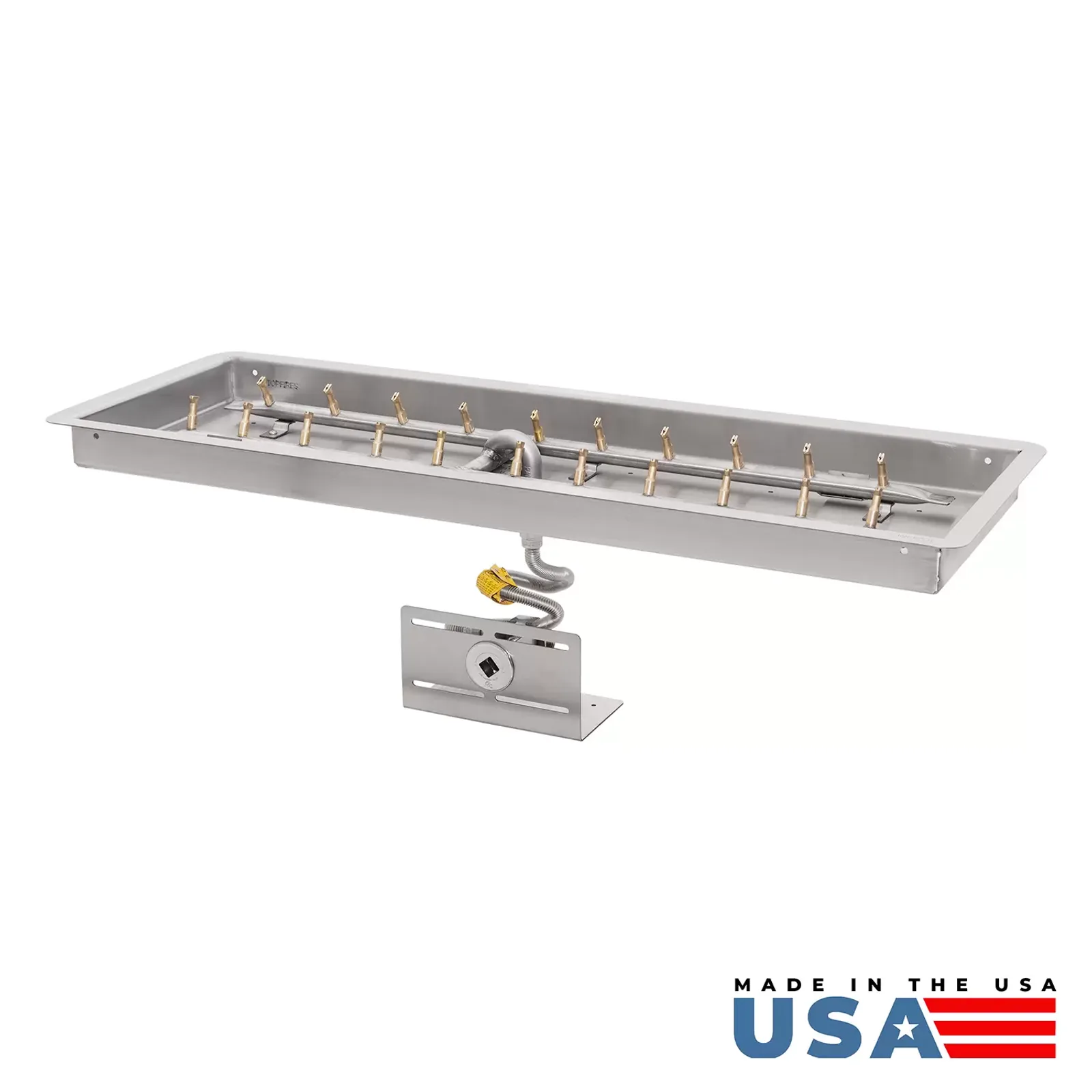
Match Lit is the entry option. You turn the brass gas valve at the pit, use a long lighter or extended match to ignite the burner, and adjust flame height at the valve. No electronics, no battery pack, no 120V power run to the pit location. Cheapest at the base price, and the simplest to install in a build where electrical was not planned for the fire feature. We recommend Match Lit for buyers who enjoy the ritual of lighting the fire, for weekend homes and secondary patios where infrequent-use reliability matters more than daily convenience, and for installations where retrofitting 120V to the pit would be invasive.
Plug & Play is The Outdoor Plus’s Electronic Ignition System (EIS). The control module plugs into a standard GFCI outlet within 10 feet of the pit, the included remote starts and stops the burner, and the system automatically shuts the gas valve if the flame extinguishes for any reason — wind, running out of propane, a child bumping the burner. Adds $800-$1,200 to the base Regal price depending on size, and requires 120V power run to the pit at build time. We recommend Plug & Play for daily-use installations, for homes with young children where auto-shutoff is a real safety value, and for buyers who want remote-start convenience from the patio door.
If you are specifying Plug & Play, confirm your electrician runs the 120V to the exact pit location in the same trench as the gas line. Retrofitting electrical to an already-poured fire pit surround is expensive and often visible in the finished stone.
Real install considerations most Regal buyers miss
A Regal installed correctly delivers 15+ years of use. Installed incorrectly, the problems show up in the first year and are expensive to retrofit. Four things worth getting right at design time.
Gas line sizing. A 65,000 BTU Regal draws real gas volume. If the line feeding the pit also feeds a built-in grill, a patio heater, and a side burner, verify the combined simultaneous draw does not exceed the line’s capacity plus 20% headroom. Underserved gas lines produce weak, flickering flames that never look right — and the pit will fail its post-install flame-height spec test. Have the gas fitter size the line to the total draw at design time, not after the trench is backfilled.
Shut-off valve placement. Most local codes require a shut-off valve within 3-6 feet of the fire feature, accessible without tools. On a Regal install, that usually means designing a small access panel or a hidden valve box into the stone surround at build time. Easy to include when the mason is on site; expensive to retrofit through finished travertine six months later.
Wind orientation. A Regal that is comfortable in a north wind is uncomfortable in a south wind. Spend an evening at the install site before you commit to the orientation — note the prevailing wind during your typical entertaining hours. Rotate the pit so the long axis is roughly parallel to the prevailing wind, and position the seating arrangement upwind of the plume. The flame will lean away from the people, not into them.
Material-to-paver interaction. This is the one most retrofitted. Corten steel sheds a trace of orange rust in year one that will stain travertine, limestone, and lighter concrete. If the patio is one of those materials and the design calls for corten, specify a 2-inch gravel border around the pit base or move to GFRC, powder-coated, or stainless instead. On dark basalt or standard concrete, corten runoff disappears into the existing tone.
Who should buy a Regal, and who should look elsewhere?
Buy a Regal 60-inch in corten steel with Match Lit if you are specifying the fire feature for a modern-industrial outdoor space, you have 10+ feet of seating around it, and electrical was not planned for the pit location. This is the volume configuration for a reason — the most reliable, lowest-maintenance combination TOP builds. Roughly $3,200.
Buy a Regal 60-inch in hammered copper if the pit is going on a pool deck or in a warm-climate installation where copper reads as the correct material next to the water feature or stone work. Expect the patina to shift noticeably every season for the first 24 months, then stabilize. Roughly $4,900.
Buy a Regal 60-inch in GFRC concrete if the project is a coastal install, if the pavers are travertine or limestone that corten runoff would stain, or if the design brief calls for a contemporary-minimal silhouette that holds its finish forever. Pick the color at order — it will not change.
Buy a Regal 48-inch with Plug & Play if the patio is compact (under 10 feet of seating depth), you have children who should not operate a Match Lit valve, and 120V can be routed to the pit at build time.
Look elsewhere if your seating arrangement calls for a round centerpiece (consider the TOP Cazo or a round fire bowl instead), if you want a usable tabletop surface around the burner opening (step up to a Cabo or Grand Colonial fire table), or if your budget cap is under $2,500 (consider the TOP Pismo in a smaller size, or a lower-priced brand entirely — the Regal’s build quality is in the 304 stainless burner, and that quality carries a floor price).
The one question we get every week about the Regal
“Is the Regal 60-inch too big for my patio?” is the question we field most. The honest answer: a 60-inch rectangular fire pit anchors a seating arrangement up to about 180 square feet of patio comfortably — think a 12x15 pavilion or a 14x13 open patio. Below that, the pit will dominate the space in a way that reads crowded. Above that, it looks correctly scaled.
If the patio is 150 square feet or less, the 54-inch Regal is the right call — same 65,000 BTU output, 6-inch shorter footprint, feels proportional in the smaller space. If the patio is 120 square feet or less, step to the 48-inch at 45,000 BTU. If the patio is 240+ square feet with a large sectional and a secondary conversation area, consider two 54-inch Regals end-to-end instead of a single 60 — you get better seating geometry and redundancy if one burner needs service on an entertaining night. We have specified that twin-pit configuration on three resort-style installs this year.
Frequently Asked Questions
What sizes does the Regal fire pit come in?+
Which Regal material is best for my patio?+
What is the difference between Match Lit and Plug & Play ignition on the Regal?+
How much does an Outdoor Plus Regal fire pit cost in 2026?+
Can the Regal run on propane instead of natural gas?+
Is the Regal fire pit a good choice for an outdoor kitchen build?+
Products & brands in this guide
Related reading
Ash — Ash writes the buying guides at FirePits.com — years of specifying fire features on residential installs, from urban patios to mountain properties.