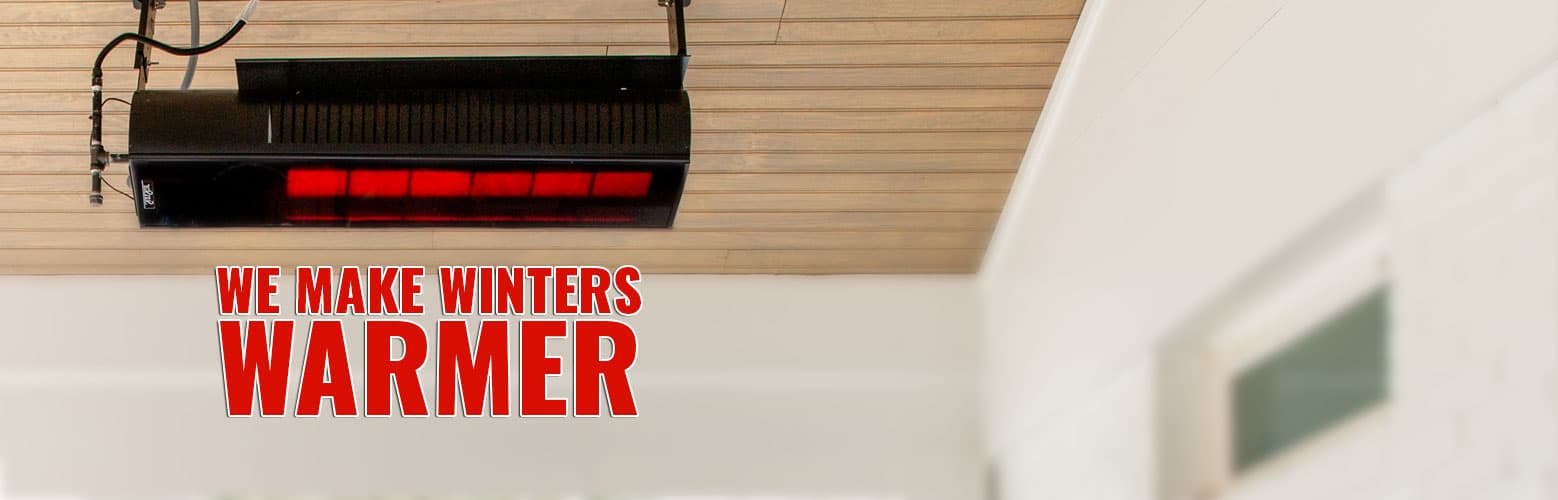
Sunstar is one of two patio-heater brands under AEI Corporation (Charlotte, NC), the other being sister brand Sunpak. Three Sunstar infrared heads — MGL35, SGL35, SGL50 — cover the mainstream residential installs with real BTU numbers and a published 3-year burner warranty. Here's how to pick between them without guessing.
Updated November 2026. Sunstar is a direct-gas infrared patio-heater brand built by AEI Corporation in Charlotte, North Carolina. Three heads make up the mainstream residential lineup — MGL35, SGL35, SGL50 — each offered in both natural gas and liquid propane, and in standard switch or wireless-remote configurations. FirePits.com is an authorized Sunstar dealer; every SKU in ourSunstar catalog ships with factory warranty intact.
This guide walks the three models, the mounting-height math that most installers underestimate, the fuel decision, and where Sunstar actually wins against Infratech and Bromic on the same spec sheet.
The three heads at a glance
Model
BTU High
BTU Low
Material
Mount height
Burner warranty
MGL35
35,000 BTU/hr
24,000 BTU/hr
Marine-grade stainless
7–10 ft
3 years
SGL35
35,000 BTU/hr
24,000 BTU/hr
Zinc-plated / silicone powder coat
7–10 ft
3 years
SGL50
50,000 BTU/hr
34,000 BTU/hr
Zinc-plated / silicone powder coat
7–10 ft
3 years
Sunstar models: real published specs
Every head is a two-stage ceramic infrared burner. The switch is a simple high/low toggle; the remote-upgrade SKUs add a wireless controller that handles the same two stages from across the patio. All three mount three ways: ceiling, wall, or post. The angle of the head is adjustable at install time to aim the infrared cone where the seating actually is.
Why MGL is worth the step up for coastal installs
The SGL housing is zinc-plated steel under a high-temperature silicone powder coat. Inland, with normal humidity and no salt exposure, that finish holds up for the life of the burner — Sunstar has shipped the same SGL formula for over a decade and the field reliability is solid. Within a mile of saltwater, though, zinc-plated steel starts to pit inside the first year regardless of how the coating looks. By year three the housing structurally weakens.
MGL uses 304-series marine-grade stainless for the entire housing. Same ceramic burner inside, same control package, same mounting kit. The marine-grade upgrade adds roughly 25-30% to the sticker price and buys 10+ years of coastal reliability. For a chlorine-heavy pool patio the math is the same — the aerosolized chlorine attacks zinc plating the way salt air does. Pick MGL35 anywhere near saltwater, a lap pool, or a hot tub with daily shocks.
The 35 vs 50 BTU decision
Sunstar publishes real BTU numbers on every model, which makes sizing straightforward once the covered seating area is measured. For a residential covered patio in a typical Zone 6 climate:
Up to ~50 sq ft of concentrated seating — a single 35,000 BTU head (MGL35 or SGL35) covers it with the burner on high during cool evenings.
50–100 sq ft — an SGL50 or a pair of 35-series heads. Two smaller heads give better coverage distribution (overlapping infrared cones leave no cold spot), but one bigger head reduces install cost by half and is simpler to wire for gas.
100+ sq ft — plan multiple heads regardless. An SGL50 covers its share, but the heat profile falls off past the cone edge. A single oversized head leaves the perimeter cold even when the burner’s on high.
Low-stage output matters when the install is in a mild climate where high is too much. The MGL35 and SGL35 modulate down to 24,000 BTU/hr on low; the SGL50 goes to 34,000. Neither is low enough for a 60°F shoulder-season night where you’d want 15,000 BTU of background warmth. For truly mild climates, a pair of 35-series heads on low beats one SGL50 on low for comfort.
Mounting height — the number that gets this wrong
Sunstar’s installation specs give specific height ranges per mounting style. The 35-series: 7-9 ft for an angled mount, 8-11 ft for a horizontal mount. The SGL50: 8-11 ft angled, 9-12 ft horizontal. The 7-ft bottom of the range applies only to angled 35-series installs — a horizontal SGL50 at 8 ft will overheat the seating directly below and leave the perimeter cold.
Don’t mount below 7 feet on any Sunstar head. The infrared cone concentrates below the published minimum, and the radiant temperature at seated shoulder-height exceeds comfort — people report the heat as ”hot but still cold on my feet” because the cone profile is wrong. If the ceiling under which you want to mount is below 7 feet, pick a wall-mounted install at the right height instead.
Natural gas vs liquid propane
Every Sunstar SKU is spec’d for one fuel at the factory — the heads aren’t field-convertible. Pick NG when there’s already a gas line within 20 feet of the install location. Pick LP when there isn’t and a portable tank is acceptable. The installer runs the line; the heater itself handles the delivered pressure without a user-side regulator adjustment.
The configuration matters for the line-sizing math: a 35,000 BTU/hr head on natural gas pulls roughly 35 cubic feet per hour; the SGL50 pulls 50. A 1/2-inch black-iron line serves one 35-series head at the mounting distance typical of a residential patio; the SGL50 sometimes wants a 3/4-inch line depending on run length. For LP, a standard 20-lb tank runs roughly 10-14 hours of 35-series operation on high.
We carry all three and this question comes up every week.Infratechmakes an electric infrared heater — no gas line, no combustion, lower BTU ceiling. Where Infratech wins: completely silent operation, permanent-looking architectural install, and the housing hides behind a pergola beam. Where it loses: 240V wiring on anything over 3,000W, and lower effective output than a 35,000+ BTU gas head in cold-climate installs.
Bromicmakes both gas and electric. The Platinum Smart-Heat gas series is the direct Sunstar competitor — similar BTU profile, direct-ignition electronics, marine-grade stainless on the top tier. Where Bromic wins: tighter architectural design, slightly cleaner styling. Where Sunstar wins: price. A Sunstar SGL35 runs 30-40% less than the equivalent Bromic Platinum 300 at authorized-dealer pricing, with the same BTU output and burner warranty term.
Warranty, parts, and claims
Sunstar publishes a 3-year warranty on the burner assembly — the single most expensive replacement part on an infrared heater. The warranty covers manufacturing defects on the ceramic element and the gas-valve assembly behind it. Housing corrosion, finish degradation, control-switch failure after the one-year electronics term, and anything caused by improper installation sit outside coverage.
AEI Corporation handles every warranty claim centrally at (949) 474-3070 or [email protected]. Claims through authorized dealers go faster — we file the paperwork and hold the replacement part on your behalf. Keep the serial-tag photo from your install day; it’s the first thing AEI asks for when a claim opens.
Our picks
For the standard inland residential covered patio: SGL35 in natural gas, standard switch. $700 range, 35,000 BTU/hr, 7-year effective service life on the housing. For a coastal install: MGL35 in the matching fuel. $900 range, same burner, 10+ year housing life. For a bigger install where one head has to cover more ground: SGL50 with the wireless remote so you’re not reaching under a hot head to toggle the switch.
Shop the current lineup at theSunstar catalog, or browse the fullSunstar product listwith filters for fuel type, BTU output, and material. Authorized dealer pricing applies to every SKU.
Ash — Ash writes the buying guides at FirePits.com — years of specifying fire features on residential installs, from urban patios to mountain properties.