What Size Patio Heater Do I Need? BTU, Watts and Square-Foot Sizing
By Ash · Published October 2026 · Updated November 2026
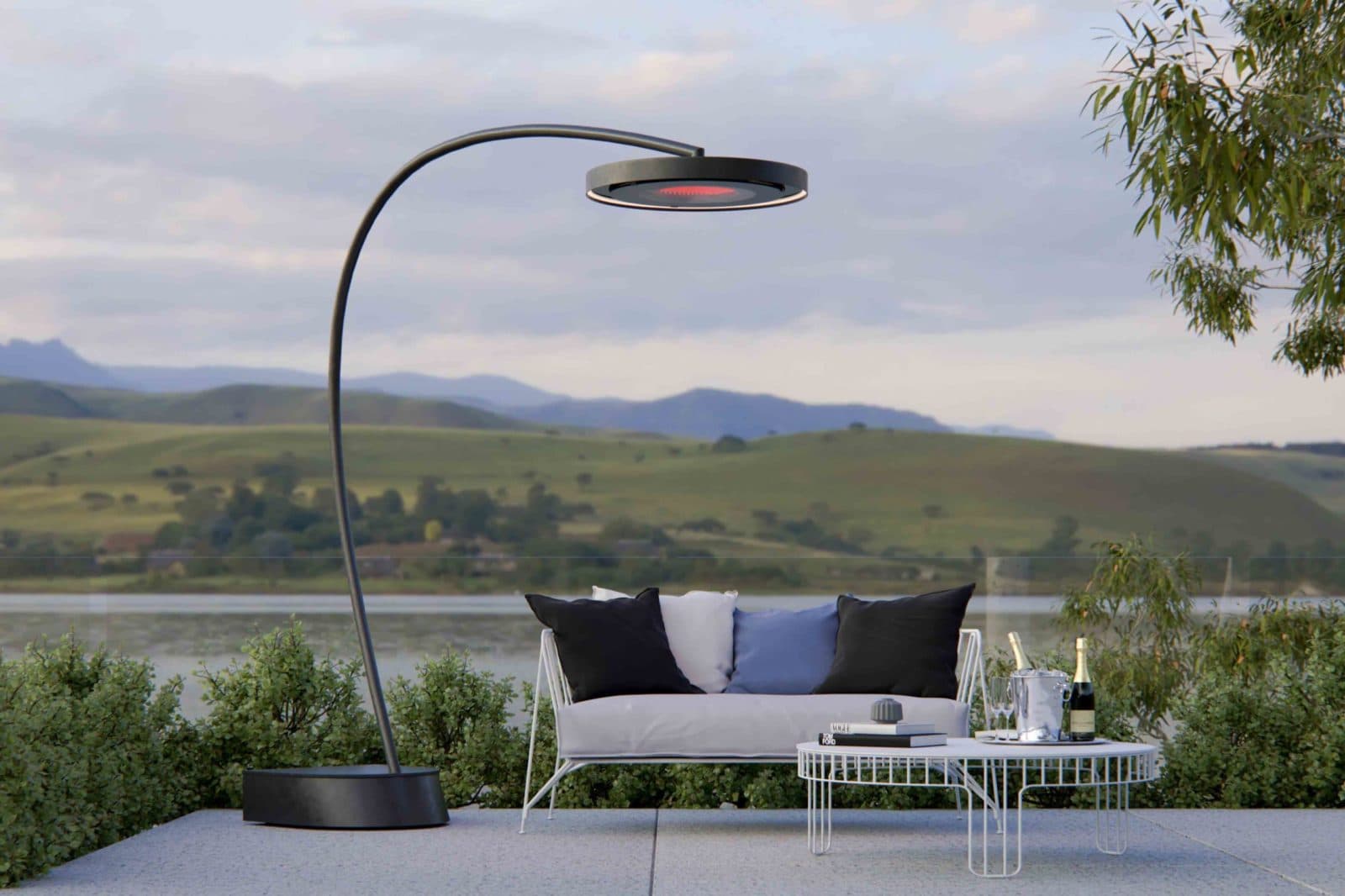
Ask what size patio heater you need and most answers stop at one number: 10,000 BTU per 100 square feet. It's a decent start. It also hides the real problem, because a propane heater and an electric infrared heater publish their coverage in completely different ways, and the spread between those claims runs about threefold. This guide puts gas and electric on the same scale with the actual spec sheets for Bromic, Heatstrip, Patio Comfort, Infratech and Lava Heat Italia, then adds the circuit, clearance and running-cost math most sizing pages skip. Updated November 2026.
What size patio heater do I need?
Most sheltered patios need about 10,000 BTU of heater output per 100 square feet. That means a 40,000 BTU propane heater for roughly 400 square feet, or about 4,500 watts of electric infrared for a 140 square foot covered seating zone. Add 30% if wind reaches the chairs.
That’s the short version. The longer version matters because “size” means two different things depending on the heater. Freestanding gas units are sized by BTU and a rough radius. Mounted electric units are sized by watts, mounting height and a published coverage zone. Mix the two methods up and you either overbuy by a wide margin or leave guests cold at 9 pm.
In my experience, the sizing conversations that go wrong all start the same way: someone measures the whole patio, divides by 100, and buys one heater for the total. Patios aren’t heated by total square footage. They’re heated by where people sit.
| Patio size | Gas freestanding | Electric infrared (mounted) |
|---|---|---|
| Up to 150 sq ft (bistro set, small porch) | Lava Heat Italia Milano, 36,000 BTU (oversized, runs on a low dial) | One Bromic Platinum Smart-Heat (143 sq ft published) or one Bromic Tungsten Smart-Heat (130 sq ft published) |
| 150 to 320 sq ft (one dining group) | Patio Comfort 40,000 BTU (10 ft radius is about 314 sq ft) | Two mounted heaters, one per zone: for example two Heatstrip Classic or two Infratech Slimline units at 2,400W each |
| 320 to 450 sq ft (dining plus lounge) | Lava Heat Italia Capri, 42,000 BTU sheltered, or Palermo, 51,000 BTU if open | Three mounted units, and a panel check first (see the circuit section) |
| 450 to 700 sq ft (entertaining patio) | Lava Heat Italia Opus, 56,000 BTU, or 2G, 66,000 BTU | Rarely practical without a dedicated subpanel |
| 700+ sq ft | Two or more heaters, one per seating zone | Multiple heaters on a planned electrical load |
What does a patio heater BTU rating actually measure?
A BTU rating measures energy input per hour, not warmth delivered to your chair. A 40,000 BTU propane heater burns fuel at 40,000 BTU per hour. How much of that reaches a seated guest depends on the reflector, the wind and the distance.
Electric heaters publish watts. Convert with one number: 1 watt equals 3.412 BTU per hour. A 2,400W heater is 8,189 BTU. A 4,000W heater is about 13,650 BTU. A 4,500W heater is about 15,350 BTU, and Bromic states 15,300 for its Platinum model. All of that electricity becomes heat, and infrared hands much of it straight to people and objects instead of warming air that drifts away.
Here’s the catch. Gas burners lose a share of their input as hot air rising off the unit, so a 40,000 BTU heater does not deliver 40,000 BTU to the seating zone. Nobody publishes the exact split for every model, so treat any single BTU-to-square-foot formula as a starting estimate. That’s why we compare published coverage next.
Why does a 15,300 BTU electric heater claim as much coverage as a bigger gas heater?
Manufacturers measure coverage differently. Bromic publishes a heated zone under a mounted beam. Patio Comfort publishes a radiant circle around a freestanding heater. Put them on one scale and the implied BTU per square foot runs from about 57 to 167, a threefold spread.
This is the Information Gain piece most sizing guides miss. I pulled the published numbers from the product spec sheets and divided BTU by claimed coverage. The results:
| Heater | Output | Published coverage | Implied BTU per sq ft |
|---|---|---|---|
| Bromic Tungsten Smart-Heat 44" | 4,000W (about 13,650 BTU) | Up to 130 sq ft | About 105 |
| Bromic Platinum Smart-Heat 53" | 4,500W (15,300 BTU) | 143 sq ft | About 107 |
| Infratech Slimline 42-1/2" | 2,400W (8,189 BTU) | About 7 ft by 7 ft (49 sq ft) | About 167 |
| Patio Comfort 40,000 BTU | 40,000 BTU propane | 10 ft radius (about 314 sq ft) | About 127 |
| Patio Comfort 40,000 BTU | 40,000 BTU propane | 15 ft radius (about 707 sq ft) | About 57 |
Two takeaways. First, the 10,000 BTU per 100 square feet rule is not made up. Both Bromic electrics land at roughly 105 to 107 BTU per square foot on their own spec sheets. Second, the 15 foot end of Patio Comfort’s range implies only 57 BTU per square foot. Marketing circles describe the outer edge where you can still feel something. They don’t describe where a guest in a light jacket is comfortable.
My planning rule: use the 10 foot radius for the Patio Comfort, not 15. That puts it near the 100-ish BTU per square foot the Bromic numbers support. If you plan around the 15 foot figure, you’ll be disappointed at the edges of the patio.
The Infratech number is the other outlier, and it makes sense. A 2,400W single-element strip heater is a spot heater. Infratech describes the Slimline for surface mounting up to eleven feet and a zone of about 7 by 7 feet, so it’s a heater for a pair of chairs or a bar stool row, not a whole patio.
Should I size by BTU or by watts?
Size gas freestanding heaters by BTU and radius. Size electric infrared by watts, published coverage and mounting height. Compare across fuels only after converting watts to BTU at 3.412, and never compare a mounted beam to a freestanding circle without checking how each was measured.
If you’re cross-shopping, a simple translation helps. A 4,500W Bromic Platinum is 15,300 BTU of input that stays dry, flameless and wind-resistant. It covers about 143 square feet. A 40,000 BTU Patio Comfort is more than two and a half times the raw input, covers a larger zone, and rolls around on wheels. Neither is better. They answer different install conditions.
One common mistake is treating gas heaters as the only “real” heat because the BTU numbers look bigger. Patio Comfort’s PC02SS uses an infrared burner with a one-piece anodized aluminum reflector, so it radiates directly like an electric heater does. A flame-tower or mushroom unit leans harder on convection, which is why wind hurts those more. Our flame tower vs mushroom comparison covers that construction difference in depth.
How do wind, roof cover and cold change the size?
Our working rules: add 30% when wind reaches the seating, add 20% when evenings sit below 40°F, and subtract about 20% under a solid roof. These are dealer rules of thumb from installs and customer feedback, not lab-tested figures.
Wind. A heater that depends on rising hot air loses it to any breeze. Directional infrared handles wind better because the energy travels as radiation, not as warm air. Bromic notes that the Platinum’s 2-inch low profile makes it highly wind-resistant, which is part of why it earns its place on exposed covered porches. Even so, I’d still add output on a patio that sits on a ridge or a waterfront. A 15,300 BTU heater in a steady 15 mph wind is not the same heater it is in a courtyard.
Roof cover. A solid roof or a dense pergola catches rising warmth and bounces it back down. That’s why mounted infrared under a pergola feels like more heat per BTU than the same output in open sky. If you’re already planning a covered space, our guide on using fire features under a covered patio covers the clearance and ventilation side.
Cold. The heater has the same output at 30°F as it does at 55°F. You just need more of it, because your guests lose heat faster. A 400 square foot patio at 50°F is a 40,000 BTU job. The same patio at 35°F in an open exposure is closer to 62,000 BTU: 40,000, plus 30% for wind, plus 20% for cold.
How do I size a patio heater by seating group?
Count the chairs, then map them to zones. A 2 to 4 person conversation group needs one small heater within 6 feet. A 4 to 6 person dining table needs one mid-size heater within 8 feet. Beyond 8 people, plan two heaters placed at the seating zones.
2 to 4 people, bistro table or balcony
One Bromic Platinum Smart-Heat mounted overhead covers this comfortably with room to spare. In tight spaces, a Infratech Slimline mounted at the table end does the job for two to four chairs. Freestanding option: the Milano at 36,000 BTU, run at a low dial.
4 to 6 people, dining table
This is the Patio Comfort 40,000 BTU sweet spot, or the Capri at 42,000 BTU if you want a flame-tower look. On the electric side, one Platinum for the table zone, or two Heatstrip Classic heaters at either end of the table for evenness.
6 to 10 people, entertaining patio
Go with the Opus at 56,000 BTU or 2G at 66,000 BTU in gas. Or put two mounted electrics on opposing walls. Which leads to the best argument for splitting the load.
Why do two smaller heaters often beat one big heater?
Heat intensity drops fast with distance, so one big heater overheats the people beside it and under-serves the people at the edge. Two smaller heaters put warmth at each seating zone. On paper the coverage totals match. In practice the guests do better with two.
Here’s the geometry. To keep the same warmth at the edge, reach grows with the square root of output. A 66,000 BTU heater has 83% more output than a 36,000 BTU heater but only about 35% more reach. Doubling output buys about 41% more radius. Area still scales with BTU, so one 66,000 BTU unit and two 33,000 BTU units cover about the same total ground. The difference is where the warmth lands.
Idealized inverse-square math makes the point. A guest sitting 3 feet from a heater receives about eleven times the intensity of a guest at 10 feet. Real reflectors flatten that curve, but the shape holds. The person beside the big heater is roasting. The person at the far end of the sofa is wearing a coat.
Two more reasons I lean toward pairs. If one runs out of propane or trips a breaker mid-dinner, the other keeps the group warm. And with two units you can run one on a mild night and both on a cold one.
What does a patio heater cost to run per hour?
At an assumed 17 cents per kilowatt-hour, a 2,400W electric heater costs about 41 cents an hour and a 4,500W unit about 77 cents. A 40,000 BTU propane heater burns about 0.44 gallons an hour, roughly $1.53 at an assumed $3.50 a gallon. Check your own rates.
Here is the math, so you can swap in your own numbers. Electric: kilowatts times your rate. 4.5 kW times $0.17 is $0.77. Propane: one gallon holds about 91,500 BTU, so 40,000 BTU per hour is 0.437 gallons. A standard 20-lb cylinder holds about 431,000 BTU, which runs a 40,000 BTU heater roughly 10 hours on high. Patio Comfort lists up to 10 hours on high for the PC02SS, and the arithmetic agrees.
The twist: per square foot of published coverage, the two land close together. The Platinum at 77 cents an hour over 143 square feet is about half a cent per square foot per hour. The Patio Comfort at $1.53 over its 10 foot circle (314 square feet) is about the same. So running cost shouldn’t pick your heater. Install conditions should.
What does the electrical or gas side demand?
At 240V, a 2,400W heater draws 10 amps, a 4,000W heater draws about 16.7 amps, and a 4,500W heater draws 18.75 amps. Electricians typically size circuits for continuous loads at 125%, so a single 4,500W heater lands near a 25-amp circuit. Four of them need 75 amps and outgrow a 60-amp subpanel.
This is the sizing limit nobody mentions until the electrician shows up. Outdoor rooms get planned around four large mounted heaters before anyone asks whether the panel can carry them. Bromic states that both the Tungsten and the Platinum use 240V AC and must be hard-wired by a licensed electrician. Treat the Heatstrip Classic and Infratech Slimline the same way: confirm the wiring requirements in the installation manual and with your electrician before you buy.
Gas has its own gate. A freestanding propane unit like the Patio Comfort needs no wiring but does need clearance: its spec lists a 24-inch clearance from the top and sides. It also includes an oxygen depletion sensor and automatic tilt shut-off past 30 degrees. It’s UL approved for outdoor use only. If you’re considering a fixed natural gas install, a licensed gas fitter handles the line, and our natural gas vs propane guide walks through the fuel decision.
How do I size heaters for three real patios?
Run the same three steps every time: find the seating zones, apply the wind, cold and roof adjustments, then match the result to a published coverage figure. Three examples below show how the result changes with the site.
A 12x12 covered porch with walls on two sides
That is 144 square feet and sheltered. The 10,000 BTU per 100 square feet rule gives about 14,400 BTU, and the roof lets you subtract a little. One Bromic Platinum Smart-Heat at a published 143 square feet is a near-perfect match. The Tungsten at 130 square feet is a hair short but works if you rarely use every seat.
A 20x20 open patio in a cold-winter climate
400 square feet, wind on three sides, evenings in the 30s. The math: 40,000 BTU, times 1.3 for wind, times 1.2 for cold, lands near 62,000 BTU. A Lava Heat Italia 2G at 66,000 BTU matches. Better: two Patio Comfort 40,000 BTU heaters, one at the dining table and one at the lounge corner, for 80,000 BTU total that follows the guests. Skip the 15 foot radius figure when you plan this one.
A 10x16 pergola with a dining table
160 square feet, roof overhead. One Platinum over the table is the clean answer. If you want even warmth along the full 16 feet, two Heatstrip Classic units at 2,400W each add up to 4,800W, about the same as the 4,500W Platinum, and spread it across both ends. The Heatstrip Classic adds remote and app control, with Bluetooth and Wi-Fi and Google and Amazon smart-home compatibility. Its brackets support wall, ceiling or chain-suspended mounting, and it carries a 3-year residential warranty (2 years commercial).
What mistakes should I avoid when sizing?
The five common mistakes: sizing for the biggest party of the year, trusting a marketing radius, ignoring the circuit, mounting too high, and forgetting clearances. Each one costs more to fix after install than to avoid on paper.
Sizing for the party, not the Tuesday. If four people use the patio on 90% of nights, size for four and bring in a second heater for the party. A heater bought for the once-a-year crowd runs hot and expensive the rest of the time.
Trusting the biggest radius. Covered above. Use the conservative end of any published range.
Mounting too high. Infrared intensity falls with distance, so a heater mounted higher than the manufacturer intends is wasting output on air. Infratech lists surface mounting up to eleven feet for the Slimline, so treat that as the ceiling for that model and stay lower when you can. Bromic’s mounting bracket gives the Platinum 60 degrees of adjustment, so you can aim the beam at the seats instead of the middle of the room.
Ignoring tank runtime. A 20-lb cylinder runs a 66,000 BTU heater about 6.5 hours at full flame and a 36,000 BTU heater about 12. If you entertain late, plan the cylinder swap or go natural gas. Variable flame control helps too: dialing a 56,000 BTU heater to half gives you 28,000 BTU and doubles the runtime.
How do I size a patio heater in five steps?
Measure the seating zones, pick the heater type by install conditions, apply the adjustments, match to published coverage, then check the circuit or clearance. That is the whole method.
Step 1. Sketch where chairs go and mark each cluster as a zone. Two zones means two heaters until proven otherwise.
Step 2. Choose the heater type. Covered with a 240V circuit available: mounted electric from Bromic or Heatstrip. Open, portable or no wiring: propane from Patio Comfort or Lava Heat Italia.
Step 3. Start with 10,000 BTU per 100 square feet of each zone. Add 30% for wind, 20% for cold, subtract 20% for a solid roof.
Step 4. Match to published coverage, using the conservative end of any range. Convert watts to BTU at 3.412 if you’re comparing across fuels. For a model-by-model electric comparison, see our best electric patio heaters guide.
Step 5. Check the circuit amps or the clearance specs before you buy. Then compare the result against our best outdoor patio heaters of 2026 list for the models that fit your size, and read the Patio Comfort brand guide or the Infratech brand guide if either fits your install.
Frequently Asked Questions
What size patio heater do I need for a 12x12 patio?+
How many BTUs do I need to heat a patio?+
Is a 40,000 BTU patio heater enough?+
How many square feet does a 4,500-watt electric patio heater heat?+
Are electric patio heaters as good as propane?+
How many patio heaters do I need for a large patio?+
Products & brands in this guide
This Season
Shop the season
Black Friday 2026
Black Friday Fire Pits
Markdowns on Corten, hand-forged, and concrete. Lifetime structural warranty.
Shop Black Friday →Holiday 2026
Holiday Fire Pit Deals
Gift-season pricing on ready-to-ship pieces that still beat Christmas.
Shop Holiday Deals →Holiday Gift Guide
Fire Pit Gift Guide
Gift-ready pieces curated by style, size, and lead time.
Browse Gifts →Christmas 2026
Gifts for Dad
The kind of gift that lives outside for 15 years, not one more spatula.
Shop Gifts for Dad →Thanksgiving 2026
Thanksgiving Outside
Ideas to keep family outside instead of piled in the kitchen.
Read the Guide →Winter 2026 Guide
Winter-Rated Fire Pits
Buyer's guide to Corten, concrete, and hand-forged pieces built for the cold.
Read the Buying Guide →Related reading
Ash — Ash writes the buying guides at FirePits.com — years of specifying fire features on residential installs, from urban patios to mountain properties.