Lava Heat Italia: The Honest Guide to Their Flame-Tower Lineup
By Ash · Published October 2026
Lava Heat Italia makes luxury Italian flame-tower patio heaters that treat warmth as architecture — a column of visible flame inside a borosilicate glass tube, mounted on marine-grade aluminum. Eight series span 36,000 to 66,000 BTU across liquid propane and natural gas, with CSA certification and a lifetime limited frame warranty on every model. Here's the honest guide to which series fits which patio, what makes the construction worth the premium, and when you'd buy something else instead. Updated October 2026.
Brand Background
Lava Heat Italia launched in 2001 with a single Los Angeles-based directive: bring the Amalfi Coast home. The founders came out of the Italian product-design world and wrote the brief at the silhouette level before they wrote it at the engineering level — a column of flame visible at eye height, held inside a borosilicate glass tube, framed by a precision-finished chassis. It reads as furniture by day. It becomes the light source after dark.
That design-first approach matters because it inverts how most of the patio-heater category operates. The commodity side of the market engineers to a price point, specs an off-the-shelf mushroom-reflector dome, and dresses the result in powder-coated sheet metal. Lava Heat started with the sculptural goal and built the heater around it. The result costs real money — the 2G flame tower in Heritage Bronze starts around $1,995, the Stainless Steel versions with custom color programs climb past $3,000 — but it’s structurally and visually a different product from a Home Depot aisle heater.
The brand’s installed base explains the engineering spec. Lava Heat Italia heaters show up on the patios of Forbes Five-Star resorts, Michelin-starred restaurants, and private residences in more than 50 countries. The hospitality industry does not forgive patio equipment that fails in year three; the specification is written against commercial-grade thermal cycling, coastal corrosion, and daily use at service hours. Residential buyers inherit that spec at residential duty cycles, which is why these heaters are over-built for a home patio and tend to outlive the furniture around them.
The Eight Series — At a Glance
Lava Heat Italia’s current lineup breaks into two visual families and one specialist. The flame-tower family keeps the signature glass column at the center of the design. The traditional conical heaters trade some of the drama for a smaller footprint and a more furniture-adjacent silhouette. The Ember is the only collapsible model.
2G flame tower (66,000 BTU) — The flagship. Tallest column, highest BTU output, biggest heat footprint. Available in Hammered Black, Heritage Bronze, and Stainless Steel; the Stainless Steel version adds the RAL and Corsa custom color programs. This is the series the brand is best known for.
Lava Lite flame tower (56,000 BTU)— Same visual language as the 2G in a slightly lighter chassis at a lower price point. Three standard colors plus the full RAL and Corsa programs on the Stainless Steel. The right pick when you want the flame-tower silhouette but don’t need the maximum output of the 2G.
Opus flame tower (56,000 BTU) — Alternate silhouette within the flame-tower family — more squared chassis geometry, same 56,000 BTU output, same three-color standard plus RAL/Corsa on Stainless Steel. Choose Opus over Lava Lite on aesthetic preference; the heat performance is comparable.
Opus Lite flame tower (56,000 BTU) — The entry point to the Opus silhouette. Same chassis geometry as Opus with a trimmer build and a lower price point. Full RAL and Corsa programs on Stainless Steel. Our most-recommended model for buyers who want the Opus look at a residential budget.
Capri (42,000 BTU) — Traditional conical patio heater silhouette rather than a flame tower. Smaller footprint than the towers, better fit for a tight dining patio or a sheltered balcony. Three standard colors plus RAL/Corsa on Stainless Steel. The right pick when flame-tower drama would overwhelm the architecture.
Milano (36,000 BTU)— The smallest standard-category model. Conical silhouette, two standard colors (Heritage Bronze and Gunmetal), tuned for intimate 2–4 person seating groups where a 56,000 BTU tower would be overkill and the Capri’s footprint still too large.
Ember (36,000 BTU, collapsible) — The only collapsible in the range. Breaks down for off-season storage or seasonal use at a vacation property. Heritage Bronze and Gunmetal finishes. Choose Ember when storage matters more than permanent patio integration.
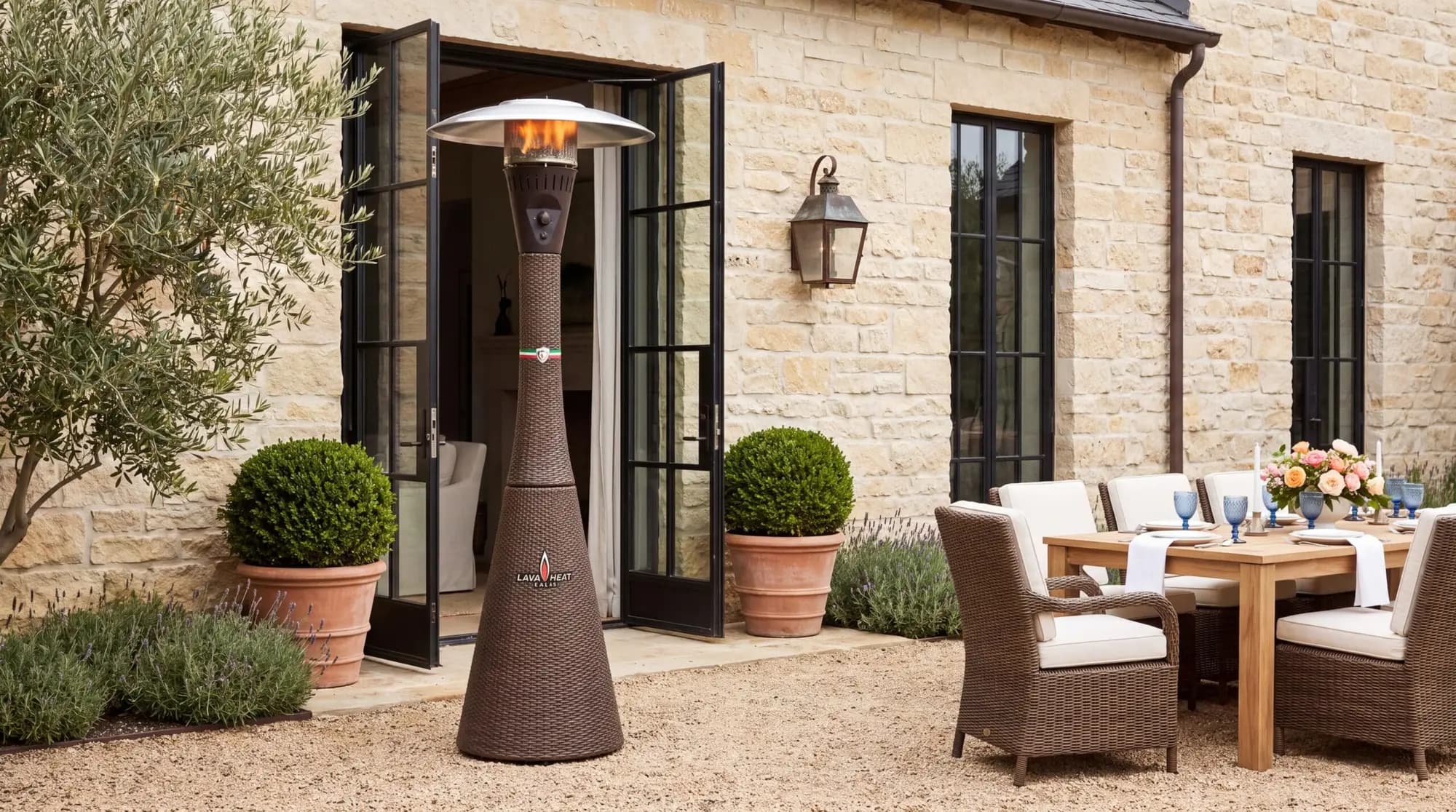
Palermo (51,000 BTU, rattan-wrapped)— Marine-grade aluminum column wrapped in all-weather rattan. Four weave colors — Ash, Charcoal, Natural, and Walnut. The right pick for coastal, shade-garden, or Mediterranean-styled patios where cold metal would feel wrong. The lifestyle photography above is a Palermo Walnut; it’s the heater that best illustrates what the brand means when they talk about design-first engineering.
What the Construction Actually Buys You
The thing that separates Lava Heat Italia from the broader patio-heater category is the materials spec, and the specification is specific enough to be worth understanding before you spend.
Marine-grade aluminum columns.The structural element of the heater is drawn marine-grade aluminum, which resists salt corrosion and freeze-thaw cycling in a way that steel-tube commodity heaters don’t. The lifetime limited frame warranty covers this material — if the column develops a structural failure, Lava Heat covers it indefinitely.
430-grade stainless burner emitters.The hottest part of the heater — the burner element and emitter plate — is 430-grade stainless, which handles the thermal cycling at the burner face without warping or discoloring. Burner components carry a 1-year warranty because they’re the consumables of the system.
Borosilicate glass column.The glass tube that holds the visible flame is shatter-resistant borosilicate, the same material family used in laboratory glassware. It’s rated for the thermal shock of lighting the heater in cold weather without cracking, and it holds the flame as the visual centerpiece without yellowing or clouding over time.
500-hour ASTM B117 salt-spray tested. Every model in the lineup passes the 500-hour salt-fog corrosion test — the hospitality-industry benchmark for coastal durability. For a residential buyer, this translates to: these heaters are rated for poolside, oceanfront, or lakeside installs without finish degradation over a normal lifecycle.
CSA certified. Every model carries CSA certification for North American gas appliance safety standards. The ignition system, pressure regulator, and burner assembly all pass CSA testing — a requirement for commercial installations in most jurisdictions, and a quality signal for residential buyers.
The RAL and Corsa Custom Color Programs
The under-advertised feature of the Lava Heat Italia lineup is the custom color program on the Stainless Steel versions. If you’re an architect speccing a heater into a design-forward outdoor space, this is where the brand pulls ahead of every competitor.
RAL is the European industrial color standard — a palette used across European design and manufacturing for decades. The Stainless Steel versions of the 2G, Lava Lite, Capri, Opus, and Opus Lite can be ordered in RAL 3003 Ruby Red, RAL 5002 Ultramarine Blue, RAL 6005 Moss Green, RAL 1018 Zinc Yellow, RAL 2001 Red Orange, RAL 7016 Anthracite Grey, RAL 1015 Light Ivory, and RAL 9016 Traffic White. If an architect has specified a RAL color into the rest of the outdoor space — gates, railings, trim — the heater can match it exactly.
Corsais Lava Heat’s own textured-finish program. Available Corsa finishes include Taupe, Pebble, Slate, Bronze, Green, Black, and Blanco. These read differently in person from the RAL solids — a subtle textural variation that catches light the way a matte architectural finish does, versus the flat solid color of a standard RAL.
Both programs run slightly longer lead times than the standard three finishes — budget an extra 2–4 weeks on top of the base lead time, and specify at order rather than trying to change finish after the order is in production.
Where Lava Heat Italia Wins vs. the Alternatives
Compared to a commodity mushroom-reflector propane heater (the sub-$300 category), the differences are structural. The commodity heater uses stamped steel over a brass burner, ships without hospitality-grade corrosion testing, and typically fails within two seasons of coastal use. The Lava Heat flame tower in the same height class delivers 2–3x the usable BTU output, 10x the material lifespan in a corrosive environment, and the visual presence of a design object rather than a utility appliance.
Compared to Bromic’s Smart-Heat platform (the premium mounted-infrared category), the two brands solve different problems. Bromic is engineered for wind-resistant directed heat under a pergola or ceiling — it reclaims floor space by mounting overhead and holds its heat zone in moderate wind. Lava Heat is engineered for freestanding patio presence — it’s the sculptural element at the center of the seating group, not a mounted appliance hiding in the ceiling. Choose Bromic for a covered pergola over an existing patio; choose Lava Heat for a dining or seating group in an open courtyard.
Compared to a traditional conical patio heater from a department-store brand, the engineering gap is in materials and testing. Both silhouettes exist in the Lava Heat lineup (Capri and Milano are traditional conical) — the premium is in the marine-grade aluminum, the salt-spray certification, and the finish program depth.
Honest Downsides
Pricing starts premium.The entry-point Milano in Heritage Bronze runs around $1,295. The flagship 2G in a RAL custom color on Stainless Steel can land past $3,100. If your budget is $500 for a patio heater, Lava Heat Italia isn’t the right brand — the department-store commodity category is where you’ll find that price point, with the trade-offs that come with it.
Freestanding design means wind-sensitivity. Every freestanding patio heater — regardless of brand — loses effective heat radius in wind, because infrared heat is directional and open-air convection carries it away. If your patio sits in a consistently windy exposure, a mounted infrared system (Bromic Platinum, Bromic Tungsten) under a pergola delivers more usable heat than a freestanding Lava Heat tower will. For most residential patios in sheltered yards, the freestanding form is the right trade-off.
Natural gas requires professional installation.The NG versions of every model require a licensed gas fitter to run the line and verify pressure regulation. The LP versions use a standard 20-lb tank and install themselves. If you’re committing to NG, budget for the gas-fitter visit alongside the heater.
Palermo rattan is weather-rated but not maintenance-free. The rattan on the Palermo is marine-grade and salt-spray tested, but it benefits from an occasional rinse during pollen season and a cover during long winter storage periods. Not a defect — just a reality of woven material on an outdoor product.
Who Should Buy Which
Buy the 2G flame towerif you want the brand’s flagship silhouette, you have the open patio space to let it breathe, and you want the maximum heat output for a large entertaining group. The best-selling finish is Heritage Bronze; the custom RAL program on the Stainless Steel version is the architect’s pick.
Buy the Lava Lite or Opus Lite if you want the flame-tower aesthetic at the entry price point of the premium lineup. Opus Lite in particular is where most residential buyers land — the look of the 2G at a residential budget.
Buy the Capri if the architecture of your patio calls for a traditional conical heater and the flame-tower drama would overwhelm the space. The Stainless Steel version in a Corsa textured finish is a sophisticated specification for a modern patio where you want material depth without visual noise.
Buy the Milano if your seating group is intimate — 2 to 4 people — and a larger output would overheat the space. 36,000 BTU in a conical silhouette is the right tool for a balcony, a bistro-style terrace, or a tight courtyard dining group.
Buy the Palermoif your patio has a Mediterranean, coastal, or shade-garden design language where metal would feel wrong. The rattan weave reads warm and lived-in in a way the metal towers can’t. Walnut and Ash are the strongest finishes for traditional architecture; Natural and Charcoal are the picks for a more contemporary setting.
Buy the Emberif you only run patio heat for part of the year and off-season storage matters. The collapsible design is the right tool for a Northeast or Mountain-region patio where the heater lives in the garage for six months at a time, or for a vacation property where you don’t want to leave a $2,000 heater outdoors unattended.
What to Confirm Before You Order
Confirm fuel type at order — the SKU suffix is -LP for liquid propane or -NG for natural gas, and the conversion between the two requires a different burner orifice. Field conversion is possible but adds a parts cost and a gas-fitter visit, so get it right at order.
If you’re ordering a Stainless Steel version with the RAL or Corsa custom color program, confirm the finish code at order and plan for 2–4 extra weeks of lead time versus the standard three colors. The custom programs are build-to-order rather than inventory-pulled.
For the NG versions, confirm your gas-fitter is scheduled before the heater arrives. The LP versions ship with a standard tank regulator and install the day they arrive; the NG versions wait on the gas-line connection.
Register the warranty within 30 days of delivery to lock in the lifetime frame coverage. The 3-year parts/finish and 1-year burner coverage activate automatically; the lifetime frame coverage requires registration to validate.
Frequently Asked Questions
Is Lava Heat Italia actually Italian?+
Which Lava Heat Italia model should I buy?+
What's the 500-hour salt-spray testing claim about?+
What's the difference between the standard colors and the RAL / Corsa custom programs?+
Natural gas or liquid propane — how do I choose?+
How much area does a Lava Heat Italia heater actually warm?+
Products & brands in this guide
Related reading
Ash — Ash writes the buying guides at FirePits.com — years of specifying fire features on residential installs, from urban patios to mountain properties.