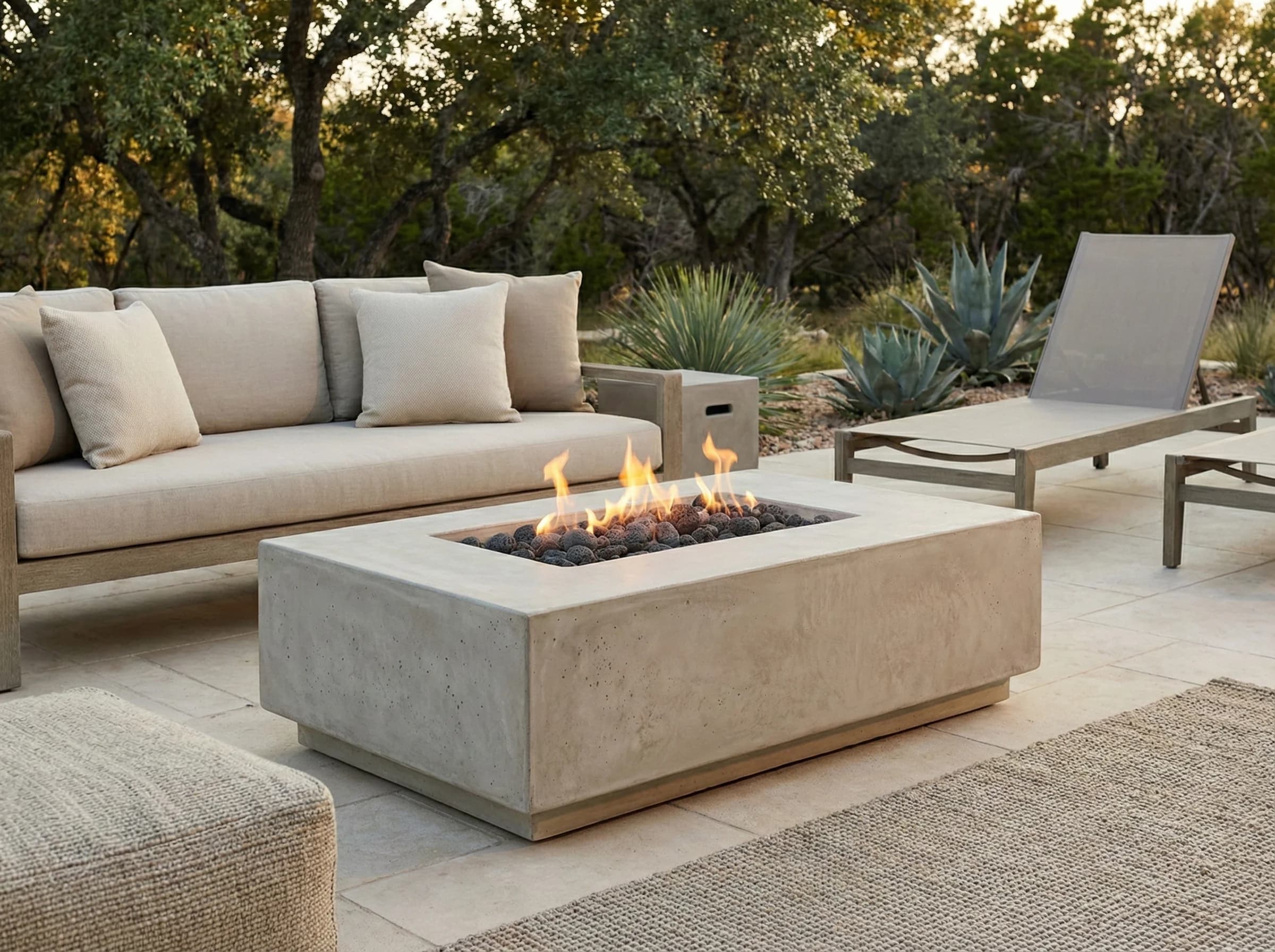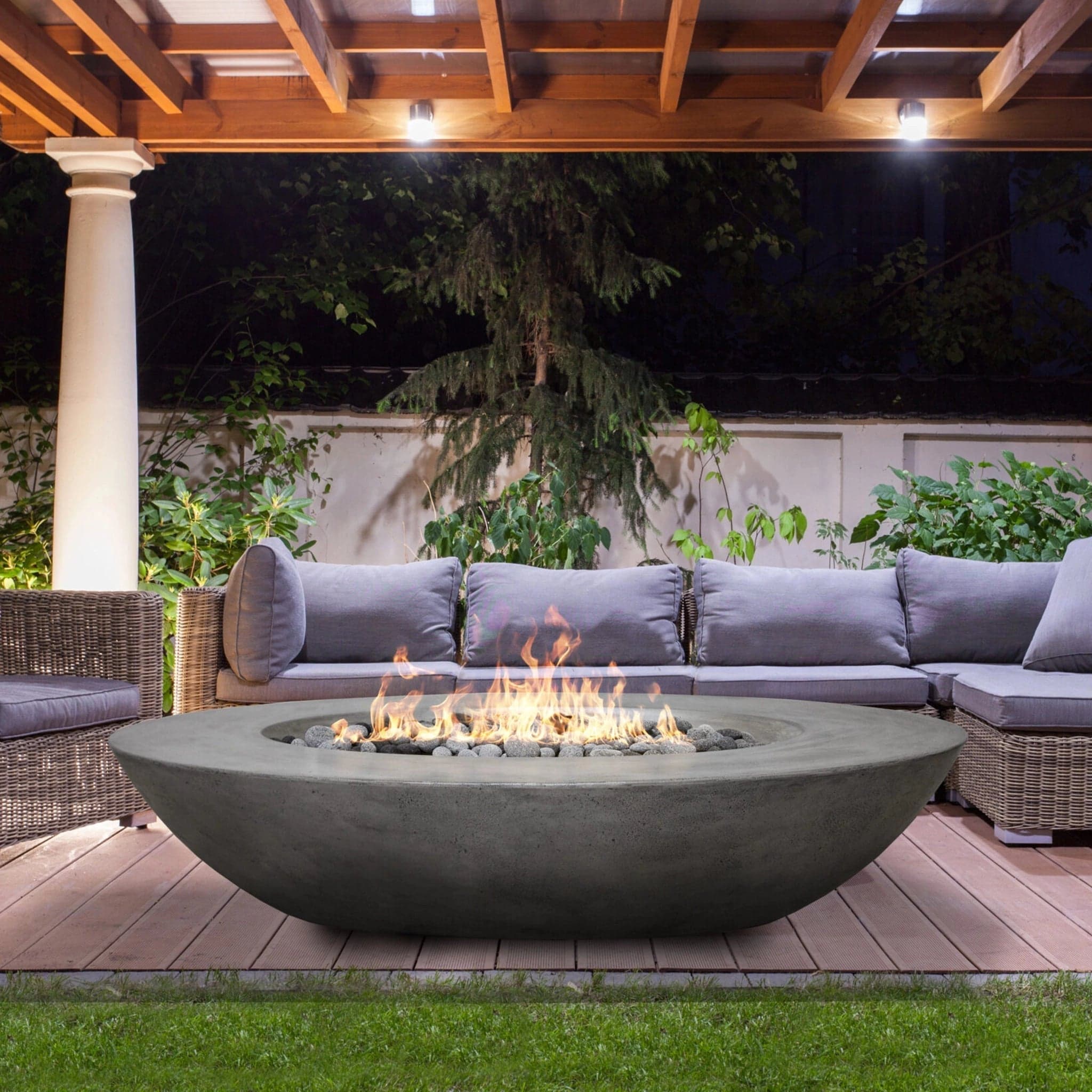
Short answer first: a sealed-base natural gas or propane fire pit under a covered patio is safe when you clear 8 to 10 feet of ceiling, 36 inches of wall, and the space has at least two open sides. A wood-burning pit under any roof is a hard no — code, insurance, and physics all agree. Updated October 2026 with the current IRC clearances, the Outdoor Plus and Prism Hardscapes overhead specs, and the insurance language that is denying covered-patio claims this fall.
TL;DR — Yes to a sealed-base gas fire pit under a covered patio with 8 feet of overhead clearance, 36 inches to any wall, and two or more open sides. No to any wood-burning pit under any roof. The right picks: a The Outdoor Plus or Prism Hardscapes GFRC gas table, or a Bromic infrared heater for fully enclosed porches.
Why This Question Keeps Being Googled
This is the second-most-asked question at our counter after “can I put a fire pit on my deck.” We get it every October when the first cold weekend hits and homeowners want to extend the patio season by two months. In my experience selling fire features for a decade, the top Google results all hedge — “check your local code,” “consult a professional,” “depends on the pit.” None of them publish the actual clearance numbers from the manufacturer install sheets, and none of them tell you which pits in a given category are physically engineered for a covered install. That is the gap this article fills.
There are three variables that decide the answer. The fuel type matters most. The enclosure count — how many sides of the covered space are open — matters second. The ceiling height sets the ceiling, literally. Get those three right and the install is routine. Get any of them wrong and you have a code violation, a warranty void, or a fire.
The Clearance Table Nobody Else Publishes
This is the one piece of Information Gain the top three articles leave out. Minimum clearance from the top of the flame to the lowest point of the ceiling or overhang, split by fuel and pit style. Numbers are pulled directly from the manufacturer install manuals we see every day — The Outdoor Plus, Prism Hardscapes, Bromic, Ohio Flame — plus IRC § M1307.3 for the regulatory floor. If a pit you’re considering isn’t on this table, pull its install manual before you buy and look for “overhead combustible clearance.”
| Fire feature type | Overhead clearance | Side clearance | Covered patio verdict | Code reference |
|---|---|---|---|---|
| Natural gas sealed-base GFRC table (Prism Tavola, TOP Del Mar) | 96 in. (8 ft) | 48 in. (4 ft) to wall | Safe with 2+ open sides, hard-plumbed NG, no cover during use | IRC § M1307.3; TOP install manual |
| Natural gas open-top steel or copper bowl (TOP Regal, Cazo) | 120 in. (10 ft) | 48 in. (4 ft) to wall | Safe with 2+ open sides, requires taller clearance due to upward radiant | IRC § M1307.3; TOP install manual |
| Propane sealed-base GFRC table, tank-in-base (TOP Unity, Del Mar LP) | 96 in. (8 ft) | 48 in. (4 ft) to wall | Safe with 2+ open sides, 20-lb tank MAX inside base per IFC § 6104 | IFC § 6104; TOP install manual |
| Propane open-top steel bowl | 120 in. (10 ft) | 48 in. (4 ft) to wall | Safe with 2+ open sides; portable propane disclaimer may still prohibit | IRC § M1307.3; IFC § 6104 |
| Wood-burning fire pit (Ohio Flame Patriot, Breeo, Solo Stove) | Not permitted under any solid roof | N/A — move to open sky | No — sparks and smoke exceed any residential covered-patio spec | NFPA 1 § 10.11; IFC § 307.4.3 |
| Natural gas fire pit under solid-roof pergola (polycarb, metal) | 96 in. for GFRC, 120 in. for open-top steel, + 24 in. heat shield | 48 in. (4 ft) to wall | Safe with 2+ open sides and manufacturer-approved heat shield above | IRC § M1307.3; pergola manufacturer spec |
| Natural gas fire pit under open-slat pergola (no roof panel) | Open-sky rules apply — 96 in. to any beam | 48 in. (4 ft) to wall | Safe — open-slat is not considered a roof under IRC § M1307.3 | IRC § M1307.3 |
The Outdoor Plus and Prism Hardscapes both spec 96 inches — 8 feet — from the top of the flame to the lowest point of the ceiling for GFRC concrete sealed-base gas pits. Open-top steel or copper bowls get bumped to 120 inches (10 feet) because the upward radiant plume is hotter. Measure from flame tip, not from pit rim.
“A covered patio is a gas-pit install, not a wood-pit install. The sparks a wood pit throws are a 6-foot vertical column — they land in your pergola rafters before they cool.”
Why Gas Is Fine Under Cover and Wood Isn’t
A natural gas or propane burner produces a predictable laminar flame. Flame height is set by the orifice size and the line pressure, not by what’s in the pit — the lava rock or fire glass is decorative, not fuel. On a 65,000 BTU burner at full output, the flame tip reaches about 18 inches above the burner pan, and heat drops to ambient within about 48 inches above the flame. That’s why the 8-foot overhead clearance works — there’s a 6-foot thermal buffer between the flame tip and the ceiling.
A wood-burning pit does something completely different. Combustion is turbulent, flame height spikes to 36 to 60 inches with each new log, and the real hazard isn’t the flame — it’s the ember eject column. Hot embers ride the thermal plume to 6, 8, 10 feet above the pit and drift sideways on the smallest breeze. They land on cedar pergola rafters, on composite decking, on patio umbrellas, on dry cushions. NFPA 1 § 10.11 prohibits open-flame devices under any combustible overhead structure for exactly this reason, and the Ohio Flame Patriot 36 owners manual is explicit — “outdoor use only, under open sky, minimum 15 feet of vertical clearance.”
The Ohio Flame line is one of the best Corten steel wood-burners in the category. It belongs on open hardscape — a stone patio, a gravel surround, a lawn with a pad. Not under a pergola, not under a porch roof, not on a covered deck. If you want fire under cover, buy gas. If you want wood fire, move the pit to open sky.
What We Carry That Is Covered-Patio Safe
Prism Hardscapes GFRC concrete gas tables. The Prism Hardscapes Ovale 60, the Tavola 3, and the rest of the Prism line are the first thing we recommend for a covered patio. GFRC concrete is a non-combustible shell, the sealed base keeps the gas line and burner enclosed, and the surface temperature on the exterior face stays under 150°F in use. Prism specs 72 to 96 inches overhead depending on bowl geometry — pull the install sheet for your model before you buy.
The Outdoor Plus GFRC natural gas tables. The The Outdoor Plus Del Mar 48 in GFRC concrete is the sealed-base plug-and-play natural gas table we most often ship to covered patios. 65,000 BTU, 96-inch overhead spec, 48-inch side clearance to wall. Comes pre-configured for NG or propane. The Regal 48 in Corten steel is the open-top equivalent — bump the overhead clearance to 120 inches on this one.
The Outdoor Plus propane tables with the tank hidden. If you don’t have a hard-plumbed natural gas line and the covered patio is still under 20 feet from your house, the Unity 48 propane table hides a 20-lb cylinder inside the sealed base. IFC § 6104 caps on-site propane at 20 lb within the covered footprint; this ships compliant out of the box. The 65,000 BTU burner gives you about 6.6 hours per tank at full output.
Bromic patio heaters — the no-combustion alternative for enclosed spaces. If your covered patio is actually a three-season room with four screened sides, the gas-pit option gets complicated fast and the electric option gets simple. The Bromic Platinum Smart-Heat 2300W electric and the gas-fired Bromic Tungsten Smart-Heat are purpose-built for covered rooms — directed-infrared beam, no open flame, ceiling-mountable at 10 inches below the rafter, no combustion byproducts on the electric unit. We cover the full lineup in the Bromic brand guide.
Ventilation and Carbon Monoxide — The Enclosed-Side Count
The variable most homeowners miss is how many sides of the covered space are open. The rule we use at the counter:
Four open sides (a pergola on the lawn, a pavilion with no walls) — standard outdoor rules apply. Clearance is the only concern.
Three open sides (one wall, three open — the classic covered patio off the back of the house) — standard outdoor rules apply. Combustion byproducts dissipate out any open side. No special vent sizing.
Two open sides (two walls, two open — an L-shaped covered patio or a corner pavilion) — still safe for a gas pit, but keep CO out of the picture by siting the pit so the two open sides give you cross-flow. Don’t tuck it into the corner where both open sides are behind the wall.
One open side (three walls plus a roof — a three-season room with one open edge) — vented combustion appliance territory. A standard outdoor gas pit becomes marginal here. If you insist, you need at least 1 square foot of permanent open ventilation per 10,000 BTU of input, split between a low and a high opening to drive natural convection. For a 65,000 BTU pit, that’s roughly 6.5 square feet of permanent vent area. Easier call: switch to an electric heater.
Zero open sides (a fully enclosed sunroom or glazed porch) — a non-listed outdoor fire pit is prohibited. The only legal option is a vented gas appliance listed to ANSI Z21.97 or an electric heater like the Bromic Platinum. Full stop.
What the Codes Actually Say
International Residential Code § M1307.3 — appliance clearances to combustibles. Default is manufacturer spec; most residential jurisdictions enforce the install manual as the operative clearance rule.
International Residential Code § G2407 — combustion air for gas appliances. The source for the 1 sq ft per 10,000 BTU vent rule when the covered space has fewer than two open sides.
International Fire Code § 307.4.3 — recreational fires. Prohibits open-flame wood-burning within 25 feet of any structure and under any combustible overhead. This is the clause your inspector will cite if you try to run an Ohio Flame under a pergola.
International Fire Code § 6104 — propane storage. Caps on-site LP cylinders at 20 lb inside the covered footprint; larger cylinders must be stored at least 10 feet from the dwelling and in a ventilated enclosure. This is why we ship covered-patio propane customers to the Unity 48 or the Del Mar 48 LP, not to a steel bowl with a 40-lb tank in a side cabinet.
NFPA 1 § 10.11 — open-flame prohibitions. The federal-level rule your local wildland-urban interface (WUI) amendments will reference. California CA Fire Code § 308, Colorado WUI zones, and most Pacific Northwest counties run stricter clearances on top of this baseline.
Call your local building department with the pit model number before you buy. The 10-minute phone call saves a $400 return shipment later.
The Insurance Clause That Denies the Claim
Standard HO-3 homeowners policies cover accidental fires from a listed, manufacturer-spec-installed fire appliance. We’ve asked three carriers (State Farm, Allstate, Liberty Mutual) for their covered-patio exclusion language. The pattern is identical across all three:
Open-flame wood-burning under any roof structure. This is the denial language we see most often. Every carrier treats this as “intentional disregard of the manufacturer’s install instructions,” and that clause is in every policy. If a wood-pit ember lights a pergola rafter, the claim gets denied under this language before the adjuster even reads the photos.
Propane cylinder over 20 lb inside the covered footprint. IFC § 6104 violation = automatic denial. The 30-lb and 40-lb cylinders common on side-cabinet bowl pits are a 10-foot setback issue when the pit is on a covered patio attached to the house.
Any install that violates the manufacturer’s overhead clearance. This is the sneakier denial. If The Outdoor Plus specs 96 inches overhead and your pergola ceiling is 90 inches, the claim adjuster has a documented reason to deny. Measure before you install, not after.
The audit-safe move: call your carrier before you install, describe the pit (make, model, fuel), the covered-patio configuration (ceiling height, open-side count, wall materials), and ask for approval in writing. Twenty minutes on the phone, and the claim adjuster has nothing to argue about if the worst happens.
If You Already Have the Wrong Pit
We get this call once a month. “I bought a wood-burner last year, we just enclosed the pergola with a solid roof, what are my options.” Three honest answers:
Move the pit. If your yard has space for a 10-by-10 stone pad 25 feet from any structure, that’s the fire-pit location. The pergola becomes a seating area without a pit, and you walk 25 feet to the fire. Not glamorous. Code-compliant and insurance-covered.
Swap to a gas table. The Prism Ovale 60 and the The Outdoor Plus Del Mar 48 are both drop-in replacements for a 48- to 60-inch wood pit footprint. Hard-plumb to natural gas if you have a line nearby — the natural gas vs propane fire pits guide walks the install cost and lifetime math. Hide a 20-lb propane cylinder in the sealed base if you don’t.
Add a heat source instead of a flame source. If the real goal is warmth under the covered patio, a Bromic directed-infrared heater delivers more usable heat per dollar than any fire pit and does it with zero flame risk. The Tungsten Smart-Heat gas ceiling-mounts at 10 inches below your rafter and covers a 10-by-10 seating area. The electric Platinum 2300W runs on a dedicated 240V circuit and has no combustion at all — the only choice for a fully-enclosed sunroom.
The Honest Bottom Line
A covered patio is a gas-pit install, not a wood-pit install. A sealed-base GFRC concrete gas table from Prism Hardscapes or The Outdoor Plus under 8 feet of overhead clearance, 36 inches to any wall, two or more open sides for ventilation — that’s the install we see hold up for ten years without a code or insurance issue. If the space is more enclosed than that, the right answer is a Bromic infrared heater, not a creative reading of the fire-pit spec sheet.
The pattern we see fail is the one that starts with “I already have the fire pit, can I make it work under the cover.” Sometimes the answer is yes with a swap, sometimes it’s no, and the twenty-minute phone call to your building department and your insurance carrier is the cheapest insurance you can buy on the install. Measure the ceiling, count the open sides, read the install manual, make the call. Then light the thing.
Frequently Asked Questions
Can you use a fire pit under a covered patio?+
What is the minimum ceiling clearance for a gas fire pit on a covered porch?+
Can a wood-burning fire pit go under a pergola?+
Do I need ventilation for a gas fire pit on a covered patio?+
What local codes apply to a covered-patio fire pit install?+
Does homeowners insurance cover a fire pit under a covered patio?+
Products & brands in this guide
Related reading
Ash — Ash writes the buying guides at FirePits.com — years of specifying fire features on residential installs, from urban patios to mountain properties.