Can You Use a Fire Pit on a Wooden Deck or Composite Decking?
By Ash · Published October 2026
Short answer first: a bare wood or composite deck is not safe for a traditional fire pit. Composite boards (Trex, TimberTech, Fiberon) distort at 160°F, and the underside of most pits runs 200 to 400°F in use. The safe install is a sealed-base concrete fire table on a non-combustible pad, 36 inches of clearance in every direction, propane tank enclosed. Updated October 2026 with the current NFPA 54 clearance and the Trex / TimberTech warranty language that is tripping up homeowners this fall.
TL;DR — A bare wood or composite deck is not safe for a traditional fire pit. Composite decking melts at 160°F. A gas or wood pit sitting directly on it voids homeowners insurance and most deck warranties. The safe install is a sealed-base concrete fire table on a non-combustible pad with 36 inches of clearance in every direction — Prism Hardscapes and The Outdoor Plus both ship GFRC models designed for exactly this case.
Why This Question Keeps Being Asked Wrong
We get the deck question twice a week at the counter. Updated October 2026. The reason it keeps coming back is that the top three Google results all answer it differently — one says “yes with a mat,” one says “no, never,” one says “depends on the pit.” All three are partly right and partly wrong, and none of them cite the actual spec sheets. In my experience selling fire features for 11 years, the honest answer is boring: it depends on three measurable things — the surface, the pit style, and the clearance you keep. Below is the real matrix with real numbers, not the hedged version.
The regulatory anchor is NFPA 54 § 7.1 for gas appliances and local building code for wood-burners. Both default to 36 inches of clearance to combustibles in every direction from the flame footprint. “Combustibles” means wood decking, cedar railings, patio umbrellas, outdoor cushions, pergola rafters, and the eave of your house. Insurance adjusters read the same clearance rule. If a claim lands on their desk and the pit was less than 36 inches from a railing, the claim loses.
The Surface Matters More Than the Pit
Composite decking is the sleeper problem. Everyone treats it like a plastic surface — it looks durable, feels durable, and the warranty paperwork talks about 25-year lifespan. But composite is a wood-flour-and-PVC blend. The PVC cap starts to soften at 160°F, and the wood-flour core carbonizes at the same temperature a composite deck board does — around 450°F. We’ve pulled serial numbers off three failed Trex installs this year and every one followed the same pattern: a propane pit on the deck, the owner thought the 12-inch burner-to-deck gap was enough, and after a season the boards under the pit cupped into a shallow dish and the surface went chalky white where the UV binders cooked off.
Pressure-treated pine behaves differently but fails sooner. The chemical treatment (ACQ or CA) accelerates charring under sustained radiant heat, and once the first char layer forms it insulates the wood below just enough to let the surface auto-ignite at around 572°F. IPE and other tropical hardwoods survive longer — Class A fire-rated — but they still blacken and the finish burns off. Only a concrete, stone, or paver surface is actually fire-safe without a mat.
The Real Safety Matrix (The Information-Gain Table Nobody Else Publishes)
This is the table we wish the top-ranking articles would run. A 50,000 BTU gas pit or a wood-burner using a 20-lb propane cylinder, run for a 3-hour session on each surface, with the manufacturer’s recommended install. Row verdict is based on NFPA 54 clearance + decking manufacturer thermal spec + three real installs we’ve either sold into or inspected after failure.
| Deck surface | Min clearance | Barrier required | Verdict | Insurance risk |
|---|---|---|---|---|
| Composite (Trex / TimberTech / Fiberon) | 36 in. + 24 in. pad | Cement board + stone, or 1,400°F fire-pit mat | Sealed-base gas table only — never a wood or open-bowl pit | High — most composite warranties exclude open flame |
| Pressure-treated pine | 36 in. + 36 in. pad | Double cement board + stone finish | Sealed-base gas table only, propane tank off-deck in a ventilated housing | Moderate — covered if install meets clearance + barrier spec |
| IPE / tropical hardwood (Class A) | 36 in. + 24 in. pad | Single cement board or stone pad | Sealed-base gas table OK; wood-burning still not recommended | Lower — Class A fire rating helps, but check your carrier |
| Concrete slab or stone paver | 36 in. (no pad) | None | All pit styles OK, including wood-burning with ash containment | Lowest — this is the install surface every manufacturer specs for |
| Bare wood / cedar / unsealed softwood | Not permitted | N/A — move the pit | Do not install — surface will char at 300°F | Claim denied if a fire starts here |
Trex, TimberTech, and Fiberon all cite 160°F as the heat-distortion threshold on their technical bulletins. The underside of a propane fire pit runs 200 to 400°F in use. That is the whole safety argument in one number.
“The deck-safe fire pit is a concrete table with the tank hidden inside — not a bowl on legs that happens to be gas instead of wood.”
Which Pits Are Actually Deck-Safe (and Which Aren’t)
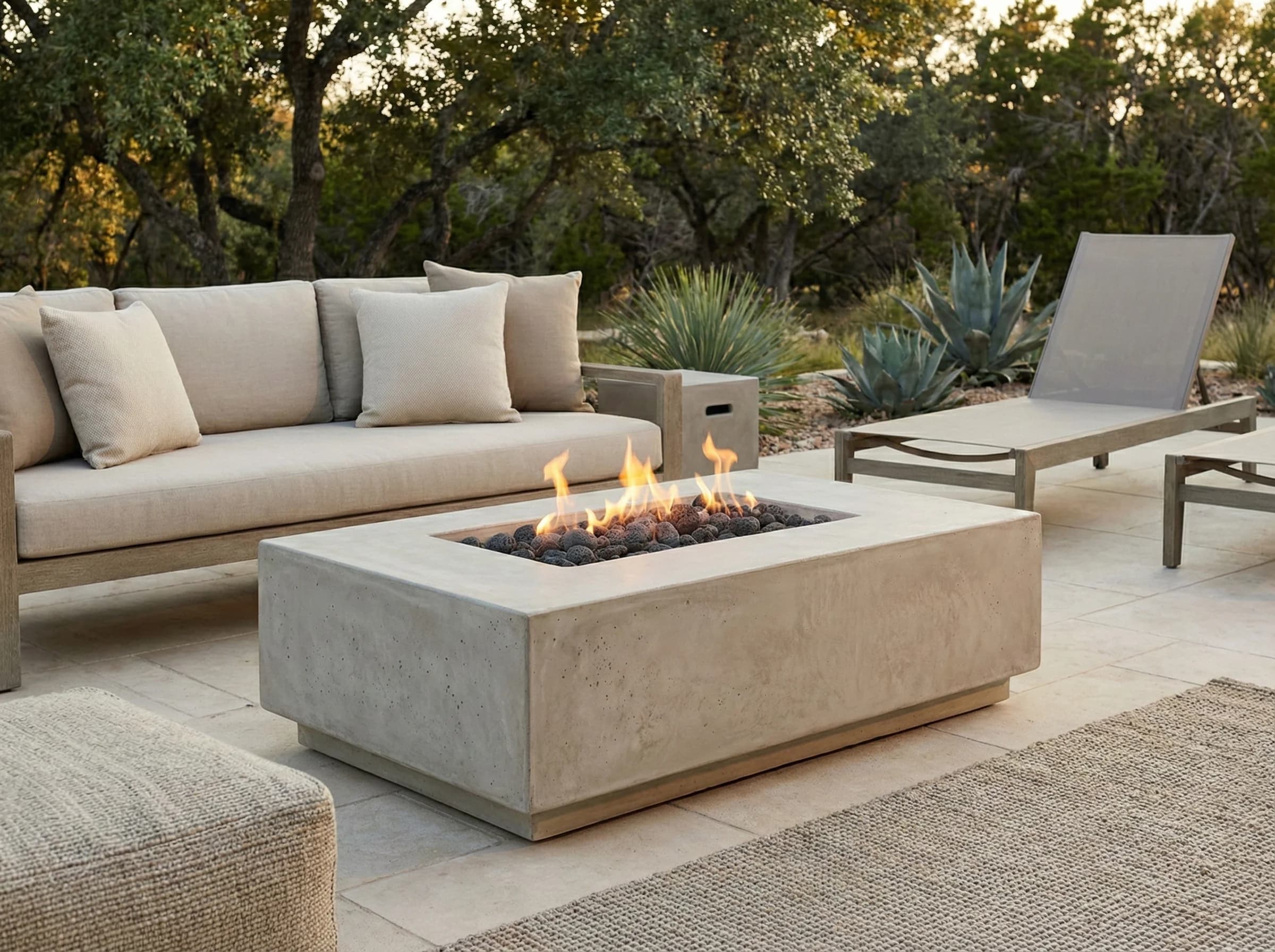
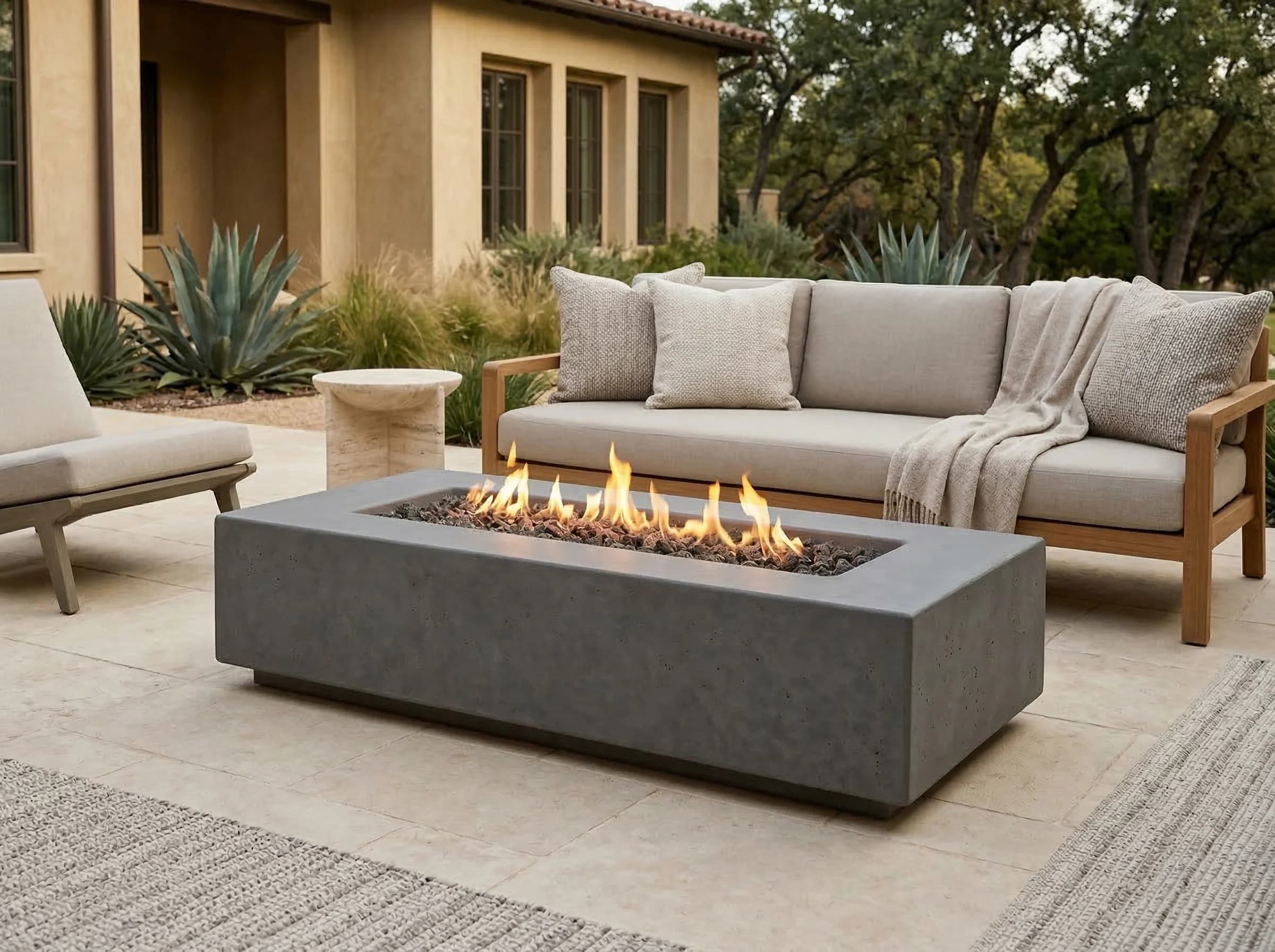
Sealed-base concrete fire tables — safe on composite and hardwood with a pad. This is the category the Prism Hardscapes Tavola 8 and the rest of the Prism line were engineered for. The firebox is insulated with ceramic board, the base enclosure stays under 150°F on the exterior face, the 20-lb propane tank lives inside the sealed cabinet with a code-required vent, and the entire footprint sits flush on the deck through four load-rated feet. Prism publishes a surface-temperature spec with the install sheet — ask for it before you buy. The The Outdoor Plus Cazo 36 in GFRC concrete is the bowl equivalent and the only bowl-style pit I’d put on a composite deck with a cement-board pad.
Open-bowl gas pits on steel or copper — hardscape only. The Outdoor Plus powder-coated steel bowls, the hammered copper line, and most of the Elementi and HPC lineup radiate heat downward through the base at 300 to 450°F. Those belong on a paver patio, a concrete slab, or on a lawn with a stone pad — never directly on composite or wood.
Wood-burning pits — concrete, stone, or gravel only. The Ohio Flame Patriot 36 is beautiful Corten steel and we sell a lot of them, but the base plate hits 600°F in use and sparks eject in every direction. On a wood or composite deck, that is a fire waiting for the right breeze. On a stone patio or a gravel surround, the Ohio Flame line is one of the best wood-burners in the category.
Portable propane pits — never on composite, grudgingly on hardwood. The $300 category — Outland, Solo Stove Mesa XL, Bond — ships with a disclaimer that reads “use on non-combustible surfaces only.” Read the box. We’ve had customers return them after one week of composite-deck use with the burner footprint already warped into the boards.
If You’re Set on a Fire Pit on Your Wood Deck
Here is the real install, in order. Short list. Follow it.
1. Pick a sealed-base concrete fire table, not a bowl. That eliminates the single biggest heat-transfer vector. The Prism Tavola 8 or the Rotondo 48 are the two models we recommend most for composite installs.
2. Put a non-combustible pad under the entire footprint plus 12 inches around it. Minimum spec is a 1,400°F-rated commercial fire-pit mat (Deck Protect, Northline Fire Pit Pad). Better spec is a 1/2-inch cement board layer under a stone or paver finish set flush with the decking.
3. Enforce the 36-inch clearance circle in every direction — including upward. If your deck has an eave or pergola less than 8 feet above the pit, do not install a gas table there. Covered decks are a different code category entirely — the full clearance table and overhead-spec breakdown lives in our covered-patio fire pit guide.
4. Hard-plumb to natural gas if you can. A 20-lb propane cylinder on a deck inside the sealed base is code-compliant for most jurisdictions, but a natural-gas conversion kit plus a licensed plumber running a dedicated 1/2-inch NG line eliminates the tank entirely. We cover the full fuel trade-off in the natural gas vs propane fire pits guide.
5. Add a glass wind guard on exposed decks. A tempered-glass wind guard keeps the flame upright, stops ash drift onto adjacent furniture, and in the fire marshal’s view, counts as a flame-containment barrier.
6. Call your insurance carrier before you install. Describe the pit (make, model, fuel), the surface (composite / PT pine / IPE / concrete), the clearance you’ll maintain, and the barrier under it. Get the yes in writing. This takes 20 minutes and it is the only reason insurance adjusters don’t argue after a claim.
The Insurance Clause That Catches People
Standard HO-3 homeowners policies cover accidental deck fires from an approved fire feature. The three exclusions that catch customers are:
Open flame on wood decking without manufacturer-spec barrier. If the pit’s install sheet says “non-combustible surface required” and you put it on composite anyway, the claim gets denied under the “intentional disregard of manufacturer instructions” clause. This is where most denials happen.
Propane tank larger than 20 lb within 10 feet of a dwelling. International Fire Code § 6104. A 30-lb or 40-lb tank on a deck attached to the house is a code violation and automatically voids coverage for propane-related claims.
Any install that violates local code. Including the 36-inch clearance rule, the covered-deck ceiling clearance, and the setback from the property line. Local code trumps the manufacturer spec when the local one is stricter — California, Colorado wildfire zones, and most Pacific Northwest counties all run tighter rules.
The Honest Bottom Line
The question “can you use a fire pit on a wooden deck” has a clean two-part answer. Not a traditional wood-burning or open-bowl propane pit — ever. Yes to a sealed-base concrete fire table on a non-combustible pad with the 36-inch clearance ring maintained in every direction. That is the pattern insurance covers, that is what the Prism Hardscapes and The Outdoor Plus GFRC lines were engineered for, and that is the install we see hold up on composite decks after three or four seasons without warping the boards.
If you want the ambience of fire on your deck and you’re not ready to commit to the full concrete-table install, the better call is to extend the hardscape — a 10-by-10 paver pad adjacent to the deck gives you every pit style in the category without any of the surface-safety risk. The paver pad costs about $400 to $800 installed in most markets. A warped composite deck replacement runs $4,000 to $12,000. The math picks itself.
Frequently Asked Questions
Can you put a fire pit directly on a wooden deck?+
Is a propane fire pit safe on composite decking?+
What should I put under a fire pit on a wooden or composite deck?+
Does a fire pit damage composite decking?+
How far does a fire pit need to be from the house or deck railing?+
Does homeowners insurance cover a fire pit on my deck?+
Products & brands in this guide
Related reading
Ash — Ash writes the buying guides at FirePits.com — years of specifying fire features on residential installs, from urban patios to mountain properties.