Flame Tower vs Mushroom Patio Heater: What You Pay For When You Spend Up
By Ash · Published October 2026
Flame-tower patio heaters cost five to ten times what a commodity mushroom heater costs. That premium pays for marine-grade materials, 10× the operational lifespan in coastal exposure, 360° heat distribution rather than a downward reflection cone, and a design presence that reads as architecture rather than equipment. Here's the honest breakdown of what the extra money actually buys — and the specific scenarios where a $200 mushroom heater is still the right call. Updated October 2026.
The Two Silhouettes, Side by Side
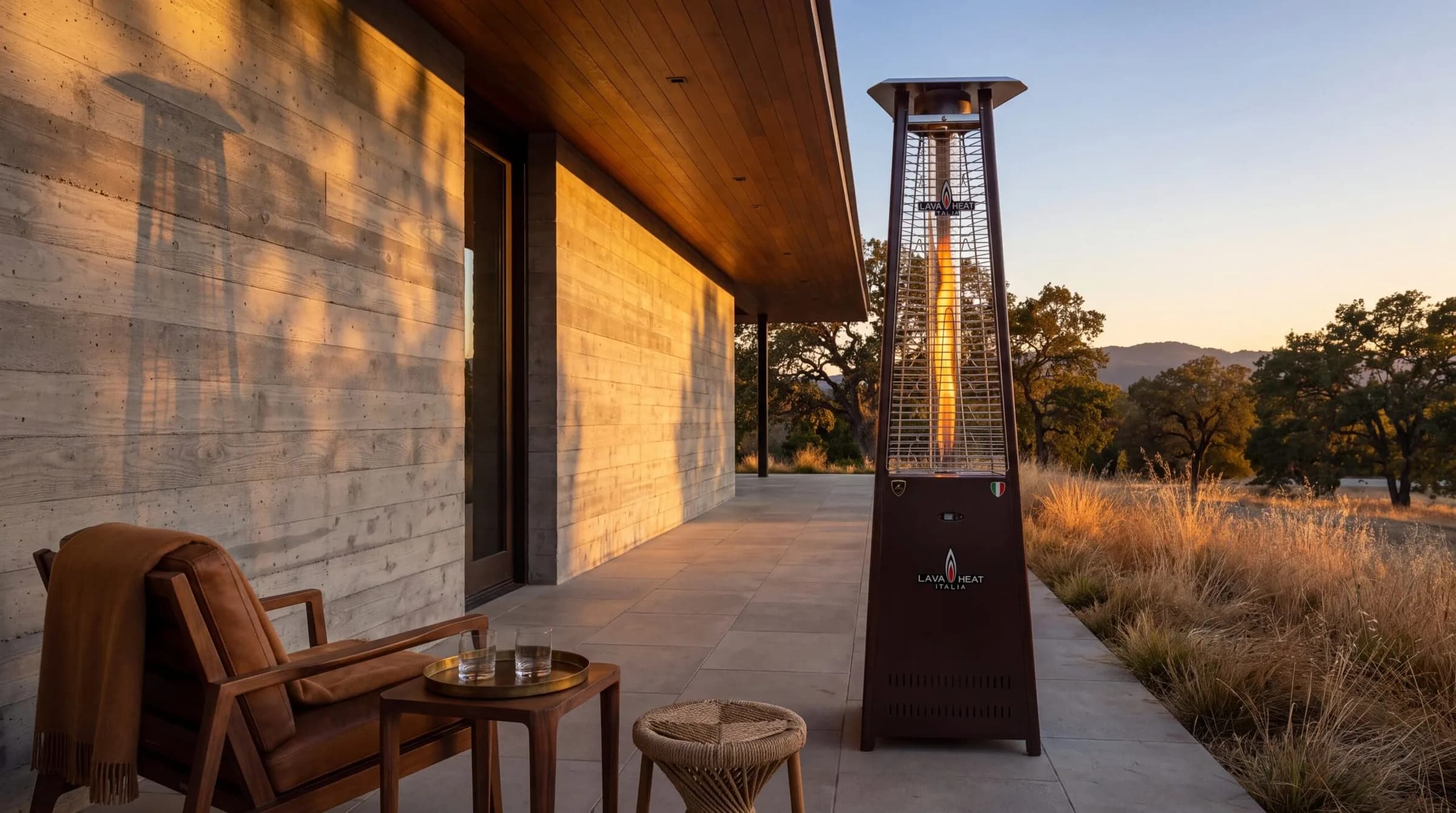
Walk into any outdoor-living showroom and you’ll find patio heaters in two dominant forms. The mushroom-reflector heater is the one everyone recognizes — a vertical post with a wide stainless umbrella at the top that bounces heat downward onto the seating area. The flame tower is the premium alternative — a tall glass column with the burner inside, so the flame itself becomes a visible vertical pillar of fire 4 to 6 feet high. Both silhouettes do the core job of warming an outdoor space in cold weather. They do it differently, and the price gap between them is dramatic.
A commodity mushroom heater from a big-box store runs $150 to $300. A premium commercial mushroom (Patio Comfort, SunGlo, AmeriGlow) runs $800 to $1,500. A premium flame tower — Lava Heat Italia being the brand that originated the silhouette — starts at $1,295 for the compact Milano and climbs past $3,000 for the 2G in a custom color. So the real question for most buyers is: does the premium silhouette deliver 5–10× the value? Not always. But often enough that it’s worth understanding what’s actually different.
How Heat Distribution Actually Differs
BTU rating is a measure of heat output per hour, not where that heat goes. A 42,000 BTU heater produces 42,000 BTU regardless of silhouette. The practical difference between a mushroom and a flame tower is how that heat gets delivered into the space around it.
Mushroom reflectors throw heat downward in a cone. The dome at the top catches the rising convective heat from the burner and reflects it back down into a roughly circular zone 8 to 12 feet across directly beneath the heater. The downward cone is more concentrated than diffuse — a seat two feet from the post is significantly warmer than a seat eight feet away, and a seat directly under the dome gets the most heat of all. This works well for a single bench, a doorway where a server stands, or any application where the heat should land in a specific spot below.
Flame towersradiate heat outward in 360° from the glass column itself. The burner is inside the column, the glass transfers the heat laterally, and the effective warm zone is a ring around the heater rather than a cone beneath it. For a seating group arranged around a dining or cocktail table, the tower delivers more even coverage. A guest sitting six feet from the column on any side gets roughly the same warmth as a guest sitting six feet from the column on the opposite side. There’s no "cold seat" problem.
The practical implication: for a four-chair conversation group around a fire-pit coffee table, a 51,000 BTU flame tower like the Palermo at the edge of the arrangement heats the whole group evenly. For a bench against a wall, a 48,000 BTU commercial mushroom with the dome aimed at the bench puts more usable heat on the people sitting there.
Construction: Where the Dollar Gap Actually Sits
The engineering difference between a $200 heater and a $2,000 heater is less about the burner and more about the materials around it. Both silhouettes use broadly similar burner tech — a stainless burner element, a brass orifice sized for propane or natural gas, and a piezo-electric or electronic ignition. The gap shows up in the structural materials.
Commodity mushroom heaters use 430-grade stainless or powder-coated steel for the dome and post. 430 stainless is magnetic-grade — cheaper to form, lower chromium content, more susceptible to rust in salt air or chlorinated pool environments. Powder-coated steel is cheaper still and reliably fails after one or two seasons in the sun as the coating cracks and the underlying steel rusts. Expect to replace a $200 heater every 2–3 years in a residential coastal environment; faster if it lives outside year-round through freeze-thaw cycles.
Flame-tower heaters at the premium end use marine-grade aluminum for the structural column (resists salt and freeze-thaw cycling) and 430-grade stainless for the burner element itself (which handles the thermal cycling at the flame face). The visible glass column is shatter-resistant borosilicate — the same material family as laboratory glassware, rated for the thermal shock of lighting the heater in cold weather. Lava Heat Italia specs 500-hour ASTM B117 salt-spray testing across every model in their lineup, which is the hospitality-industry benchmark — the same spec used by Forbes Five-Star resorts and Michelin-starred restaurants. For a residential coastal buyer, this is the difference between replacing a $200 heater three times in a decade versus keeping a $1,995 heater for the full decade.
Mid-tier commercial mushroom heaters (Patio Comfort, SunGlo) close most of the materials gap at the $800–$1,500 price point. They use 304-grade stainless, better regulators, and heavier gauge metal than the department-store commodity. The gap vs. a flame tower at that mid-tier point is more about silhouette and heat distribution than durability.
Design Presence: What You’re Really Buying
The thing most buyers underestimate about a flame tower is the visual effect. A mushroom heater reads as equipment — the dome is utilitarian, the post is a utility column, the whole object says "service item" even when the construction is premium. A flame tower reads as architecture. The vertical column of visible fire is a focal point in the space during the day (sculptural element) and becomes the primary light source at night.
For a residential patio where the heater is going to be a permanent part of the design, this matters. The Palermo in Walnut rattan doesn’t look like a heater at all — it reads as a piece of outdoor furniture that happens to produce heat. The Opus Lite in Hammered Black reads as a sculptural column that happens to produce flame. The mushroom equivalent at the same price point still reads as equipment.
For a commercial setting — restaurant patio, event rental, hotel pool deck — this cuts both ways. The restaurant that wants a quiet, invisible heat source values the mushroom’s utility-first design. The hotel that wants the heater to be part of the romance of the outdoor dining room pays up for the flame tower. The spec gets written against what the heater is supposed to communicate, not just what BTU output it delivers.
The 10-Year Cost of Ownership Math
Price-at-purchase is misleading for patio heaters because the lifespan gap between the cheapest and most expensive is huge. Here’s the honest math over a 10-year window for a residential buyer with moderate use (100 hours of operation per year).
$200 commodity mushroom heater, 2–3 year lifespan. Replace 4 times over a decade = $800 in heater purchase. Add $150 propane tank per year × 10 years = $1,500 in fuel. Total 10-year cost: $2,300. The heater sits outside the entire time looking progressively worse as the finish fails.
$1,000 commercial mushroom heater, 7–10 year lifespan. One or two heaters over a decade = $1,000–$2,000. Same $1,500 fuel. Total: $2,500–$3,500. The heater holds its finish for most of the decade.
$2,000 premium flame tower, 15+ year lifespan with warranty support. One heater, with lifetime frame warranty covering structural failures. $2,000 purchase. Same $1,500 fuel. Total: $3,500 over 10 years, with 5+ more years of useful life after that. The heater becomes a permanent part of the space.
The absolute dollar difference between the commodity path and the premium path over a decade is roughly $1,200 — meaningful but not dramatic — and the premium buyer gets a design object they actually want in the space rather than three sequential utility items they tolerate.
Where the Mushroom Still Wins
For the sake of honesty, there are specific scenarios where the cheaper option is the correct call rather than a compromise.
Service-area heating in a backyard where visibility doesn’t matter.A heater warming a side yard where guests don’t sit and the visual presence is irrelevant — any commodity mushroom at 48,000 BTU does the heating work. Don’t spend $2,000 on sculpture for a service area.
Short-term installations.A heater that will live at a vacation property for one or two seasons before the house changes hands, or at a construction job site, or at a wedding rental business. The flame tower’s 15-year lifespan is value you don’t get to collect. Buy down the capital cost.
Doorway or bench heating with a specific target. A mushroom reflector aimed down at a specific zone (a doorway where a greeter stands, a bench along a wall) puts more heat on that spot than a flame tower radiating in 360°. Pick the right tool for the geometry.
Commercial-grade mushroom at the mid tier. Patio Comfort, SunGlo, and AmeriGlow commercial mushrooms at $800–$1,500 are legitimately good heaters built for commercial duty cycles. They close most of the construction gap vs. a flame tower while still looking like a traditional heater. If the aesthetic preference is for the classic silhouette, these are the right pick.
Where the Flame Tower Wins Decisively
Residential patio where the heater is part of the design.If you’re investing in the outdoor space (a $20,000+ patio build with real landscaping and furniture), the heater choice should match the rest of the material language. A $200 utility heater on an $8,000 travertine patio looks exactly like what it is. A flame tower on the same patio reads as part of the architecture.
Coastal, poolside, or oceanfront installs. This is where the salt-spray-tested marine-grade aluminum construction actually pays off. A commodity mushroom lasts 18 months before the rust shows. A premium flame tower lasts the full warranted lifespan.
Entertaining layouts where guests sit around the heater. The 360° heat distribution is the right tool for the geometry. Four chairs around a conversation table want the tower; one bench along a wall wants the mushroom.
Hospitality installations.Any restaurant patio, hotel pool deck, or event venue where the heater is part of the guest experience. The visual presence and the hospitality-grade construction spec are both part of what’s being bought.
What to Confirm Before You Order
Fuel. Natural gas needs a gas line (and a licensed gas fitter). Liquid propane uses a standard 20-lb tank and installs the day it arrives. Both silhouettes come in both fuels. The SKU suffix (-LP or -NG) is how you specify at order.
Dimensions. Flame towers are tall — most run 7–8 feet. Confirm your pergola or covered patio has the clearance. The Ember is the only collapsible in the Lava Heat lineup; everything else assembles once and stays assembled.
BTU for the space. For an open patio with 4–6 guests, aim for 42,000–56,000 BTU. For a larger entertaining area, 65,000 BTU or two smaller heaters positioned to overlap coverage.
Warranty terms.Lava Heat Italia’s flame-tower warranty runs lifetime limited on the frame, 3 years on parts and finish, 1 year on burner components. Register within 30 days of delivery to lock in the lifetime coverage.
Frequently Asked Questions
What is a flame-tower patio heater, exactly?+
What's a mushroom-reflector heater?+
Do flame-tower heaters actually produce more heat?+
Are flame-tower heaters worth 5–10× the price?+
Can a mushroom heater be commercial-grade?+
What about wind? Do flame-tower heaters handle it?+
Products & brands in this guide
Related reading
Ash — Ash writes the buying guides at FirePits.com — years of specifying fire features on residential installs, from urban patios to mountain properties.