Updated October 2026. Patio-heater season is here and most of the top-ranked 2026 buying guides are the same thin round-up of mushroom-style propane units with a Weber grill photo at the top. We sell this category every day. The honest truth is that choosing a patio heater is a four-way decision — fuel, mounting type, coverage area, and whether the heater is the design centerpiece or an invisible workhorse — and getting any one of those wrong is how a $900 heater ends up warming nothing.
How We Ranked the 2026 Field
Four variables, in this order: install type (mounted vs freestanding vs tabletop), fuel (natural gas, liquid propane, 240V electric infrared), real BTU-to-coverage-area math (not the aspirational numbers on the box), and warranty with a real parts pipeline behind it. A heater that scores well on three of four is a strong pick for the use case those three variables fit. A heater that scores well on all four at a single price point does not exist in this category, which is why the right answer is always “best for your install,” not “best overall.”
We left tabletop units off the ranked list. They are atmospheric, not functional — you feel them from two feet away and nowhere else. If a tabletop heater is what you want, the honest category to compare it against is a candle, not a Bromic.
Best Mounted Gas Patio Heater — Bromic Platinum Smart-Heat
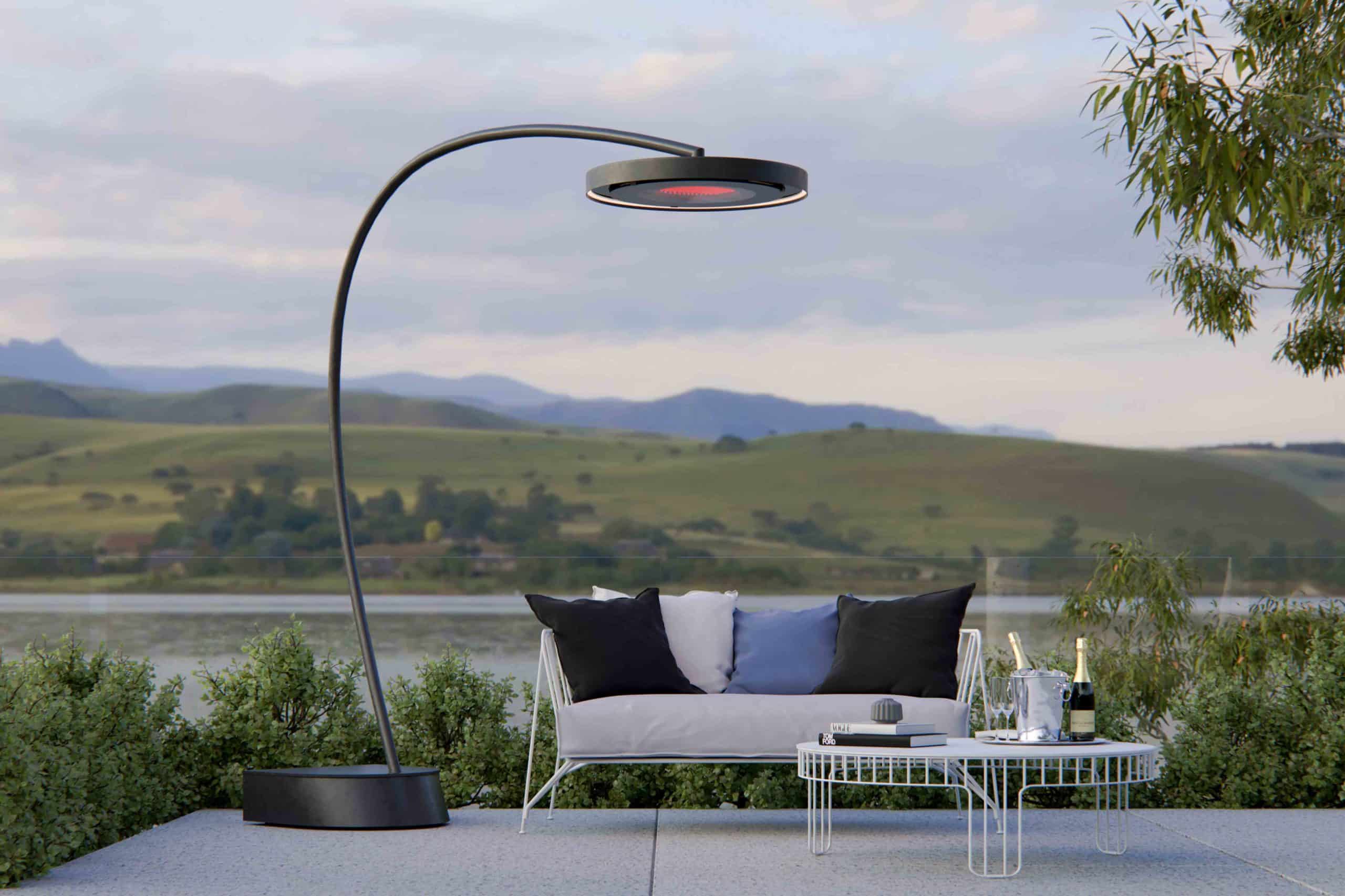
The Bromic Platinum Smart-Heat gas model is our top pick for permanent mounted gas install. Published output is 39,800 BTU on the 500 Series. The directed-infrared glass-ceramic emitter holds its heat zone in winds up to 12 mph, which is the single engineering decision that separates Bromic from everything else in the mounted category. Direct-ignition electronics with automated re-ignition means you light it once at the start of the evening and forget it — no match-start ritual.
The Platinum ships in natural gas and liquid propane. Marine-grade variant for coastal and poolside installs. Mounts to a wall, ceiling, pole or pergola post with pivot brackets so you aim the heat zone at the actual seating group instead of straight down into empty floor space. In our install experience, a Platinum wall-mount above a 10-by-10 dining area in a Pacific Northwest or Northeast winter holds people comfortable down to about 35 degrees ambient. Below that you want a second unit or you supplement with convective heat.
The honest downsides: install is not optional. Budget $200 to $600 for the gas line run on top of the heater cost, and the fitter has to confirm the pressure regulator matches your supply. Paper warranty is 2 years parts, 1 year labor — shorter than Infratech’s 10-year element warranty but in our service history the real-world service life is a decade plus even on heavy commercial deployments.
Best Freestanding Flame Tower — Lava Heat Italia 2G
The Lava Heat Italia 2G at 66,000 BTU is the strongest freestanding flame-tower pick for 2026 and the right answer when the heater is the design centerpiece. Real visible flame inside the glass column, stainless-steel finish, casters so one person can roll it from the garage to the patio without the two-person lift most freestanding heaters demand. 66,000 BTU is the residential ceiling for freestanding output in this category — anything higher gets into commercial-only models.
The 2G covers roughly 650 square feet of patio under moderate conditions — a 15-foot-radius seating group with overlap buffer. In open patios with wind above 10 mph, derate the effective coverage by 40 to 50 percent — the convective component of the flame is lost to any real air movement. If your patio sits in a wind corridor, the 2G is still beautiful but a mounted Bromic Platinum will out-heat it. Match the heater to the conditions.
Where the 2G wins: visual presence. On a patio where guests notice the heater, the Lava Heat flame-tower reads as architecture rather than appliance. The Opus and Capri siblings down the lineup (56,000 and 42,000 BTU) carry the same aesthetic at lower output tiers if the 2G is overspec for your group size — see our BTU sizing guide for the real coverage math.
Best 240V Electric Infrared — Bull Power Warm 48"
The Bull Power Warm 48-inch 5000W dual-element electric infrared is the install-friendly electric pick when a 240V circuit is already available at the install location. 5000W of real output across two independently-switched elements, dual-mount hardware for wall or ceiling, outdoor-rated electronics. The Bull Power Warm is the right call when you want electric infrared without the Bromic premium, when the install site is a 240V-ready outdoor kitchen, and when 48 inches of linear coverage fit the pergola or cabana better than a round emitter.
The dual-element design matters. In mild conditions you run one element at 2500W. In cold conditions you switch both on at 5000W. That cuts operating cost in half for the shoulder-season nights where you want some supplemental heat but not full output. Round-emitter electric heaters are either on or off.
The 240V-only spec is both the Bull’s biggest advantage and the install gotcha. On an outdoor kitchen that already has 240V for a built-in refrigerator or griddle, adding a Power Warm is a 20-amp branch circuit — straightforward for a licensed electrician. If the install site has only 120V service, you are running a new 240V circuit from the panel before the heater goes up, and that cost usually lands between $400 and $900 depending on routing. Confirm the circuit before ordering.
BTU to Coverage Area — The Honest Math
Most buying guides publish BTU-to-square-feet charts that assume still air and an enclosed space. Real patios have wind, variable ceiling height, and open sides. The honest 2026 math:
Still air, enclosed porch or sheltered patio: 10,000 BTU per 100 square feet of area you want to feel warm. A 20-by-20 enclosed porch needs about 40,000 BTU — one Bromic Platinum gas 500 Series or a Lava Heat Capri at 42,000 BTU covers it comfortably.
Open patio, moderate conditions: add 30 percent to the still-air number. The same 400-square-foot patio now needs about 52,000 BTU — one Lava Heat Palermo at 51,000 BTU or two mounted Bromic Tungsten units at 29,000 BTU each pointed inward from the corners.
Cold climate below 40 degrees ambient, open patio: add another 20 percent. The 400-square-foot patio now needs about 65,000 BTU — a Lava Heat 2G at 66,000 BTU, or two Bromic Platinum gas 500 Series.
Electric infrared is the exception. The published BTU-equivalent on an electric infrared unit (11,600 BTU on a 3400W Bromic Platinum Electric, roughly equivalent on the Bull Power Warm at 5000W) is not comparable to a convective gas number because the output is concentrated in a directed beam rather than radiating in all directions. For electric infrared, size by seating-group dimensions rather than total patio square footage — a 3400W unit covers an 8-by-8 seating group, a 5000W Bull Power Warm covers roughly 10-by-10.
Voltage and Ignition — The Install Gotchas
Electric patio heaters in this tier run on 240V or 208V, not 120V. Repeating that because it is where every budget-tier shopper gets caught: there is no useful outdoor-rated electric patio heater that runs on a standard household outlet. The 2500W to 5000W output demands a dedicated 240V or 208V circuit, and that circuit requires a licensed electrician in most US jurisdictions. The 208V variant exists for commercial buildings on three-phase power — residential installs are almost always 240V single-phase.
Gas ignition splits into three types. Match-light is the budget-tier mushroom heater pattern — a piezo striker clicks the pilot and you babysit the ignition. Electronic ignition with manual pilot lights the pilot once per season and the main burner on demand — this is the Lava Heat Italia pattern. Direct-ignition with automated re-ignition is the Bromic Smart-Heat pattern — the heater lights the main burner directly, holds flame on a flame-sense rod, and re-ignites automatically if a wind gust blows the flame out. In our service history, direct-ignition is where the paying-more-for-Bromic math actually earns itself back — it is the difference between a heater that works every evening and one you fight to light.
Warranty Reality Check
Published warranty terms in the 2026 field range from 1 to 10 years with wide gaps between brands.
Infratech leads the paper warranty — 10 years on heating elements. If paper warranty is the deciding factor, Infratech is the pick, and they are a strong brand in their own right on US-made permanent-mount electric. Bromic publishes 2 years parts and 1 year labor across Smart-Heat but the real-world service life is a decade-plus and the parts pipeline from Bromic’s US distributor is reliable even on 10-year-old units. Lava Heat publishes 1 year on the heater and 2 years on the burner — the burner being the most-replaced service item is honest coverage. Bull publishes 1 year limited on the Power Warm.
The budget mushroom-heater category is where you see 90-day or no-published warranty units. These exist and they technically work the first season. In our service experience, propane mushroom heaters at the sub-$300 price point are consumables — plan on replacement every 2 to 3 seasons rather than service and repair. If total cost of ownership matters, the mid-tier mounted or flame-tower units with a real warranty and real service life are usually the cheaper buy across 10 years.
What to Confirm Before You Order
Confirm the fuel decision up front. Natural gas, liquid propane, 240V electric, or 208V electric. The install cost on each is different and the heater choice downstream is fuel-specific. If a gas line is not already present at the install location, electric infrared is usually the smarter pick for a covered patio and liquid propane is usually the smarter pick for an open patio where you want higher BTU output.
Measure the real seating-group dimensions and run them through the BTU math above. Over-speccing is expensive and under-speccing leaves cold spots that no shopping comparison catches until the first cold night. For mounted installs on a pergola or covered patio, confirm the mounting surface has structural backing at the mount point — a Bromic Platinum gas is roughly 35 pounds mounted and drywall alone will not hold it.
For freestanding units, confirm the propane tank or gas line routing before the heater ships. A Lava Heat 2G runs through a standard 20-pound propane tank in about 10 hours of continuous operation on high — if you entertain weekly, plan for a second tank or a natural-gas conversion. For 240V electric units, confirm the circuit is ready and the breaker is sized correctly before ordering — a 5000W Bull Power Warm wants a 30-amp 240V breaker on 10-gauge wire.
Frequently Asked Questions
What is the best patio heater to buy in 2026?+
How many BTU do I need for a patio heater?+
Is electric or gas better for a patio heater?+
Can you leave a patio heater outside in the rain?+
What is the difference between infrared and radiant patio heaters?+
How long does a patio heater warranty last?+
Products & brands in this guide
Related reading
Ash — Ash writes the buying guides at FirePits.com — years of specifying fire features on residential installs, from urban patios to mountain properties.