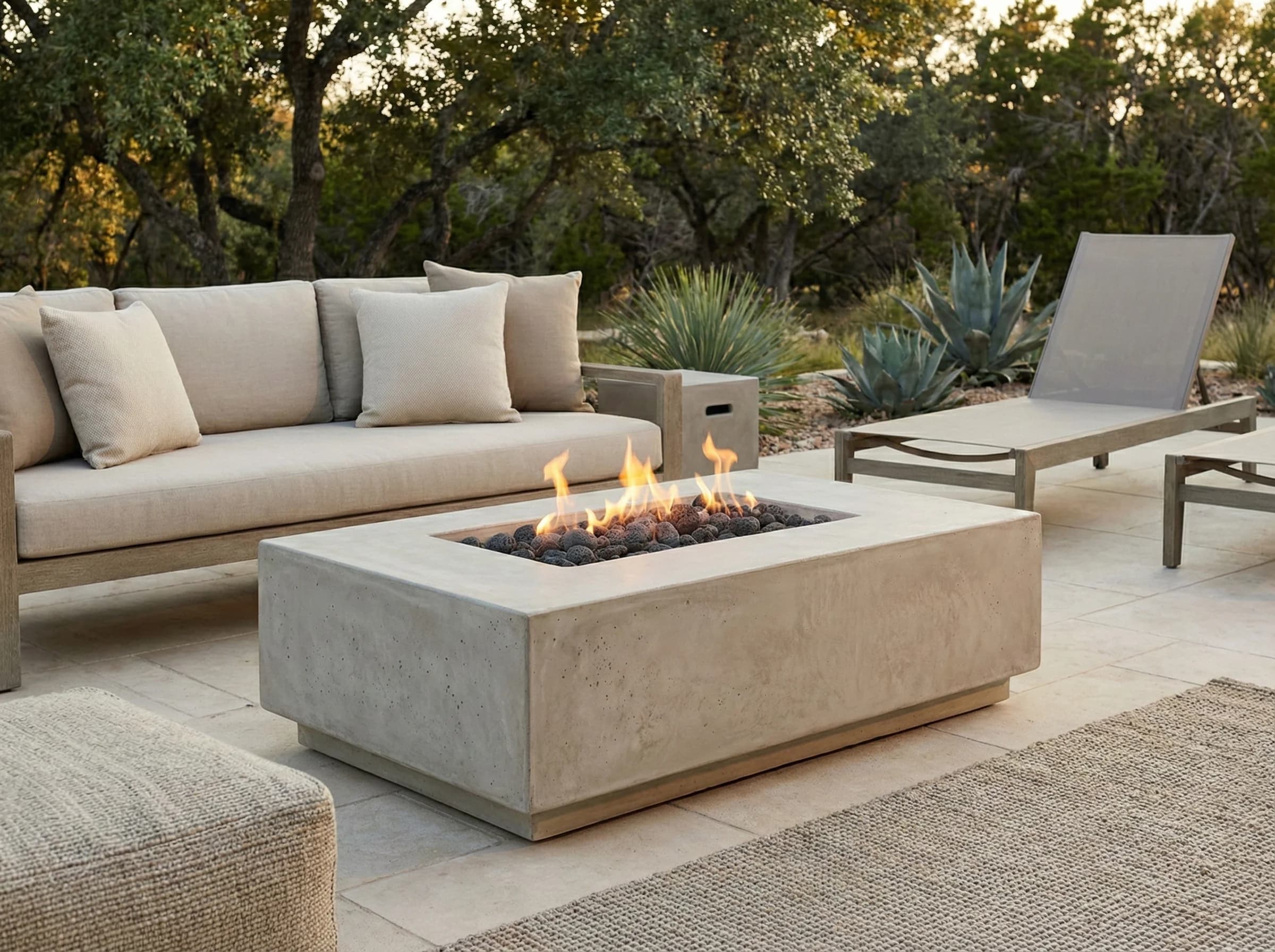
90,000 BTU Fire Pits: When They're Worth It (and When They're Not)
Short answer: A 90,000 BTU fire pit throws usable heat out to about 8-10 feet on a still night — enough to keep four people warm on a 45°F evening in short sleeves. You need a ¾" gas line (or a full-size propane tank), a taller flame will look dramatic but burn through gas faster, and you should only pick 90K if you're heating people, not decorating a patio.
The 90K BTU threshold is where a gas fire pit stops being a big candle and starts doing real work. Below 60K, you're setting a mood; above 90K, you're competing with a small patio heater. Most customers who ask us about 90K models have already tried a lower-output pit and been underwhelmed on cold nights.
What 90,000 BTU actually feels like
BTU is a measure of heat output per hour. 90,000 BTU/hr is roughly the same output as a residential furnace on high heat — but instead of pushing warm air through a duct, it's radiating heat outward in a 360° pattern from an exposed burner ring or bullet-burner grid. The numbers below are from customer feedback and manufacturer thermal test data, not marketing copy.
- Flame height at full output: 18-24" above the burner surface
- Radiant heat noticeable up to: ~10 ft from the pit at 60°F ambient
- Usable warmth (short sleeves comfortable) at: ~6-8 ft radius on a 45°F still night
- Wind sensitivity: 8+ mph wind cuts effective heat radius by 30-40%
- Gas consumption at full output: propane ~2.5 lb/hr (~5.5 hr per 20-lb tank), natural gas ~90 CF/hr
How 90K compares to 60K
The gap between 60K and 90K is bigger in practice than the numbers suggest. Flame height nearly doubles, heat radius grows by 3-4 feet, and the pit becomes something you can actually gather around in cool weather rather than glance at from your couch through a window.
That said: 60K is plenty for a small patio (~10 ft diameter) with two or three people, mild climate, and mostly ambiance use. If you're in Southern California or Florida, 60K is often the right answer. If you're in Colorado, the Northeast, or the Pacific Northwest and you want to use the pit October through April, 90K starts to matter.
Rule of thumb: add 10K BTU for every 10°F below 55°F you want to use the pit comfortably in short sleeves. A 90K pit is comfortable down to about 35°F; a 60K pit only really works above 55°F unless you're bundled up.
The gas line sizing question
You can't just plumb a 90K burner into any gas line and expect it to work. Gas volume capacity is a function of line diameter, run length, and pressure. Undersize the line and the pit will run yellow-tipped, dirty, and never hit its rated BTU. This is the single most common install mistake we see.
Natural gas rules of thumb:
- ½" line: adequate for up to 60K BTU at 25 ft
- ¾" line: adequate for 90-125K BTU at 25-50 ft (most common for 90K installs)
- 1" line: needed if the run is 50+ ft or you're feeding multiple appliances
- Always confirm with a plumber using the CSA/NFPA 54 sizing table for your utility pressure
Propane rules of thumb:
- 20-lb tank: gets you ~5-6 hours of continuous burn at 90K — fine for entertaining, tedious for weekly use
- 40-lb tank: doubles the runtime and better vapor pressure in cold weather
- 100-lb tank: what we recommend for regular 90K use — 25+ hours between fills, handles cold weather without sluggish pressure drop
- Always mount tank at least 10 ft from the pit and out of the direct flame path
Which brands make a real 90K BTU fire pit
Not every manufacturer builds to their published BTU number. These are the makers whose 90K+ models we've installed and stand behind:
The Outdoor Plus — Their bullet burner grids (rectangular and round, single and double) run from 65K up to 150K BTU. The 90K sweet spot lands in their 24" and 30" round bullet burners and the 30" x 12" rectangular. Stainless construction, robust ignition options (spark, HEI, electronic), and a spec sheet that matches what the pit actually delivers.
HPC Fire — Purpose-built for high-BTU installs. Their H-burners and interlink burners run from 90K to 350K BTU. If you want a fire pit that behaves more like a hearth than a candle, HPC is where the 90K conversation usually ends. Match burner size to pit opening (bigger opening = higher BTU needed to fill the flame footprint).
Warming Trends — Their CROSSFIRE brass burners hit 90K+ on their larger sizes (24"+ diameter) and produce visibly taller, more organic flames than a standard stainless ring. Higher up-front cost, but the flame quality is a real differentiator on a design-forward install.
When you should NOT buy a 90K fire pit
- If the pit will only be used for occasional ambiance — 45-60K delivers a nicer flame at a fraction of the gas cost
- If your gas line is ½" and running new pipe is $1,000+ — spend that budget on a larger, better-built 60K pit instead
- If you're on propane and don't want to deal with 100-lb tanks — 90K burns through 20-lb tanks fast
- If the pit is in an open, windy location — you'll lose most of the heat to convection anyway
- If the pit table is under a covered patio — 90K may violate clearance code (18-24" above the flame is typical minimum to combustibles)
Frequently asked questions
Can I hook a 90K BTU fire pit to a standard 20-lb propane tank?
Technically yes, but you'll get 5-6 hours of runtime max and vapor pressure will drop noticeably in cold weather. If you're using the pit weekly, upgrade to a 40 or 100-lb tank.
How far away should the seating be?
Sweet spot is 6-8 ft from the flame for comfort — closer and the direct radiant is intense; farther and you lose the warmth. A 6-8-person circular seating arrangement at 7 ft radius is the standard we design against.
Does a 90K pit need a special ignition?
Not required, but recommended. Manual matchlit ignition on a 90K burner is intimidating (the flame lights aggressively). Spark or HEI (high-energy ignition) is much safer at this output level and standard on premium brands.
Can I adjust the BTU output down when I don't need full heat?
Yes — most 90K burners have a control valve that throttles from ~30% to 100%. You can run at 30K BTU for a small-flame ambiance evening and dial up to 90K on a cold night. That flexibility is one of the reasons we recommend the higher-output pit over a fixed-output smaller model.
What's better — a 90K single burner or two 45K burners?
For most residential installs, a single 90K burner. Fewer failure points, one gas line, one shutoff. Two burners make sense on very long linear installations (60"+ trough-style pits) where a single burner can't cover the surface evenly.
Related guides
Pair this with our Fire Pit Sizing Guide (matches pit diameter to seating capacity), Gas vs Propane Fire Pit (fuel decision), and NFPA 54 Compliance Guide (code requirements for outdoor gas installs).