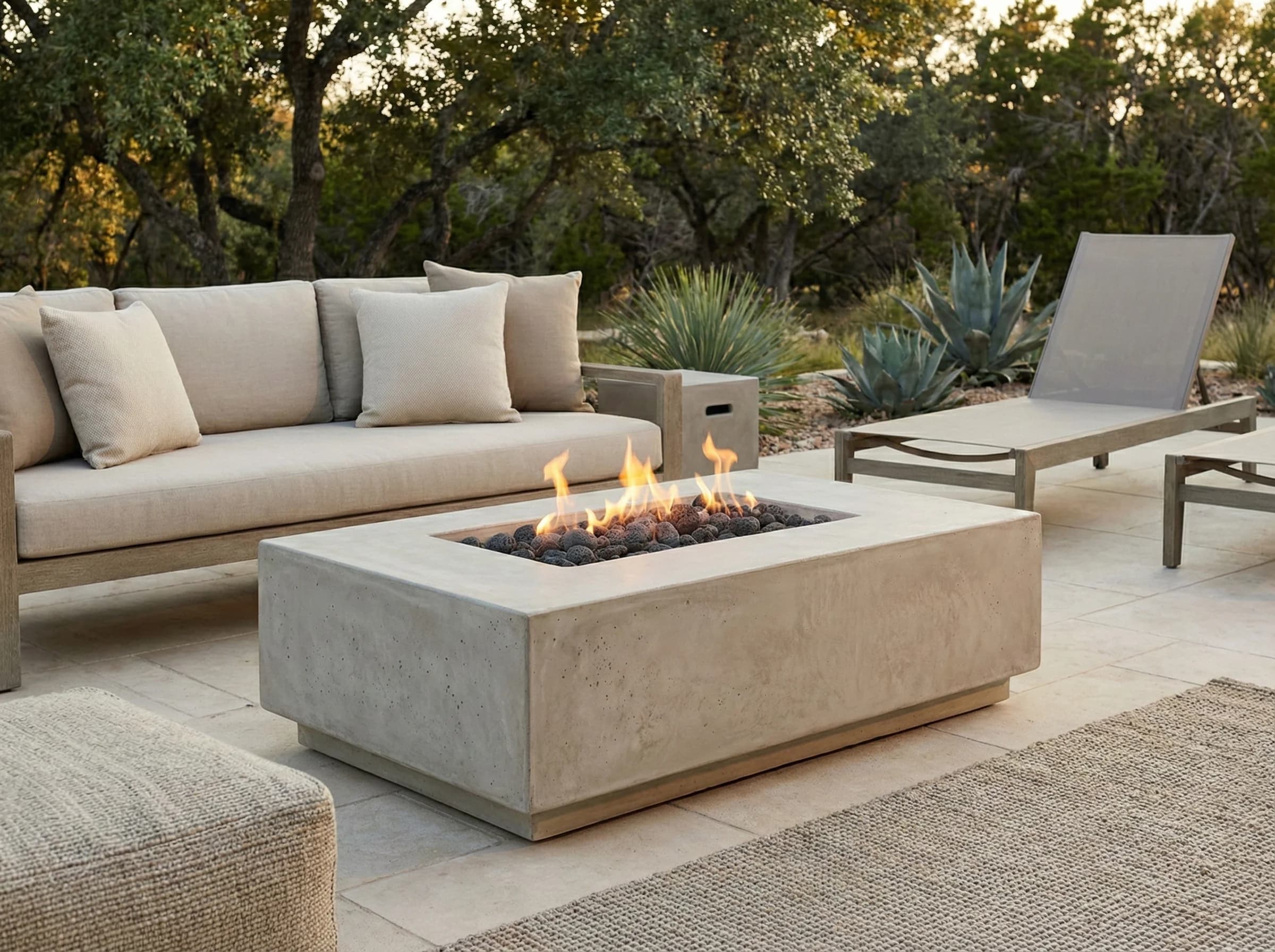
Modern Fire Pits 2026: Design, Materials, and What Actually Looks Good on a Patio
Short answer: A truly modern fire pit gets three things right: clean geometry (square, rectangle, or linear trough — not fussy shapes), one dominant material (concrete, corten, stainless, or hammered copper — not mixed), and a flame that's controlled and precise (H-burner or linear crossfire — not a chaotic burner-in-a-hole). Best picks in 2026: The Outdoor Plus Rectangular in copper or stainless, Prism Hardscapes Tavola linear, HPC Fire Rectangular H-burner in match-lit or electronic ignition.
"Modern fire pit" is one of those design categories where 80% of what's marketed as modern is actually just "contemporary" or "transitional." Real modern design is disciplined. This guide walks the actual decisions — shape, material, ignition, media, and where the pit sits in the space — so the fire pit reads as one deliberate object instead of a piece of outdoor furniture that happened to catch fire.
What makes a fire pit actually modern
Modern design has some non-negotiables. If a fire pit misses any of these, it slips into "contemporary," "rustic-modern," or something else entirely.
Clean geometry: Square, rectangle, or long linear trough. Circle if the space calls for it. No hexagons, no fluted edges, no scrollwork, no ornamental bases.
Single dominant material: One primary surface reads as modern. Concrete, corten steel, brushed stainless, or hammered copper — each works on its own. Combining three of them stops being modern and starts being fussy.
Precise flame: Linear crossfire burners or H-burners produce flame that looks intentional. Round burner rings look great in traditional pits but read as generic in modern ones. Fire glass or lava rock as media, never faux logs.
Grounded proportions: Modern pits sit low and wide. Height above the patio should be 15-20" for a lounge-around pit, 24-30" for a dining-height pit — no in-between.
Restraint in the details: Handles hidden or absent. Ignition controls hidden or flush. Access panels invisible when the pit is off. If you notice the hardware, the design is fighting the flame.
Best modern fire pit materials
Cast concrete (GFRC): the versatile default
Glass-fiber-reinforced concrete is what most modern fire pit tables use. Structurally strong, holds precise edges and sharp corners, takes color pigment cleanly, and weighs enough to feel permanent without being unmovable. The Outdoor Plus and Prism Hardscapes both make excellent GFRC modern pits.
GFRC works in almost any color palette because it reads as neutral. Charcoal, natural gray, buff, and black are the strongest modern choices. Avoid the browns and tans — they push toward transitional.
Corten (weathering) steel: the design-forward pick
Corten is the material that separates real modern design from checklist-modern. It develops a warm orange-brown patina over 6-12 months of exposure and stabilizes at a rich, matte finish that reads as intentional and expensive. Best on plazas, gravel gardens, and modern minimalist landscapes.
The tradeoff: corten runs iron-colored water for the first 6 months of weathering. If it sits on concrete or light stone, it will stain the surface below. Plan the install with 3-6" of gravel or a copper drip pan underneath during the weathering phase.
Brushed / hammered copper: the warmth without the heaviness
Copper works with modern design when it's brushed or hammered rather than polished. Polished copper reads as ornate; brushed copper reads as a considered material choice. Copper also develops a natural patina — teal-green in humid climates, warm brown in dry — which most owners embrace rather than fight.
Best paired with concrete or wood decking. Avoid setting copper directly against stainless steel accents; the tonal jump reads as unresolved.
Brushed 304 stainless steel: the low-maintenance modern
Stainless is the modern material for anyone who doesn't want to think about patina, weathering, or long-term surface changes. It stays what it is on day one for 20 years. Brushed finish (never mirror) is critical — mirror-polished stainless reads as commercial-kitchen, not modern-residential.
The Outdoor Plus builds excellent brushed stainless pits in rectangular, square, and round configurations. In coastal air, this is the material that outlasts every alternative.
The three modern fire pit shapes worth considering
Linear trough (48-60" long): the statement piece
A linear fire pit is the most decisively modern shape. Long, narrow, low profile — usually 48-60" long by 12-16" wide. Best sited along a sightline (against a wall, at the edge of a pool, dividing a seating area from a lawn). The flame reads as a horizontal line rather than a point of interest.
Prism Hardscapes Tavola is our go-to linear pit — 60" concrete trough with a crossfire burner that produces a controlled sheet of flame. The Outdoor Plus Ready-to-Finish rectangular series is the higher-customization option if you want a specific finish or color.
Square (36-48"): the seating-area anchor
A square fire pit anchors a seating arrangement of four chairs. 36-48" is the right size — bigger than that starts to overwhelm the seating group; smaller than that loses presence. Best in concrete GFRC or brushed stainless.
Height matters: 18-22" for lounge chairs, 28-32" for dining chairs, 40" for bar-height stools. Match the fire pit height to the chair height, not the other way around.
Rectangular (36" x 20" or larger): the coffee-table replacement
A rectangular pit sits like an outdoor coffee table between two facing sofas. Same footprint as a coffee table (roughly 20-24" wide, 36-48" long), same height (16-20"), just with a controlled flame in the middle. This is the format that made "fire pit table" a mainstream category.
The three modern fire pit brands worth buying
The Outdoor Plus (TOP): the customization leader
TOP is the brand for anyone who wants to specify exactly what they're getting — shape, size, material, finish color, burner type, ignition method. Almost everything they build is made-to-order. Ready-to-Finish concrete pits ship in 4-6 weeks; stainless and copper builds run 8-12 weeks.
Best TOP models for modern: Rectangular Copper (36-72" widths available), Ready-to-Finish Square in GFRC concrete, Brushed Stainless Round for coastal installs. Their Match Lit ignition is the modern-minimalist choice — no exposed controls, just a striker access point.
Prism Hardscapes: the design-first specialist
Prism builds a smaller catalog than TOP but every model is deliberately designed rather than configured. Their Tavola linear pit is the modern-fire-pit poster child — sold at every high-end outdoor design showroom in the country. Piazza square and Moderno rectangular round out the modern line.
Prism ships from stock more often than TOP, so lead times are shorter (2-4 weeks typical). The tradeoff is less customization — you pick from their designs, not build your own.
HPC Fire: the burner-tech leader
Hearth Products Controls (HPC) makes the best burner in the industry — their H-burner and crossfire ring burners produce more even, controlled flame than any competitor. If you're buying a modern fire pit primarily for how the flame looks, an HPC burner (either as their finished pit or retrofitted into a Ready-to-Finish enclosure) is the tell.
HPC's finished pits lean traditional in most of their catalog, but the Rectangular H-Burner series and their Fire Pit Table line are legitimately modern. Electronic ignition option is worth the upgrade if you don't want to strike a match every time.
Match-lit vs electronic ignition
Match-lit ignition looks cleaner (no ignition controls visible) and costs less ($200-400 savings). Trade-off: you strike a long lighter or fireplace match at a gas port every time you start the pit. Electronic ignition (push-button start) costs more, adds a small control panel that has to hide somewhere in the pit design, and eventually needs battery replacement.
For modern design: match-lit if the pit is used casually, electronic if it's used frequently or if guests will operate it. AWEIS (all-weather electronic ignition system) from HPC is the electronic option that actually works reliably in wind and rain.
Fire media: glass vs lava rock
Fire glass is the modern choice — small tempered glass pebbles in one solid color that reflect and refract flame. Best colors for modern design: black, clear, cobalt blue, or copper. Avoid multicolor mixes; they read busy.
Lava rock is the more traditional media — natural texture, matte finish, tan-to-black color range. Works with concrete and corten pits; less right for stainless or copper.
Never use river rock or landscape gravel as fire media. Trapped moisture in porous rock causes explosive failure at fire pit temperatures — a documented safety hazard.
Sizing to the space
- Small patio (100-200 sq ft): 24-30" square or round pit, low profile
- Medium patio (200-400 sq ft): 36-42" rectangle or square, dining or lounge height
- Large patio / plaza (400+ sq ft): 48-60" linear or 42"+ square, statement piece
- Poolside / outdoor room: linear trough 48-72" along a sightline
Frequently asked questions
How much should I spend on a modern fire pit?
$1,500-3,000 gets you a Ready-to-Finish concrete or GFRC pit with a quality burner. $3,000-6,000 gets you a fully-finished designer piece from Prism or an entry Copper/Stainless from TOP. $6,000-12,000 is flagship territory — custom fabrication, premium materials, electronic ignition, integrated wind guards. Above $12,000 is bespoke architectural work.
Do I need natural gas or is propane fine for a modern pit?
Both work. Natural gas is a permanent install that requires a plumber — no tank to hide, unlimited runtime. Propane requires a 20-lb tank hidden in the pit base (all TOP and Prism pits accommodate one) — burns 8-10 hours per tank at moderate flame.
Can a modern fire pit be built into a hardscape?
Yes — TOP's Ready-to-Finish and HPC's raw burner pans are designed for exactly this. Your mason builds a stone or concrete enclosure to spec and drops the burner assembly in. Requires clearance to combustibles compliance and NFPA 54 gas line sizing — worth reading our clearance and gas line guides before committing.
What about wood-burning modern fire pits?
Solid Cast, Ohio Flame, and similar make legitimate modern wood-burning pits — corten steel bowls with clean geometry. They deliver a very different experience: real wood smoke, more heat, no on-off convenience. Great as a secondary pit or in a landscape where gas isn't an option, but for most residential modern designs, gas is the primary.
Related guides
For heat output → 90,000 BTU Fire Pit Buyer's Guide. For safety compliance → Fire Pit Clearance to Combustibles. For gas line sizing → NFPA 54 Fire Pit Installation. Browse modern fire pits at firepits.com.