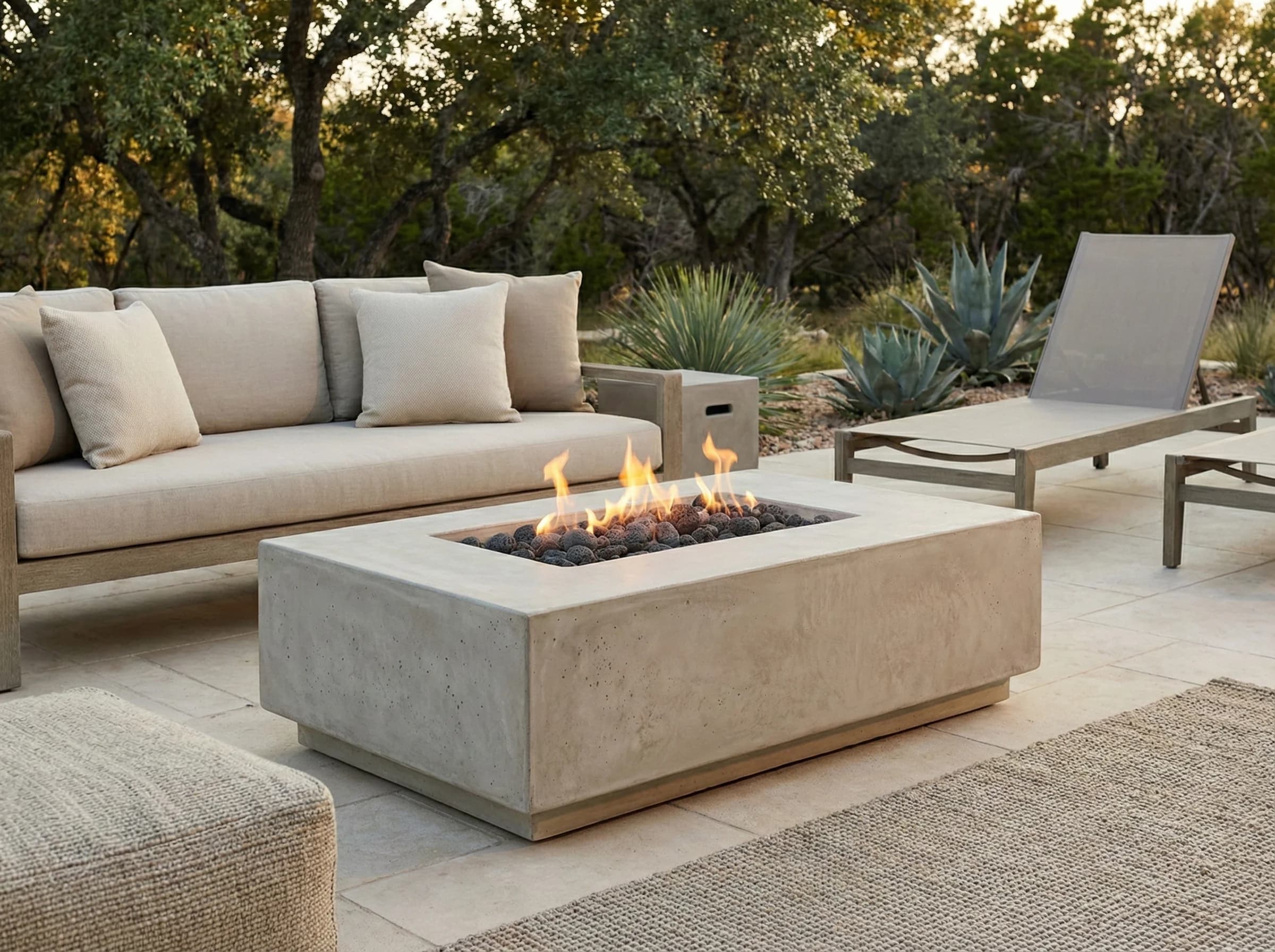
Pool Fire Bowls: Buyer's Guide to Sizing, Materials & Install
Short answer: Two matched bowls flanking the pool entry, 18-24 inches in diameter, in copper or GFRC concrete, on a natural-gas line with an outdoor-rated shutoff valve within 10 feet. Symmetry is what makes the install read as designed. A single fire bowl at the corner of the pool looks accidental.
Fire bowls at pool corners are the highest-ROI visual upgrade you can make to an existing pool deck. Nothing else — no landscaping, no umbrella, no pool light — comes close to the impact of a flame at water level after sunset. We spec these on almost every high-end pool remodel.
But the wrong bowl in the wrong spot on a pool deck looks worse than nothing. Here's how to get it right.
The single most important rule: install in pairs
Every pool fire bowl install we've done that reads as truly designed uses two matched bowls, flanking either the pool entry or the pool's short axis. A single fire bowl at one corner looks like an afterthought no matter how expensive it was.
Budget for two. If two doesn't fit the space, look at a linear trough burner running the length of one edge instead — that's the other design that works. Never one bowl.
Sizing the bowl to the pool
Fire bowls at pool decks read visually against the pool as their backdrop, not against the patio. That means smaller bowls disappear on larger pools. Approximate rule of thumb:
- Small pool (under 12 ft on the long axis): 18-inch bowls
- Medium pool (12-20 ft): 20-24 inch bowls
- Large pool (over 20 ft): 24-30 inch bowls
- Spa or plunge pool: 14-18 inch bowls (smaller reads as intentional at this scale)
Bigger bowls hold more flame, which reads better against water. If you have to choose between 20 and 24 inch on a medium pool, go 24.
Best materials for pool-adjacent installs
Hammered copper — the design-forward choice. The Outdoor Plus makes 20-30 inch copper bowls that hold up outdoors in chlorine-adjacent environments with no maintenance. Copper develops a green patina over 2-3 years; some owners love it, some polish annually. Highest visual impact and priced accordingly ($1,800-3,500 per bowl).
GFRC concrete — the architectural choice. Prism Hardscapes Cilindro, Rotondo, and Moderno bowls in glass-fiber concrete are freeze-thaw stable, splash-tolerant, and available in warm or cool finish tones that match modern pool decks ($1,400-2,800 per bowl). The architects' pick.
Stainless steel — the durability play. HPC Fire and The Outdoor Plus both sell 304 stainless bowls for coastal or high-humidity pool installs where copper's patina or GFRC's porosity aren't ideal. Very clean modern look ($1,600-3,000).
Cast bronze / heritage metals — the trophy install. Custom orders 6-12 weeks; expect $4,000+ per bowl. For estate-tier projects only.
Skip anything cheaper than a premium brand for a pool install. Budget fire bowls (steel with paint, thin-wall stainless, imports) fail visually and structurally against chlorine air within 2-3 seasons.
The install: gas line, valve, and burner
Every pool fire bowl install needs three things beyond the bowl itself:
1. Natural gas or propane run to each bowl. Propane is portable and fine for isolated poolside installs — a 20-lb tank sits in a hidden cabinet nearby. Natural gas is cleaner (no visible tanks) but requires a permitted plumber to run the line under the pool deck to each bowl. Budget $500-1,500 per bowl for the NG install depending on distance from the meter and if the deck can be trenched.
2. Waterproof shutoff valve within 10 ft of each bowl. Local code varies but every US jurisdiction requires an accessible manual shutoff. Best practice: install a keyed valve so kids can't accidentally turn it on. Add a small stainless valve access hatch flush with the deck.
3. CSA-listed burner with electronic ignition. Push-button or remote ignition, not manual matchlit — you can't safely lean over the pool with a lighter. The Outdoor Plus, HPC Fire, and Warming Trends all sell burner kits engineered for outdoor use around water.
The design detail nobody tells you about
The bowl needs to sit at a height where the flame reads AGAINST the water, not above it. That usually means the bowl top surface at 18-22 inches above the pool coping (the stone edging). Too low and the bowl is hidden by the coping when viewed from the pool; too high and it hovers awkwardly.
The trick is bowl height + pedestal or plinth base. Most premium bowls ship with a shorter integrated base than you want for a pool install. Either buy a taller pedestal accessory from the same brand, or set the bowl on a masonry base you build to match your coping height.
Real-world install combinations that work
- Prism Cilindro 36 on stone plinth, pair flanking pool steps, natural gas — modern architectural look
- The Outdoor Plus 24-inch copper bowl on integrated stand, pair at long-axis midpoints, propane — warm traditional look
- Warming Trends CROSSFIRE burner in custom GFRC bowl, pair at deep-end corners — dramatic flame character
- HPC Fire 30-inch stainless linear trough along one edge — modern pool-house look, single-bowl alternative
What we don't recommend for pool installs
- Fire pits with wood-burning inserts — falling ash near the pool is a disaster
- Bowls smaller than 18 inches — invisible from anywhere but standing next to them
- A single bowl in a corner — reads as an afterthought no matter the material
- Match-lit ignition anywhere near the pool coping — safety issue
- Any bowl without a proper drain hole in the burner pan — water pools inside during rain
Budget guide
For a pair of premium pool fire bowls installed, all-in with gas plumbing:
- Entry premium (GFRC): $4,000-7,000 (bowls $3-5K + install $1-2K)
- Mid-tier (copper or stainless): $6,000-10,000 (bowls $4-7K + install $2-3K)
- Design-forward (large bowls + custom pedestals): $10,000-18,000
- Bespoke (cast bronze, custom fabrication): $20,000+
Frequently asked questions
Will chlorine damage the fire bowl?
Chlorine air is corrosive over time on cheap materials — thin stainless, painted steel, low-grade copper. Premium brands (The Outdoor Plus, Prism, HPC Fire, Warming Trends) use materials rated for coastal or humid outdoor use and handle chlorine environments fine for 15+ years.
Can I put a fire bowl right at the pool edge?
Yes — the standard install is 6-12 inches from the pool coping. Just make sure the bowl is stable (heavy enough or bolted) and the burner is set up so a falling drink glass or windy day can't blow embers into the water. On propane bowls specifically, mount the tank at least 10 feet from the bowl and out of the direct flame path.
Do I need a permit?
For natural-gas bowls: yes, in every US jurisdiction — the gas line requires a plumbing permit and often an electrical permit if the ignition is 110V. For propane bowls with an external tank: usually no permit for the bowl itself, but check local code on where the tank sits. When in doubt, call the local building department.
Can I retrofit fire bowls to an existing pool without ripping up the deck?
Propane setups yes — tank + regulator + bowl and you're done, no deck trenching required. Natural gas retrofits are harder — some existing pool decks route a gas line via trenching the perimeter; others require breaking pavers. Budget an extra $500-1,500 vs a new-build install for the retrofit complexity.
What's the biggest install mistake?
Buying one bowl instead of two. The second-biggest is buying bowls too small for the pool scale. Both mistakes are fixed by measuring the pool axis before ordering and always ordering matching pairs.
Related guides
For more on burner and BTU sizing: 90,000 BTU Fire Pits Buyer's Guide. For material comparison: Corten vs Stainless Steel Fire Pits. For pool + deck integration on the natural-gas side: Gas vs Propane Fire Pit.