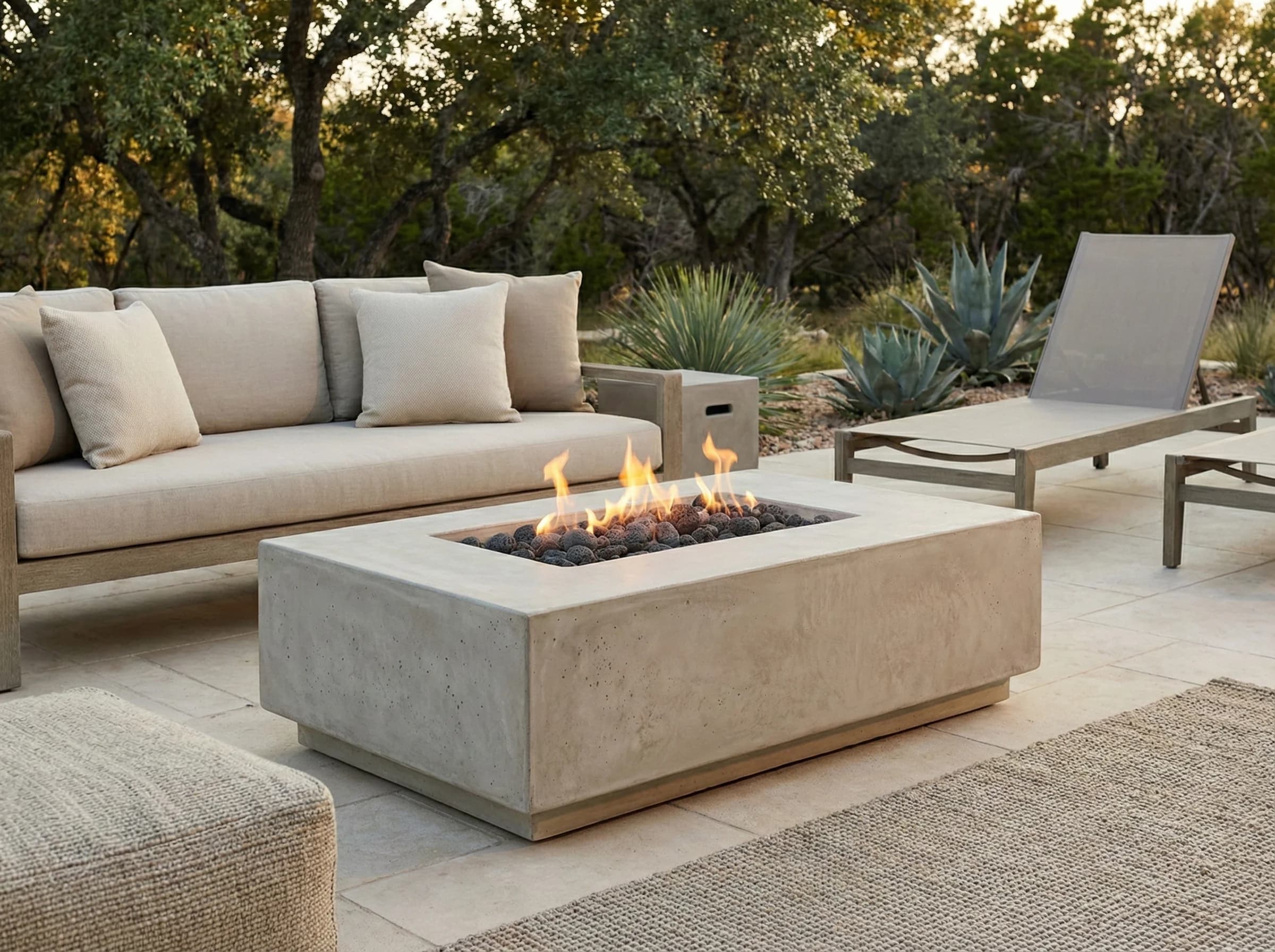
Wood-Burning vs Gas Fire Pits 2026: Which One Should You Buy?
Short answer: Gas fire pit if you want to press a button and enjoy a fire in 30 seconds — clean, controllable, works anywhere gas or a propane tank does, no smoke to bother the neighbors, no ash to clean up. Wood-burning fire pit if you want the real experience — actual wood smoke, crackle, ability to cook over it, higher heat output, no fuel bill. Most residential buyers under 40 pick gas; most rural / cabin / large-property buyers pick wood.
We sell both. Ohio Flame is our top wood-burning line; The Outdoor Plus, Prism Hardscapes, and HPC Fire cover our gas lineup. Neither is objectively better — they solve different problems. This guide walks the actual decision so you don't buy the one you'll regret.
Wood-burning fire pits: the honest tradeoffs
A wood-burning fire pit is a metal or masonry vessel — usually corten steel, stainless, or fabricated stone — that you fill with seasoned hardwood and light. The fire burns 45-90 minutes per load and throws real heat (400-600°F at the surface). Everything about it is analog.
Pros:
- Real smoke, real crackle, real fire — the sensory experience gas can't replicate
- No fuel line, no tank, no gas plumbing — sits anywhere with clearance to combustibles
- Higher heat output than gas — a well-loaded 36" wood pit is warmer than a 150K BTU gas table
- You can cook over it — grates and skewers work; add a Solo Stove-style vent design and it doubles as a cooktop
- $0/hour operating cost if you gather your own firewood; $2-4/hour if you buy
Cons:
- 20-30 minutes to light and reach full heat; 30-60 minutes to safely leave unattended
- Wood storage — a cord of hardwood takes up 4x8x4 feet of dry, covered space
- Ash cleanup — every burn produces 1-2 cups of ash; wet ash gets messy
- Smoke drift — neighbors within 50 feet may object; some HOAs and municipalities ban wood-burning in residential zones
- Weather-dependent — hard to light in wet or windy conditions
- Fire glass / decorative media not possible; the fuel is the aesthetic
Gas fire pits: the honest tradeoffs
A gas fire pit is a burner (natural gas or propane) sitting in a vessel of fire glass, lava rock, or ceramic media. Push a button (electronic ignition) or strike a match (match-lit), and you have flame in 30 seconds. Turn a knob to adjust height. Shut off completely when done.
Pros:
- 30 seconds from off to flame; 5 seconds from flame to off
- Zero smoke, zero ash, zero cleanup — media stays in place for years
- Flame height adjustable — low ambient for dinner, full flame for warmth
- Safe to walk away from immediately; no ember watch, no wet-blanket protocol
- Works in wind, rain, snow — controlled combustion doesn't care about weather
- Fire glass in any color — modern-design flexibility wood can't match
- Legal in most HOA / condo / apartment-balcony contexts where wood is banned
Cons:
- Fuel cost: propane runs $2-4/hour at moderate flame; natural gas about half that
- Requires a gas line install ($500-1,500) or ongoing tank swaps
- No wood smoke, no crackle — the experience is quieter and more decorative
- Electronic ignition eventually needs battery / igniter replacement (5-10 year interval)
- Not a cooking surface — flame temp is too controlled and media traps heat
Cost of ownership: 5-year projection
Comparing a typical residential setup — 36" fire pit, used 40 hours/year (about once a week, April-October).
Wood-burning ($800 pit, self-gathered wood): $800 upfront · $0/year fuel · $0/year maintenance = $800 total over 5 years.
Wood-burning ($800 pit, purchased firewood): $800 upfront · $200/year fuel (10 bundles at $20) · $0 maintenance = $1,800 total.
Gas fire pit ($2,500 pit, propane tank): $2,500 upfront · $200/year propane (20 tank refills) · $50 5-year igniter kit = $3,550 total.
Gas fire pit ($2,500 pit, natural gas line): $2,500 pit + $1,000 gas line = $3,500 upfront · $100/year gas · $50 5-year igniter = $4,050 total.
Gas is more expensive to buy and own. What you're paying for: convenience, cleanup elimination, and the ability to have a fire on impulse.
Permit + regulation reality check
This is the deciding factor for a lot of buyers who don't realize it until they're halfway through the decision. Local ordinances vary widely.
- Most metro areas: wood-burning fire pits allowed on private property with 25-foot clearance from structures, subject to burn-day restrictions (spare-the-air days)
- California, especially LA/Bay Area/Central Valley: wood-burning increasingly restricted or banned in residential zones
- Colorado, Arizona: seasonal wood-burn bans during fire season (June-October in many counties)
- HOA communities: many ban wood-burning outright; gas is almost always allowed
- Apartment / condo balconies: gas propane fire pits typically allowed with restrictions; wood almost never allowed
Check your local air quality management district before committing to wood. A wood-burning pit you can't legally light is an expensive lawn sculpture.
When wood-burning is clearly the right pick
- Rural or acreage properties with no near neighbors
- Cabin / vacation home use where the fire IS the entertainment
- You already have a wood source (property with hardwood trees, family sawmill, cheap local cordwood)
- The sensory experience of real wood fire is non-negotiable
- You want to cook over the fire — Dutch ovens, cast-iron skillets, campfire cooking
When gas is clearly the right pick
- Suburban or urban lot with neighbors within 100 feet
- HOA community or condo/apartment context
- You use the pit spontaneously — Friday dinner, weekend afternoon, one drink after work
- Modern-design outdoor room where clean flame + fire glass reads better than a stone bowl
- You already have natural gas at the house — the line install is trivial from an existing meter
- Anywhere seasonal burn bans would rule out wood for months at a time
Hybrid: wood + gas together
If the budget allows, some buyers install both — a gas fire table on the primary patio for spontaneous use, plus a wood-burning fire pit in a secondary yard area for occasional real-fire nights. It's a legitimate answer for larger properties and gets you the best of both without a compromise pick.
Our top picks in each category
Wood-burning: Ohio Flame Patriot 36" ($749) — American-made corten steel, patinas beautifully, lifetime construction. Full breakdown in our Ohio Flame Patriot vs Liberty guide.
Gas (mid-range): Prism Hardscapes Piazza 32" ($1,999) — GFRC concrete, 65K BTU, modern square silhouette. See our Best Gas Fire Tables 2026 for the full ranked lineup.
Gas (premium): The Outdoor Plus Rectangular Copper 72" ($6,499) — statement centerpiece, 120K BTU, hammered copper that patinas over 12-18 months.
Frequently asked questions
Can I convert a wood-burning fire pit to gas?
Sometimes — depends on the pit's construction. Metal pits with a flat bottom can accept a gas burner insert (Hearth Products Controls sells retrofit kits from $300). Bowl-shaped or contoured pits usually can't accommodate the flat burner pan. A gas line to the pit location is a separate install.
Are gas fire pits as warm as wood?
Not usually. A well-loaded 36" wood-burning pit throws 40,000-60,000 BTU sustained; the same-sized gas pit is typically 60,000-90,000 BTU rated but delivers less felt heat because the flame is more controlled and less radiant. For pure warmth output, wood wins.
Can I use a gas fire pit under a covered patio?
Yes if the roof is 10+ feet above the flame and the space has cross-ventilation. Wood-burning under a covered patio is almost never safe — smoke has nowhere to go. See our clearance to combustibles guide for specifics.
How long does a propane tank last on a gas fire pit?
A 20-lb tank runs 6-10 hours at full flame; 12-15 hours at moderate flame. For weekly use (2-3 hours per session), a tank lasts about a month.
Related guides
For gas fire table picks → Best Gas Fire Tables 2026. For modern-design direction → Modern Fire Pits 2026. For wood-burning brand deep-dive → Ohio Flame Fire Pits Review. For BTU vs heat output → 90,000 BTU Fire Pit Buyer's Guide. Browse all fire pits at firepits.com.