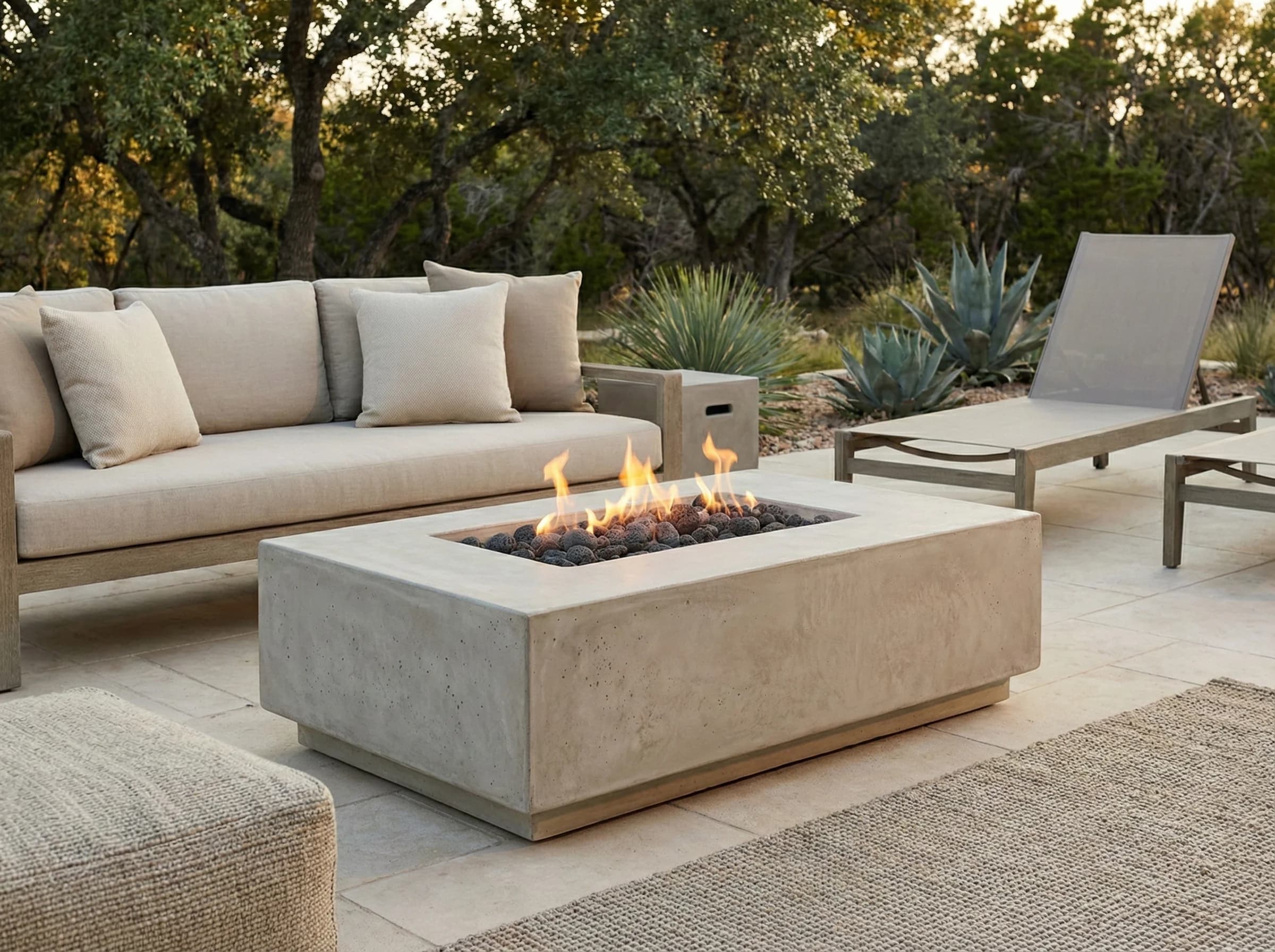
Fire Pit Clearance to Combustibles: What Local Code Actually Requires
Short answer: 10 feet from any structure (house wall, wood fence, wood deck edge, or vegetation) for wood-burning fire pits. 3-6 feet is often acceptable for gas fire pits with manufacturer clearance published. Overhead clearance to combustible covered patio: 18-24 inches minimum above the top of the flame. Local code beats every rule of thumb — always confirm with your municipal building department before you install.
The 'leave 6 feet' clearance advice you see everywhere is not code — it's a rough guess that ignores fuel type, structure material, and your local amendments. This guide covers what actually matters when you're planning or defending an install.
The 10-foot rule (and when it varies)
Most US jurisdictions default to a 10-foot horizontal clearance from any combustible structure for wood-burning fire pits. That means 10 feet from:
- The house wall (any siding — wood, vinyl, fiber cement)
- Wood or composite decks (edge of decking, not the edge of the joist)
- Wood fences (any pressure-treated or cedar fence)
- Soft plantings that ignite readily (dry grass, shrubs, mulch beds)
- Any freestanding wood structure — pergola posts, gazebo footings
For gas fire pits (natural gas or propane), the number drops — often 3-6 feet if the manufacturer publishes a specific clearance for that model. Gas produces no embers, no popping wood, and dramatically less radiant heat at the same BTU rating, so codes distinguish it from wood-burning.
Clearance table by structure and fuel
Approximate defaults — always confirm with local code + manufacturer spec:
House wall (siding): 10 ft wood-burning · 4-6 ft gas (per manufacturer)
Wood deck edge: 10 ft wood-burning · 3-6 ft gas · special heat shield rules apply on wood decks (Trex, IPE, cedar, pressure-treated pine all combustible)
Wood fence: 10 ft wood-burning · 4-6 ft gas
Vegetation (dry grass, shrubs, mulch): 10 ft any fuel — plantings burn regardless
Overhead combustible cover: 18-24 inches minimum above flame · check hood height + roofline of the covered structure
Freestanding pergola posts: 10 ft wood-burning · 3-6 ft gas · watch overhead cover if pergola has a solid roof
Concrete or stone patio surface: 0 ft — non-combustible; fire pit can sit on directly
Adjacent BBQ or outdoor kitchen: typically 24-36 inches from cooking appliance (fuel gas source coordination)
Fire pit ON a wood deck — the special rule
Installing a fire pit directly on a wood or composite deck is where most installs go wrong. The fix isn't 'just be careful' — it's a heat shield or protective mat rated for outdoor deck use.
- For wood pits: elevate the pit on ceramic legs (2-3 inches of air gap) AND put a fire-rated ember mat (18" larger than pit footprint) under it. Don't skip either.
- For gas pits: still use a mat OR install on a stone tile paver directly on the deck to break heat contact. Manufacturer spec supersedes rule of thumb.
- Composite decking (Trex, Fiberon) is more heat-sensitive than wood — spec sheet specifically prohibits fire pits without the manufacturer's approved barrier system.
- Pressure-treated wood decks — treated for rot, not fire. Same clearance rules as untreated wood.
Overhead clearance for covered patios
Any solid roof (metal, tile, asphalt shingle, wood beam ceiling) above the fire pit requires overhead clearance — typically 18-24 inches above the top of the flame under normal operation.
If the ceiling is combustible (wood beams, wood tongue-and-groove, plywood underlayment), the clearance grows to 36+ inches AND many jurisdictions require an outdoor-rated vent hood above the pit. Open-air pergolas (no solid roof) don't have overhead clearance rules — smoke and heat vent up freely.
This is where most 'covered patio fire pit' installs fail inspection. If you're building a covered outdoor room and planning a fire pit under it, engage a plumber AND a building inspector before framing the roof structure.
How to actually check your local code
The 10-foot rule is a starting point. Your specific jurisdiction may adopt IRC (International Residential Code), IFC (International Fire Code), or a state amendment that changes the numbers. Steps to confirm:
- Google '[your city name] outdoor fire code' — many municipalities publish the exact text
- Call the local building department during office hours — 5-minute conversation, they'll cite the exact section
- If pulling a permit for a bigger install (built-in gas, structural masonry surround), the plan reviewer will confirm clearance as part of the review
- For rural / county jurisdictions: state fire marshal's office is the fallback if no municipal code exists
- HOAs sometimes have stricter rules — check CC&Rs before you dig
Manufacturer clearance specs — what to look for
Every premium fire pit (Ohio Flame, Prism Hardscapes, The Outdoor Plus, HPC Fire, Warming Trends) publishes a per-model clearance in the install manual. Manufacturer clearance supersedes the generic rule of thumb — often the manufacturer has tested the pit's radiant heat pattern and can safely reduce clearance to 3-6 feet on gas pits.
- Ohio Flame Patriot / Liberty: 10 ft to combustibles (wood-burning, per manufacturer)
- Prism Hardscapes GFRC fire tables: 4-6 ft to combustibles (gas)
- The Outdoor Plus fire bowls: 3-6 ft per model (varies by burner size and material)
- HPC Fire: model-specific, always published in the owner's manual
Pull the actual manual for your model — never assume, and never quote 'my dealer said 4 feet' at inspection. Bring the PDF.
Frequently asked questions
Do I need a permit for a fire pit install?
Freestanding wood-burning fire pit on a stone patio: usually no permit required. Built-in gas fire pit that needs a gas line connection: YES — the gas line requires a plumbing permit in every US jurisdiction. Structural masonry surround (concrete block + veneer): often a building permit as well. Always call the building department to confirm — permit costs are usually $50-200 vs $500-1500 for retroactive compliance if inspection catches an unpermitted install.
Can I put a fire pit under a solid-roof pergola?
Yes if you have 18-36 inches of overhead clearance to a non-combustible ceiling material AND an outdoor vent hood if the ceiling is combustible. Under a wood-beam pergola with a solid roof, most manufacturers say no — the radiant heat + smoke plume damages the wood over time even if it doesn't ignite.
What's the clearance to a swimming pool?
6-10 ft is standard, mostly for splash-water protection of the burner ports rather than fire clearance. Pool decks are typically stone or concrete (non-combustible) so structural clearance doesn't apply. See our Pool Fire Bowls guide for the full setup.
Does the clearance change with wind direction?
Code doesn't distinguish, but common sense does. If you're on the leeward side of a windy patio, the effective safe distance from a wood-burning pit doubles for ember drift. Gas pits don't produce embers so wind matters less for clearance (more for flame stability).
What about my HOA — can they set stricter rules?
Yes. Many HOAs prohibit wood-burning entirely, require specific gas-only pit models, or require clearances well beyond code (some go to 20 ft). Check the CC&Rs before you buy — a $3K fire pit that violates HOA rules is expensive art.
Related guides
For code-compliant gas fire pit installs: NFPA 54 Outdoor Fire Pit Compliance. For fuel-type decisions before install: Gas vs Propane Fire Pit. For the general safety walkthrough: Fire Pit Safety Guide.