Fire Pit Covers That Actually Fit: The 2026 Buyer's Guide
By Ash · Published October 2026
Updated October 2026. We sell more fire pit covers in October and March than in the rest of the year combined — one before the first freeze, one when owners realize what a winter uncovered actually did to the burner pan. A $200 cover saves a $600 burner-ring replacement and a $120 service call. The math writes itself, but only if the cover actually fits the pit it is protecting, and that is where most buyers get it wrong. Here is how to pick a cover that lasts, in the two categories we actually stock on FirePits.com: OEM-fitted covers from Prism Hardscapes, and universal canvas covers from The Outdoor Plus.
OEM-fitted vs universal canvas — which category do you need?
There are two kinds of fire pit covers worth buying. The first is an OEM-fitted cover, cut to the exact silhouette of a specific model by the brand that made the pit. The second is a universal canvas cover, cut to a diameter and drop that matches a wide range of pits in that size class. Everything else — plastic tarps, generic patio-furniture covers, grill covers pressed into service — is wrong for the job and will not survive a season.
If your fire pit is a Prism Hardscapes Tavola, Moderno, Dune, or Oasis, buy the Prism-made cover for your specific series. Prism publishes a dedicated cover SKU for every table and bowl geometry they ship, because the Moderno 1 bowl, Moderno 4 oval, and Verona bowl have three different top-lip profiles and a one-size-fits-all cover would hang loose on two of them. Prism covers run $148 to $326 depending on model and fit tighter than any universal.
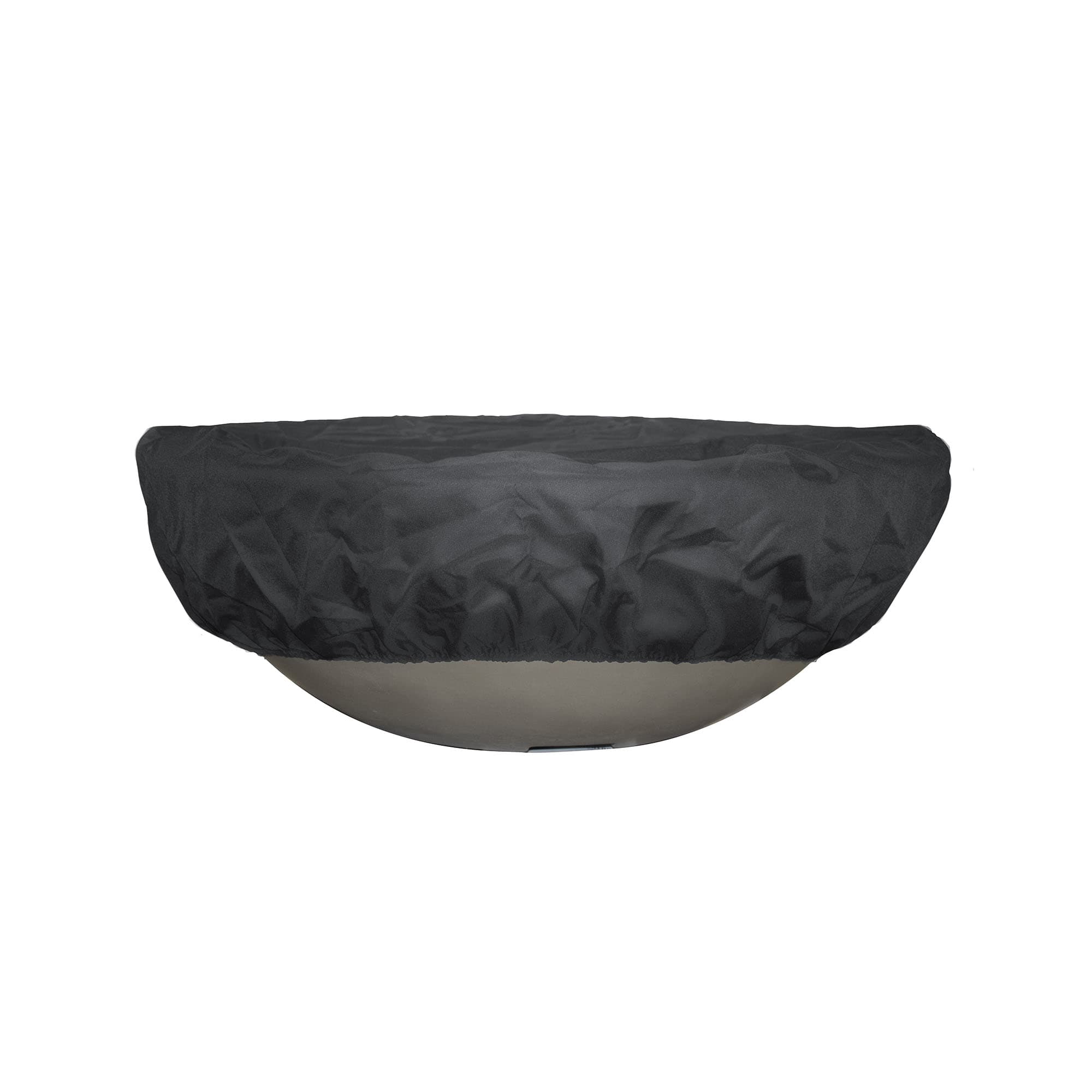
If you own a fire pit from any brand without an OEM cover — including Ohio Flame, our handmade Patriot and Liberty wood-burners that ship bare — a universal canvas cover from The Outdoor Plus is the right call. TOP cuts covers in 24, 27, 30, 31, 32, 33, 36, 42, 48, 60, 72, and 84-inch diameters, with 8 to 24-inch drops, in both round and square cuts. Match the diameter and drop to your pit and you get a near-OEM fit for $140 to $590.
Measure the pit before you shop
Three dimensions matter. Outside diameter at the widest point of the top lip. Total height from the ground to the top of the lip. Base diameter if the pit tapers (common on bowl-style pits like the Moderno 1 and the Dune). Measure with a cloth tape or a straight-edge-and-ruler combination — do not eyeball it, and do not round down.
Add two inches to the diameter when you shop. A cover cut exactly to the pit’s outside diameter binds on the lip as it drops, which stretches the hem and rips the strap channels within a dozen on-off cycles. Two inches of clearance is the industry standard and matches how both Prism and TOP size their SKUs.
For rectangular tables — Tavola 2, Tavola 4, Tavola 8, and TOP’s rectangular lineup — measure long side, short side, and height. The short side is where buyers make the mistake, assuming a 60 by 24-inch table takes the same cover as a 60-inch round. It does not. A rectangular cover has four cinch points instead of a continuous cord; the geometry is different.
Canvas weight — the whole game
Denier, abbreviated D, measures the thickness of the thread the canvas is woven from. 300D is what big-box patio covers are made of; it UV-cracks in one Arizona summer or one Minnesota winter. 600D is the entry point for a real fire pit cover and will last three to five seasons under a pergola or in a mild climate. 900D to 1,200D is what we sell for Gulf Coast, Rocky Mountain, and open-exposure coastal installs where the cover is in weather year-round.
The Outdoor Plus canvas is 600D with a polyurethane backing — the sweet spot for inland-climate durability without the stiffness of 1,200D marine canvas. Prism covers are a slightly different construction, a polyester-blend canvas with a water-repellent treatment, rated by Prism for a five-year outdoor life when stored dry in the off-season.
Here is the test: a cover without a published denier number is under 600D. Every quality manufacturer discloses it openly. If the listing says heavy-duty canvas with no number, it is marketing. Walk.
Vents prevent the moisture-trap problem
A fully sealed cover is worse than no cover at all. Humidity gets in anyway — the pit itself is warmer than ambient at the end of a burn, which drives condensation under the cover — and then it has nowhere to go. The result is rust on the burner ring, corrosion on the ignition electrode, and in wood-burning pits a soggy ember bed that stains the inside of the firebox.
Every quality fire pit cover has mesh-covered vents or a cinch skirt that breathes. The Outdoor Plus covers vent through the drop skirt — the cord cinches the bottom to the base but leaves a ventilation gap along the seam. Prism covers vent through sewn mesh panels on the sides. Both approaches work; what does not work is a plastic-tarp wrap-and-bungee setup that seals the pit under a wet blanket.
If a cover claims to be fully waterproof with no vents, it is actively bad for your pit. Water-resistant with airflow is the specification you want, not sealed and stagnant.
Strap systems and wind anchoring
Any cover without a strap system blows off in the first real storm. For round pits, look for a continuous cinch cord through the hem that pulls the entire drop skirt tight against the base. For rectangular tables, four corner straps with buckles do the same job in a geometry a round cord cannot handle.
Elastic hems degrade in UV within 18 months and lose tension permanently once they do. Cord-and-toggle or strap-and-buckle systems stay tight for the life of the cover. If a listing specifies elastic hem as the only closure, factor in a shortened lifespan — the canvas will outlast the elastic by years, which means an otherwise-good cover goes in the trash because the retention system failed.
For open-exposure installs, add a strap-to-base tie-down. Both Prism and TOP covers include loop points at the bottom hem that let you anchor the cover to the pit’s base or to a pergola post. A cover that blows off in a storm is not protecting anything, and in a bad gust it lands somewhere it causes damage on the way.
Prism Hardscapes OEM covers — exact-fit picks
Prism makes four cover families, each cut to a specific series. The Tavola cover ships in five sub-sizes to fit the Tavola 1, 2, 3, 4, 5, 6, 8, 42, 66 Slim, and Porto — all five Tavola silhouettes get a dedicated SKU because the Tavola 2 bowl, the Tavola 4 oval, and the Tavola 8 rectangle are three different top-lip geometries.
The Moderno cover ships in four sub-sizes to fit the Moderno 1, 2, 3, 4, 5, 6, 8, Verona, and Cilindro — the same approach, one SKU per lip profile. The Dune and Oasis share a cover because the bowl geometries overlap. The Propane Enclosure cover is its own SKU for the Prism tank-hide base that pairs with every Prism pit converted to propane.
Pick the Prism cover by matching your pit’s series name and model number. The variant selector on the product page lists every compatible model inline, so there is no ambiguity about which sub-size fits a Moderno 5 versus a Moderno 1. If you own a Prism piece, buy Prism. The $160-ish spend is the right ratio for a pit that cost $2,500 to $4,500 new.
The Outdoor Plus universal canvas — the catch-all
If you own a fire pit from a brand that does not sell an OEM cover — Ohio Flame, HPC, Warming Trends, custom concrete pieces, or any older unit whose manufacturer is out of business — The Outdoor Plus is the right landing spot. TOP cuts universal canvas covers in the exact diameters that match the real catalog: 24-inch for small bowls, 30 and 36-inch for the entry-level round segment, 48-inch for the volume sweet spot, 60 and 72-inch for large-format tables, 84-inch for Tavola-8-class rectangles.
Match the pit’s outside diameter plus two inches to the TOP cover’s labeled diameter. A 36-inch Ohio Flame Patriot takes a TOP 36 or 42-inch round. A 48-inch Patriot takes a 48 or 60-inch round. For a 42-inch Patriot, buy the 48 — a cover that is slightly oversized is fine, a cover that is slightly undersized tears.
Drop height matters as much as diameter. TOP labels every SKU with both — a 48-inch x 16-inch cover is 48-inch diameter with a 16-inch drop skirt. Measure your pit’s height from the ground to the top of the lip; the TOP drop skirt should match or slightly exceed that number so the cord cinches below the lip, not at it.
Common mistakes we see at FirePits.com
Mistake one: buying by top-lip diameter alone. A 48-inch Prism Tavola 4 top-lip diameter is only part of the measurement — the base and the handle protrusions matter too, and that is why the Tavola gets its own SKU rather than a universal 48-inch cover. On a non-Prism pit, measure the widest point including any brass pan handle or lift-ring that sticks out.
Mistake two: skipping the cover during the install season and planning to buy later. The pit arrives in April, sits uncovered through pollen season and the summer thunderstorm cycle, and by the time the owner shops for a cover in October the burner ring is already rusted. Buy the cover with the pit. It gets stored flat under the pergola or in the garage and comes out when the pit is cool after each burn.
Mistake three: using a grill cover. A grill cover is cut for a hood-plus-cart silhouette with a backsplash — the geometry does not match a round or rectangular fire pit at all. It balloons at the sides, blows off in the first storm, and leaves the burner pan exposed to exactly the elements the cover was supposed to block. If a grill cover is what you have on hand, it is working against you.
When you actually need a cover
A gas or propane pit under a fully enclosed outdoor kitchen with a hood and side walls — probably no cover needed between burns, but definitely a cover for the off-season when the pit will not be used for months. The lingering fuel vapor in the lines plus the ambient dust in a sealed structure is still worth a canvas barrier.
A pit on an open patio, by a pool, or anywhere with pollen, coastal air, tree-drip, or a real winter — cover it between every burn. A quality cover pays for itself in one season in these conditions. The ignition stays dry, the burner orifice stays clear, and the stainless or Cor-Ten steel stays clean enough that spring startup is a wipe-down instead of a service call.
Anywhere in between is a judgment call, and we default to covering. The math is asymmetric. Worst case you spent $200 on a cover you did not strictly need. Alternative worst case, you skipped it and replaced $600 in burner components and paid a $120 service visit at year three. The cover is the cheaper experiment every time.
Frequently Asked Questions
Do fire pit covers really protect against winter weather?+
Should I buy an OEM fire pit cover or a universal canvas cover?+
What canvas weight do I need for a fire pit cover?+
How do I measure my fire pit for a cover?+
Can I use a grill cover on my fire pit?+
Do I still need a cover if my fire pit is under a pergola?+
Products & brands in this guide
Related reading
Ash — Ash writes the buying guides at FirePits.com — years of specifying fire features on residential installs, from urban patios to mountain properties.