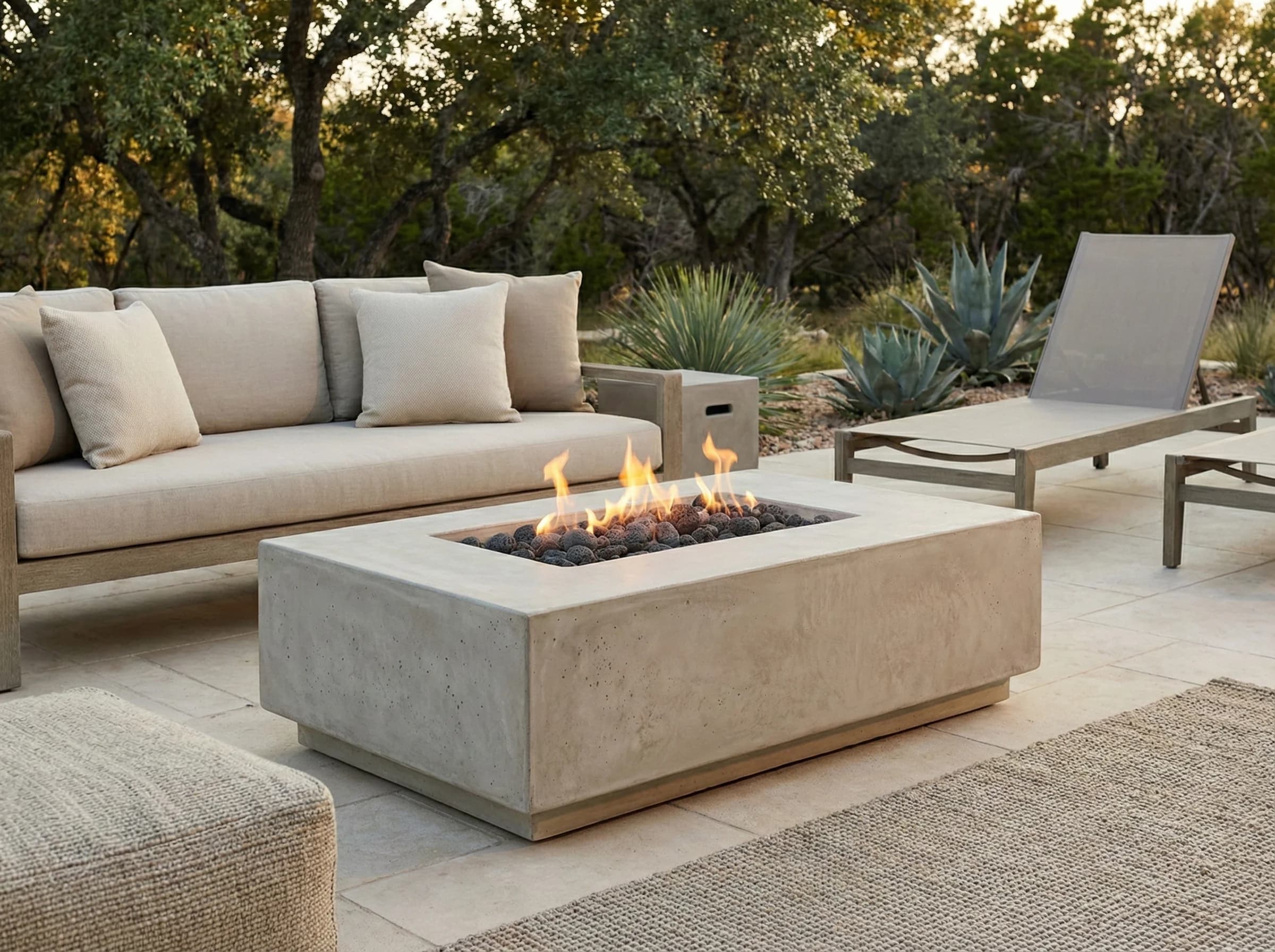
GFRC vs Concrete Fire Pit Tables: What the Label Actually Means
By Ash · Published October 2026
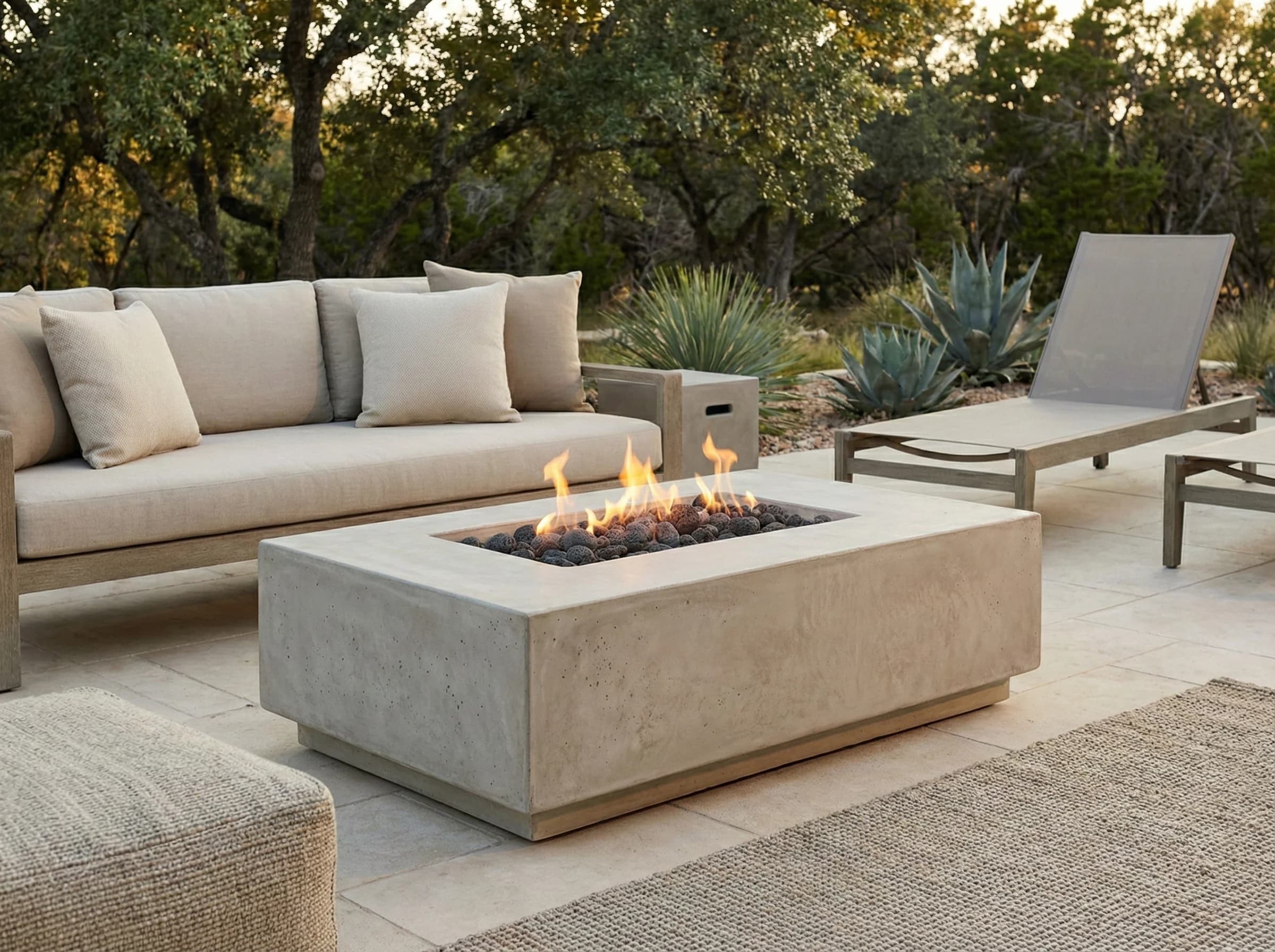
Updated October 2026. Every premium fire pit table listing says “concrete” and most searchers walk away assuming they all share the same material. They don’t. GFRC — glass fiber reinforced concrete — is a different product with different weight, different durability, and a different price band. Here is what the label actually means, and when the GFRC premium is worth it.
The Short Answer
GFRC is lighter, holds crisper modernist edges, and does not crack in freeze-thaw climates — three things standard cast concrete cannot claim. Prism Hardscapes and The Outdoor Plus Sedona bowls are the two GFRC lines we stock on FirePits.com; both carry a lifetime structural warranty that standard cast-concrete pits never offer. The 20-40% price premium pays for 25+ year lifespan, 14-color pigment selection, and the weight savings that make elevated-deck and poolside installations realistic.
What Is GFRC?
GFRC stands for glass fiber reinforced concrete. It is a specific material formulation: fine-aggregate concrete mixed with 3-5% by weight of alkali-resistant glass fibers, cast against a mold, and hand-finished. The glass fibers replace the steel rebar that standard reinforced concrete depends on for tensile strength. That single substitution changes almost everything about how the finished piece behaves outdoors.
The engineering reason it matters: steel and concrete expand at different rates when they heat and cool. In a standard cast-concrete fire pit, the steel rebar inside pulls against the concrete around it on every hot-cold cycle. Over 5-10 winters that stress opens micro-cracks. The cracks let water in. The water freezes and expands. The concrete fails. GFRC eliminates that failure mode because glass fibers expand at the same rate as the concrete matrix. No stress, no cracks, no winter failure.
The second practical consequence is wall thickness. Standard cast concrete needs 3-4 inches of material to carry load. GFRC carries the same load at 3/4 to 1 inch. That is why the Prism Hardscapes Tavola 4 can hold a knife-edge rectangular silhouette with 1-inch walls where a standard-concrete attempt at the same silhouette would collapse during casting or crumble within two seasons.
Weight: The Difference That Actually Changes Installation
This is where the material choice stops being abstract. A 48-inch rectangular GFRC fire pit table weighs 300-400 pounds. The same silhouette cast in standard rebar-reinforced concrete weighs 650-900 pounds. On a 66-inch piece like the Prism Hardscapes Tavola 4, GFRC lands around 500-600 pounds; the standard-concrete equivalent runs 1,100-1,400 pounds.
Here is why that matters in a real yard. A standard residential deck is built to 40 pounds per square foot of live load. A GFRC Tavola 4 concentrates roughly 150 psf on its base footprint — within code, if the deck is well-built. Standard concrete at the same silhouette would concentrate 350+ psf, which exceeds the design load of most residential decks. GFRC is the reason premium concrete fire tables can go on elevated decks and raised pool copings at all. Standard cast concrete at that size needs engineered support most residential projects cannot afford.
Smaller GFRC pieces like the Prism Hardscapes Moderno 2 (29-inch pool fire bowl, around 180 pounds) and the Outdoor Plus Sedona 27-inch GFRC fire & water bowl (around 160 pounds) are inside the realistic reach of a two-person lift. Standard-concrete bowls at the same silhouette would run 350-450 pounds and need four hands plus a dolly.
Durability: Freeze-Thaw and the 25-Year Question
Both materials can last 25 years outdoors if installed correctly. The failure modes are different and the climate matters.
GFRC has no steel inside to corrode and no rebar-driven thermal stress, so freeze-thaw is a non-event. Prism Hardscapes warranties their GFRC pieces for life against structural failure and honors the warranty from Minnesota to Montana. The Outdoor Plus Sedona GFRC bowls carry the same lifetime structural warranty. What eventually ages a GFRC piece is the pigment and the surface finish — a sealer refresh every 2-3 seasons keeps both pristine.
Standard reinforced concrete fails on a predictable curve in cold climates. Year 3-5: hairline cracks appear on the top rim where thermal cycling is sharpest. Year 6-10: cracks propagate down the sidewalls and water pools in them. Year 10-12: the piece structurally compromises, typically at a corner, and the warranty you bought when the piece was new has already expired. In mild climates (coastal California, the Sun Belt) standard concrete can hit 20 years. In the Rust Belt, Mountain West, and Northeast it rarely does.
The Material + Weight + Price Table
Four GFRC pieces we stock on FirePits.com, with the real spec data behind each. Standard-concrete comparison numbers are market averages across big-box and generic manufacturers at the same silhouette and size.
Prism Hardscapes Tavola 4 (66-inch rectangular GFRC): 500-600 lbs, 65,000 BTU, 14 pigment finishes, lifetime structural warranty. Around $3,500-4,500. Standard-concrete equivalent: 1,100-1,400 lbs, 50,000-65,000 BTU, 2-4 finishes, 5-year warranty, around $2,500-3,200.
Prism Hardscapes Moderno 2 (29-inch round GFRC pool fire bowl): 180 lbs, 65,000 BTU, 14 pigment finishes, lifetime structural warranty. Around $1,200-1,500. Standard-concrete equivalent: 350-450 lbs, 50,000 BTU, 2-3 finishes, 3-5 year warranty, around $650-900.
The Outdoor Plus Sedona 27-inch GFRC fire & water bowl (Ebony Wood Grain): 160 lbs, 45,000 BTU, 3 wood-grain finishes, lifetime structural warranty. Around $2,500-3,000. Standard concrete does not offer this product category at all — the wood-grain texture requires GFRC’s thinner wall and finer aggregate.
The Outdoor Plus Sedona 33-inch GFRC fire & water bowl (Limestone): 240 lbs, 65,000 BTU, 10 pigment finishes, lifetime structural warranty. Around $2,800-3,400. Standard concrete at the same silhouette would run 500-600 lbs and $1,400-1,900, with no wood-grain or fine-pigment finish option.
Finishes: Why GFRC Reads Different in a Design Brief
Standard cast concrete fire pits ship in two or three colors — natural gray, charcoal, maybe sandstone. The pigment sits in the top 1/8 inch of surface and reveals a different base color at any chip or scratch. GFRC pigment is mixed through the full material depth. A chip reveals the same color as the surface, which matters more than it sounds like when the piece ages five years.
Prism Hardscapes offers 14 standard finishes: Pewter and Charcoal for modernist palettes, Ultra White and Natural Gray for coastal minimalism, Cafe and Sandalwood for warm-neutral, Rust and Chestnut for Southwestern. The Outdoor Plus Sedona GFRC bowls split into two finish families — the Wood Grain line (Ebony, Ivory, Oak) presses a stained-oak texture into the concrete during casting, and the Pigmented line (Limestone, Black, Chestnut, Gray, Ash, Natural Gray, Brown, Chocolate, Vanilla, Olive) runs flat pigment through the material. Both read warmer and more sculptural than a cast-concrete bowl in natural gray.
Custom color-matching to a specific hardscape sample is available on both lines for larger projects (6-10 week lead time). Standard concrete manufacturers do not offer custom matching because the pigment sits only on the surface.
Maintenance Reality
GFRC maintenance is light-touch. Three real tasks across the year.
First, a penetrating concrete sealer refresh every 2-3 seasons. About $45 for a bottle, 30 minutes to spray on and wipe excess. Keeps the pigment color-stable and sheds water. Skip the sealer and a GFRC piece develops a soft patina over 5-10 years that many owners prefer — the natural weathering reads warm and architectural rather than tired. The decision is aesthetic, not structural.
Second, cover during off-season. The GFRC exterior is fine uncovered year-round, but the stainless burner tray inside does not want to sit full of rainwater through a Minnesota winter. Every manufacturer sells a matching cover ($150-350) and it is the cheapest longevity insurance you can buy for the piece.
Third, soft-brush cleaning. Mild soap, water, soft brush — about once a season. Avoid pressure washing (etches the surface and shortens sealer life) and avoid wire brushes (scratches the pigmented finish).
Standard concrete needs the same sealer refresh schedule plus one maintenance task GFRC does not: watching for crack propagation and sealing new cracks with a flexible concrete filler before water gets in. By year 8-10 that becomes an annual task on most standard-concrete pits in cold climates.
Who Should Buy GFRC
Buy a GFRC fire pit table if your climate sees freeze-thaw cycling (above the Mason-Dixon line, basically), if you need the piece on an elevated deck or raised pool coping, if the finish needs to match a specific hardscape color through its full life, or if the modernist silhouette with clean knife-edge walls is the design goal. Prism Hardscapes is the deepest line and the longest warranty; The Outdoor Plus Sedona GFRC bowls are the right pick when the design wants wood-grain texture or a smaller round silhouette for pool coping.
Buy standard cast concrete only if the climate is mild (Sun Belt, coastal California) and the budget is tight. In cold-climate installations, the standard-concrete piece is a 5-10 year purchase, not a 25-year one. The difference between standard and GFRC — roughly $1,000-1,500 at mid-size — pays itself back the first time you do not have to replace a cracked pit.
What to Confirm Before You Order
Confirm the piece is actually GFRC and not labeled “concrete” without a specification. Prism Hardscapes and The Outdoor Plus Sedona bowls are explicitly GFRC; many big-box listings use the word “concrete” without saying which kind. If the listing does not name GFRC, assume standard cast concrete and plan accordingly.
Confirm fuel type (natural gas vs propane) at order. Field conversion requires a licensed gas fitter and a conversion kit on either material.
Order the matching cover with the piece. $150-350 well spent.
Specify the finish against a physical sample for larger projects — both Prism Hardscapes and The Outdoor Plus will ship a pigment chip or small sample tile at no charge for design-build projects. Hardscape color at viewing distance reads differently than it does on a product-page swatch.
Build in 3-5 weeks for standard colors on either line, 6-10 weeks for custom color matching. GFRC is always order-to-cast; nothing ships from stock at this tier.
Frequently Asked Questions
What is GFRC and how is it different from regular concrete?+
Is GFRC actually lighter than normal concrete fire pits?+
Does GFRC crack in freeze-thaw climates?+
What finishes come on GFRC fire pit tables?+
What does a GFRC fire pit cost compared to standard concrete?+
How do I maintain a GFRC fire pit table?+
Products & brands in this guide
Related reading
Ash — Ash writes the buying guides at FirePits.com — years of specifying fire features on residential installs, from urban patios to mountain properties.