Best Stones and Rocks for a Fire Pit Area (and the One That Will Actually Explode)
By Ash · Published October 2026
Updated October 2026. Every stone around a fire pit is doing one of two jobs — looking right, or not exploding. Most buying guides mix those jobs up and recommend river rock because it photographs well, which is how you end up with a stone that pops shrapnel across your patio the first time it heats up fast. This guide is the inert-vs-dangerous split for the area AROUND the pit (not inside the bowl), with real clearance numbers, drainage rules, and aesthetic pairings for contemporary, rustic, and modern setups.
Why River Rock Is the One Stone That Will Actually Explode
Start here, because this is the single thing most landscape guides get wrong. River rock is formed in waterways over thousands of years. Water is literally the shaping force. The result is a stone with microscopic pockets, hairline cracks, and trapped moisture distributed through its interior. Dry it on your counter for a week and it still has moisture locked inside the matrix — the stone is sealed enough to hold it in, porous enough to collect it in the first place.
Then you put that rock near a 55,000-BTU gas burner or an open wood fire. The outer surface hits 300°F in minutes. The trapped moisture inside flashes to steam. Steam expands roughly 1,600 times its liquid volume. The stone has nowhere to vent that pressure, so it fails the same way a sealed can of soda fails in a fire — explosively. Sometimes the pop is small and the stone just splits. Sometimes it throws fragments 10 or 15 feet across a patio. Firefighter training materials call it out specifically because campfire-pit injuries from exploding river rock are a recurring category.
The second-worst offenders are sandstone, limestone, and any smooth beach-collected stones. Same failure mode, slightly lower frequency. The common thread is any stone that is either porous enough to absorb water, or sealed-smooth enough to trap it inside. The safe stones are the ones that are either genuinely inert (lava, granite, dense concrete) or that drain fast enough to never hold moisture under heat (crushed quarried gravel).
“We tell every customer the same thing. If you want the river-rock look, keep it outside the 36-inch clearance ring. Inside that ring, you want stone that quarried out of the ground dry, not stone that spent 10,000 years in a river.”
The Real Stone-Safety Table for the Fire Pit Area
Here is the honest sorting. These are the materials we actually spec on install jobs, grouped by what the stone does under heat.
Safe — fully inert, use anywhere including the clearance ring:
Lava rock. Volcanic, already thermally shocked at formation, zero trapped moisture. The default bowl media and the safe pick for a decorative inner ring around the pit. Black, red, and gray grades all behave the same. Buy the 3/4 to 2-inch grade for the ring (smaller sizes migrate too easily).
Fire glass. Tempered recycled glass, engineered specifically for burner trays. Reflects flame beautifully in contemporary installations like the Prism Hardscapes Moderno or a Prism Tavola 8. Expensive per pound but the only media that reads as truly modern.
Crushed granite / decomposed granite (DG). Quarried dense stone, pre-crushed, functionally dust-dry. Our pick for the walking-surface stone around a wood-burning pit like the Ohio Flame Patriot 36. Compacts into a stable surface, drains well, available in sand, gold, and gray tones.
Pea gravel. Quarried, small, rounded. Drains fast, cheap, available everywhere. Will migrate without an edging but otherwise foolproof.
Flagstone, bluestone, dense pavers. Large-format quarried stone. Zero migration, handles direct heat, pairs with every fire pit style. The default patio base material under a raised pit.
Dangerous — never inside the clearance ring:
River rock. Covered above. Do not use. Not around the pit, not in a decorative inner ring, not inside the bowl.
Sandstone. Porous sedimentary stone that absorbs moisture. Delaminates and sometimes pops under heat cycling.
Limestone (as loose rock). Chemically reactive at high heat — can calcine and crack. Dense architectural limestone pavers set at distance are fine; loose landscape limestone around the pit is not.
Beach rock / smooth creek stones. Same water-trapped failure as river rock.
Pumice as a landscape stone. Confusingly, pumice is sold as a fire-pit media — that version is engineered dry. The landscape-grade pumice sold at garden centers for soil amendment is water-saturated and will pop.
NFPA-54 default — measured from the burner edge to wood decking, plants, umbrellas, or siding. Inert hardscape (flagstone, bluestone, crushed granite) can run right up to the pit base. See the full clearance math in the sizing guide.
The Clearance Ring: What Goes Where Around the Pit
Think of the area around any fire pit as three concentric zones, each with its own material rules.
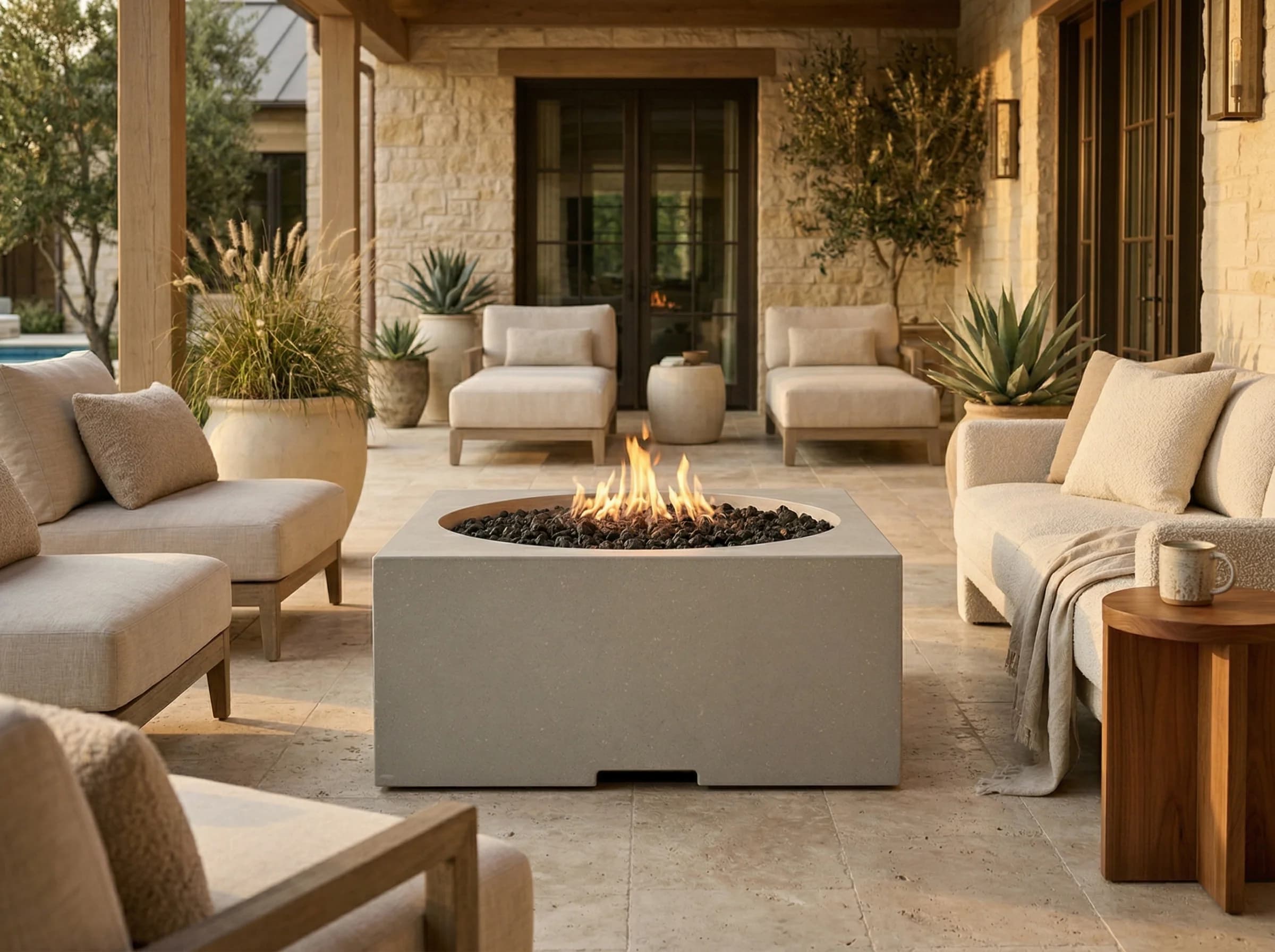
Zone 1 — the pit base (0 to 24 inches out). This is directly under and immediately around the burner. The surface here needs to handle direct radiant heat and the occasional dropped ember. Flagstone, bluestone, dense concrete pavers, poured concrete, or a dedicated heat-shield pad are the right calls. If you want a decorative inner ring in this zone, lava rock or fire glass is the only safe decorative media.
Zone 2 — the seating ring (24 to 60 inches out). This is where chairs and feet go. The surface here needs to be walkable, drain well, and not scorch from the occasional ember that drifts out. Crushed granite, pea gravel, flagstone, bluestone, or standard patio pavers all work. Avoid anything that migrates aggressively (unedged pea gravel) or anything soft (bark, mulch, or decomposed wood products — those are literal fuel).
Zone 3 — the landscape beyond (60+ inches out). Outside the clearance ring, almost anything is fair. This is where the river rock dry creek bed, the ornamental limestone boulders, the sandstone edge pieces all belong. The 36-inch clearance from NFPA-54 is the minimum; some jurisdictions (parts of California, high-wildfire areas in Colorado and Arizona) require more. Check your local code before you commit to a layout.
Does Drainage Change Your Stone Choice?
Yes, and it is the quiet consideration that separates a patio that stays stable for 10 years from one that sinks and shifts after two. Any loose stone around a fire pit needs to sit over a base that drains. A pea gravel ring poured directly on compacted clay will pond water, freeze in winter, and heave in spring. The whole ring sinks unevenly, and the stones migrate into the voids.
The right base is 2 to 4 inches of road base (3/4-inch crushed stone with fines) compacted with a plate compactor, topped with 2 to 4 inches of the finish stone. For a flagstone or bluestone laid surface, add a 1-inch leveling layer of coarse sand between the road base and the stones. For a crushed-granite walking surface, no leveling layer needed — the granite compacts into the base directly.
If the site has drainage problems (low spots, clay soil, downhill runoff), slope the finish grade away from the pit at 1 to 2 percent (about 1/8-inch per foot). A level fire pit area that holds water is a bigger problem than a slightly sloped one that drains.
How to Pick Stones That Match the Fire Pit’s Style
The style match is where most patios succeed or fail visually. The pit sets the aesthetic tone; the surrounding stone either reinforces it or fights it. Three style buckets cover 90 percent of installs.
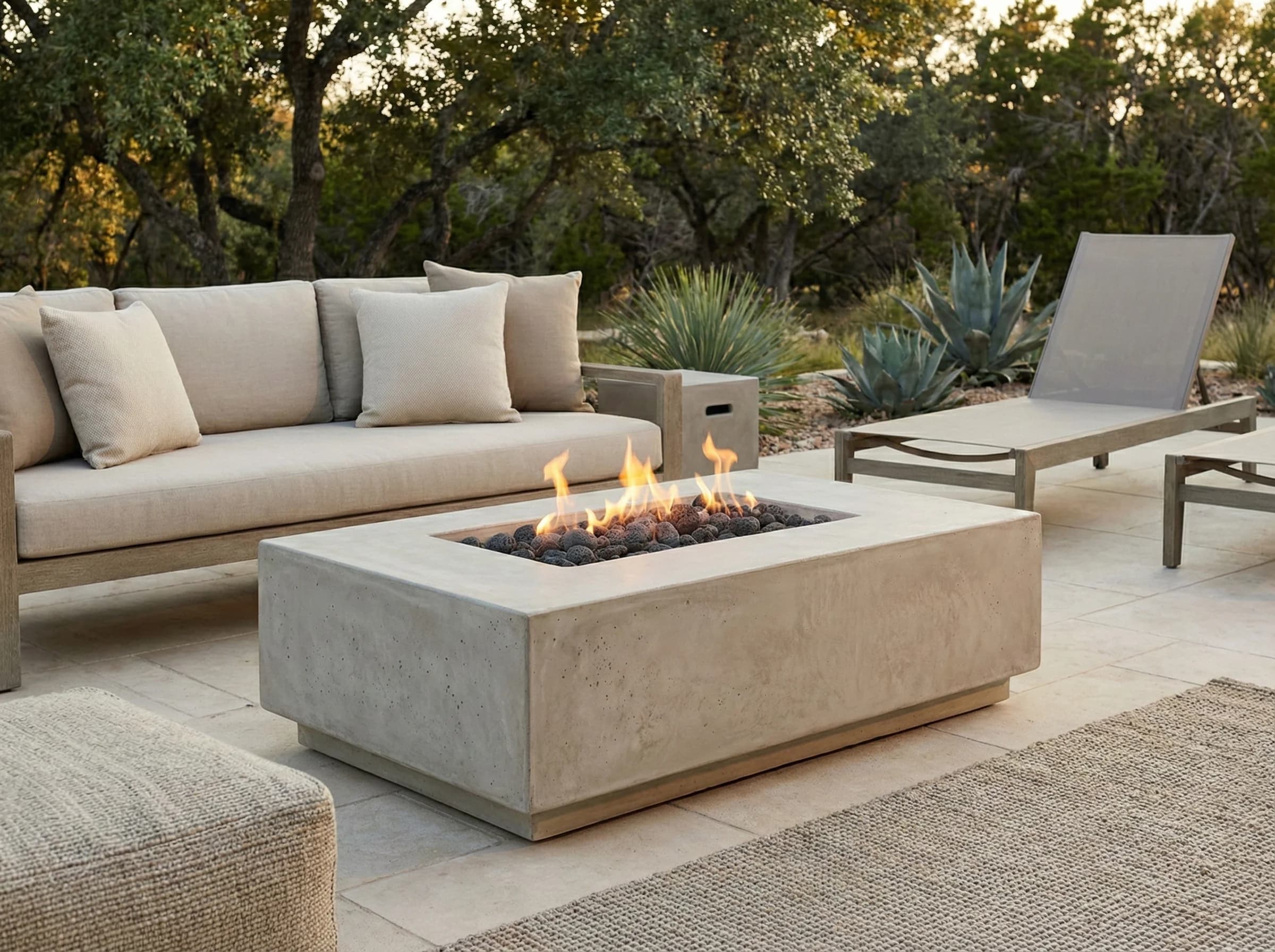
Contemporary — concrete or steel pit, clean lines. Think Prism Hardscapes Tavola, Moderno, or Embarcadero, or any of the sharp-edged The Outdoor Plus steel bowls. Pair with large-format flagstone pavers (24-inch square or larger), poured concrete, or a crushed-granite ring around a bluestone pad. Fire glass in the bowl, not lava rock. The visual move is restraint — minimal variation in stone size, monochromatic tones, no decorative river rock accents.
Rustic — wood-burning steel pit, Corten finish. Think the Ohio Flame Patriot or similar hand-forged steel. Pair with irregular flagstone, mixed-size bluestone, decomposed granite rings, and (outside the clearance ring) decorative river rock or boulder accents in the surrounding landscape beds. The visual move is intentional variation — mixed sizes, warm tones, stone that looks like it was placed by hand.
Modern minimalist — low-profile concrete or steel bowl. Think a Prism Cilindro 36 column or a shallow steel bowl from The Outdoor Plus. Pair with crushed white quartz or a monochromatic pea gravel ring (gray or white), framed by a single run of large pavers. The visual move is color discipline — one or two stone tones, no texture mixing, nothing that looks collected.
The style doesn’t change the safety rules. River rock is still off-limits inside the clearance ring in every one of these setups. The aesthetic lives in Zone 3 and beyond.
What to Do If You Already Have the Wrong Stones
This comes up often enough it deserves its own section. If your patio already has river rock, sandstone, or beach stones inside the clearance ring, the fix is not rip-everything-out — it is relocate and replace.
Pull the stones inside the 36-inch clearance ring and move them to Zone 3 as a dry creek bed, border accent, or planter top-dress. They are perfectly safe out there — the problem is only radiant heat. In the clearance ring, lay in 2 to 4 inches of crushed granite over compacted base, or install a flagstone pad. One afternoon of work, two $80 bags of crushed granite from a stone yard, and you have an installation that is both safer and better-looking than the original.
If you are starting from grass, the planning sequence is: pick the pit first, measure the 36-inch clearance ring, lay the base, choose the finish stone, and only then order patio furniture that fits the remaining footprint. Patios built pit-first stay used. Patios built furniture-first end up with the pit squeezed into a corner that fails the clearance math.
Frequently Asked Questions
What stones are safe to use around a fire pit?+
Can you use river rock around a fire pit?+
What should you put under a fire pit on grass?+
How much clearance do stones need around a gas fire pit?+
Is pea gravel safe to use around a fire pit?+
What is the best base for a fire pit on a paver patio?+
Products & brands in this guide
Related reading
Ash — Ash writes the buying guides at FirePits.com — years of specifying fire features on residential installs, from urban patios to mountain properties.