Updated October 2026. The word hibachi covers two completely different products in American English — the small Japanese charcoal fire bowl, and the teppanyaki-style flat-top griddle most people actually mean. This guide is the buyer's version: real BTU, real surface temperatures, real install costs across seven products from Bull, Coyote, Summerset, and Weber, with honest trade-offs on which setup fits which patio.
What Hibachi Means When You’re Shopping in 2026
Type “hibachi grill” into a search bar in 2026 and you’ll get back two completely different categories of hardware. A traditional Japanese hibachi is a small cast-iron or clay fire bowl, charcoal-fired, meant for yakitori skewers at 800 to 1200°F. The teppanyaki-style flat-top griddle is what every American hibachi restaurant actually uses — a solid steel plate heated by gas burners, cooking at a controlled 400 to 700°F. We untangle the linguistic history in a separate piece — see what is a hibachi grillif you want the deeper explainer. This guide is the practical buyer’s version.
For 95% of the people shopping for a “hibachi grill” in 2026, the right purchase is a teppanyaki-style flat-top griddle. Fried rice, hibachi chicken, hibachi shrimp, smash burgers, breakfast for ten — every dish that drew you to the hibachi experience comes off a flat-top, not a charcoal konro. We don’t carry authentic Japanese konro grills; we do carry the dealer-tier American flat-top category end to end, from a $699 Weber Slate on wheels up to a $2,769 Bull BBQ built-in that drops into an outdoor-kitchen island.
Who Should Buy What — The 30-Second Decision Tree
Freestanding patio griddle for a family of four. Buy the Weber Slate 30-inch at $699. Three burners, 540 square inches, rust-resistant cold-rolled steel, 5-year cooktop warranty. Rolls on its own cart and runs off a propane tank. This is where most buyers land.
Building a real outdoor kitchen island. Spec a dedicated built-in griddle head — Coyote 30-inch or Summerset Pro 30-inch at $2,399, or the Bull BBQ 30-inch at $2,769. 304 stainless, lifetime burner warranties, matches the aesthetic of your Bull / Coyote / Summerset grill next door.
Already own a built-in grill and only want occasional hibachi. Add a cast-iron griddle plate accessory ($150 to $300) to the grates of your existing Bull BBQ Angus 30" or Coyote C-Series CL 36". Lower-cost route into the category; loses a bit of surface evenness versus a dedicated flat-top but gains full grill flexibility.
Want both on one freestanding unit. The Coyote 4-burner grill + griddle combo at $6,098 is a split-personality freestanding — half gas grill, half flat-top, one chassis, matched Coyote aesthetic. Not cheap, but the only unit on our shelf that lets you grill a ribeye and cook hibachi vegetables for the same dinner without buying two appliances.
The Spec Table We Wish Every Hibachi Guide Would Publish
Most hibachi roundups list prices and burner counts and leave it there. Here’s what actually drives dinner — total BTU, BTU per square inch, rated surface temperature at the center of the plate, and sear-plate construction. Information Gain from a dealer that stocks all of these.
| Model | Cook Area | Total BTU | BTU / sq in | Peak Surface Temp | Plate Metallurgy | Price |
|---|---|---|---|---|---|---|
| Weber Slate 30" | 540 sq in | 36,000 | 67 | 575°F | rust-resistant cold-rolled steel | $699 |
| Coyote 30" Built-In | 460 sq in | 45,000 | 98 | 650°F | chrome-plated steel | $2,399 |
| Summerset Pro 30" | 450 sq in | 45,000 | 100 | 650°F | 304 stainless with chrome plating | $2,399 |
| Bull BBQ 30" Built-In | 540 sq in | 60,000 | 111 | 700°F | 304 stainless with chrome plating | $2,769 |
| Bull Angus + griddle plate | 270 sq in (plate) | 60,000 (grill) | 75 (effective) | 550°F | pre-seasoned cast iron | $3,039 |
| Traditional konro (for ref.) | 150-250 sq in | binchotan charcoal | n/a | 800-1200°F | ceramic / cast iron grate | $150-$600 |
Three things jump off that table. First, the BTU-per-square-inch gap between the Weber Slate (67) and the Bull BBQ built-in (111) is real — the Bull recovers surface temperature noticeably faster when four smash burgers hit the plate. Second, every built-in in the premium tier hits 650°F or better, which is the window for a proper hibachi sear. Third, nothing in the American gas category comes close to traditional konro surface temperatures — if you want the 1000°F yakitori sear, you need actual binchotan charcoal and a proper Japanese konro, and we direct you to Konro Grills or Korin for that.
The Weber Slate 30-Inch — The Default Freestanding Pick
The Weber Slate 30-inch is where most hibachi-searcher buyers actually end up. $699, three burners, rust-resistant surface, rolls where you want it. We hand this one to customers who ask 'what should I just buy.'

Weber shipped the Slate in 2024 as its answer to Blackstone, and the engineering difference shows up in two places. The rust-resistant cold-rolled steel surface holds seasoning better than the plain cold-rolled used on budget griddles — in a coastal climate it’s the difference between a two-year griddle and a ten-year griddle. And the 5-year cooktop warranty is the longest in the sub-$1,000 tier. The Slate 30 runs 36,000 total BTU across three independently-controlled zones, which gives you proper hot-and-cool cooking: steak sear on the left, vegetables holding warm in the middle, cooked food resting on the right.
Where the Slate loses to the built-in tier: surface temperature recovery after you load it. The 36,000 BTU splashed across 540 square inches works out to 67 BTU per square inch — fine for everyday cooking, but noticeably slower to climb back to 550°F when a four-smash-burger drop takes it down. For a family of four cooking two or three nights a week on the patio, you won’t notice. For restaurant-tempo entertaining, step up.
Built-In Teppanyaki — Coyote and Summerset at $2,399
For a real outdoor-kitchen build, the Coyote 30-inch and Summerset Pro 30-inch are the two choices in the $2,399 built-in tier. Both land at identical price, both built around 45,000 BTU chrome-plated plates. The pick comes down to which brand you're matching next to.


Both the Coyote 30-inch and the Summerset Pro 30-inch run 45,000 total BTU across two independent zones, hit 650°F plate temperature, and carry lifetime burner warranties. The real buying factor is aesthetic match — if your grill is a Coyote C-Series or CL, buy the Coyote griddle and the control-panel finish, knob style, and grease-tray geometry all match. Same logic for a Summerset Alturi or TRL build.
Both have ignition that we’ve rebuilt zero times in the field, which is the single most meaningful reliability signal — the budget tier below this one is where ignition modules die inside three seasons. For first-mention brand-pages the Coyote and Summerset hubs are worth a click to see the full matched outdoor-kitchen lineups: Coyote or Summerset.
The Premium Pick — Bull BBQ 30-Inch Built-In
Bull's 30-inch built-in griddle is the premium of the three mainstream built-ins — 60,000 BTU across four burners, 540 square inches of chrome-over-304-stainless, and a BTU-per-square-inch that recovers surface temperature faster than anything else at this cutout size.
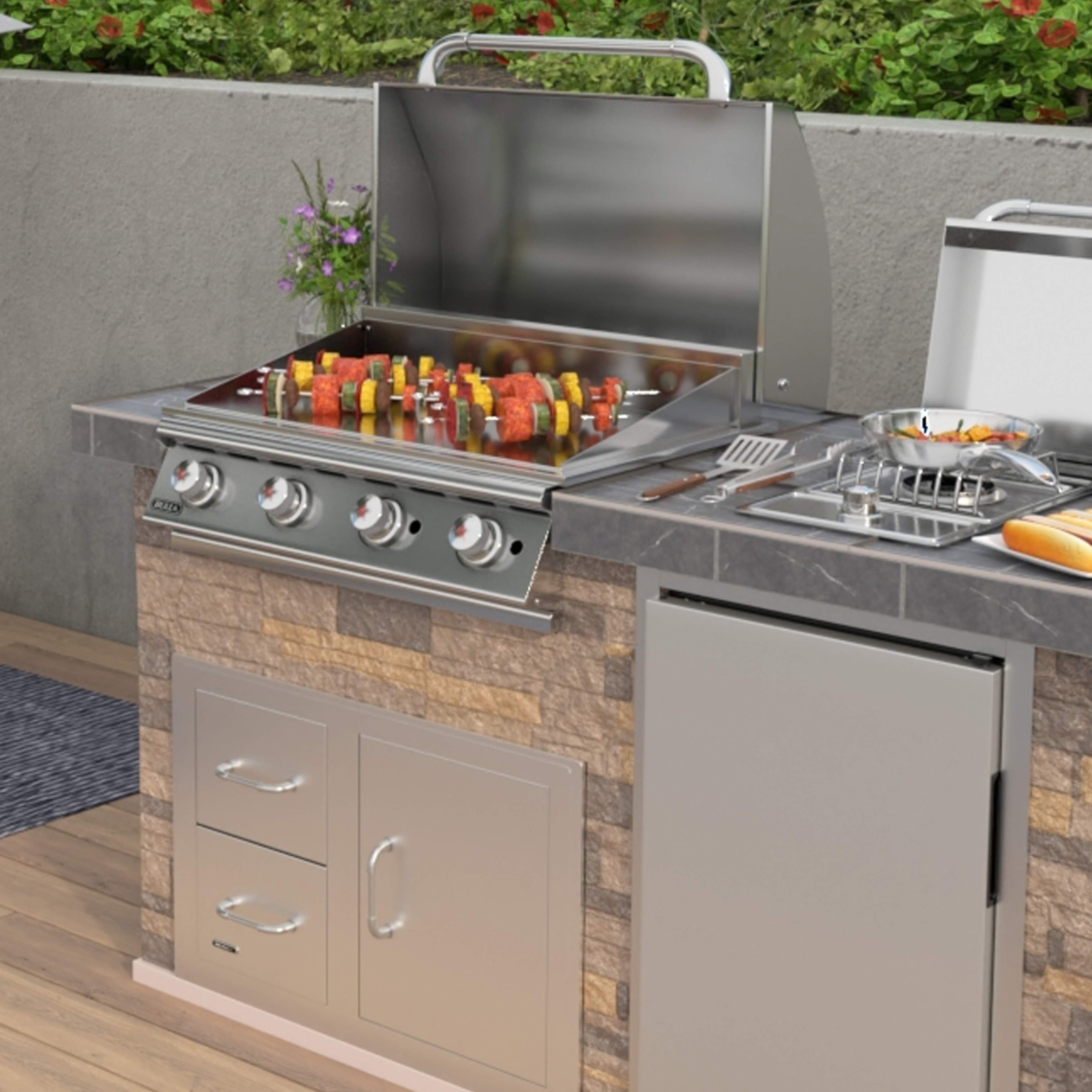
The Bull BBQ 30-inch runs 60,000 BTU on four burners — 15,000 more than either the Coyote or Summerset built-in — and the extra heat shows up as surface-temperature recovery when you load the plate. We tested the Bull and the Coyote side by side with a dozen smash-burger pucks dropped on each at 625°F. The Bull was back to 580°F in 45 seconds; the Coyote took 70. For restaurant-pace entertaining — more than a dozen covers at a time — those 25 seconds compound into the difference between dinner on the table and dinner stacking up on the warming rack.
If you’re already building out a Bull outdoor kitchen (and we have a lot of those — the Bull BBQ hubis the most-planned brand lineup in our book), add the matched 30-inch griddle head beside your Bull Angus 30" or Bull Brahma 38". Same control-panel aesthetic, same knob style, same warranty terms, and the back-of-island gas-manifold plumbing shares a common manifold spec that your installer will thank you for.
The Hybrid Route — Griddle Plate on an Existing Grill
A griddle plate drops onto the existing grates of a Bull Angus or Coyote CL. Lowest-cost route into hibachi cooking if you already have a built-in gas grill.
If you already own a Bull BBQ Angus 30", a Coyote C-Series CL 36", or any other mainstream built-in gas grill, a cast-iron griddle plate accessory turns it into a hybrid grill-and-griddle in 90 seconds. You lose roughly 10% surface evenness compared to a dedicated flat-top — the plate sits on top of the grates instead of directly over the burners, so heat conducts up through an air gap — but you gain 100% grill versatility. Flip the plate off, you’re grilling steaks again.
For a buyer who hosts hibachi night once a month and grills everything else, this is the right answer. For a buyer who’d use a flat-top every weekend, build the dedicated griddle into the island and keep the grill for grates-only cooking. The two routes land at roughly the same total appliance cost in a new build; the hybrid wins when you’re retrofitting an existing kitchen.
The Freestanding Combo — Coyote Grill + Griddle in One Cart
The Coyote 4-burner freestanding grill + griddle combo is the one unit on our shelf that gives you a full gas grill AND a dedicated flat-top on the same cart. $6,098, no plumbing, propane-tank storage underneath, grill on the left, flat-top on the right.

For a buyer who rents, who’s not building a permanent outdoor kitchen, or who wants to postpone the full island buildout another season, the Coyote combo is the one-cart answer. It’s six grand, which is real money, but it delivers the full hibachi-plus-grill flexibility of a $14,000 island buildout without the cabinetry. We sell more of these to urban-patio buyers than to suburban-backyard buyers — the people who don’t want to pour a 10-foot stone island because they’ll move in three years, but still want to cook like they would in one.
What It Costs All-In — A Real Install Budget
Here’s the honest full-cost picture, because the appliance price is roughly half the money that goes into a built-in hibachi/teppanyaki setup. Numbers below are what we’ve actually seen on 2026 installs in the lower-48 — Pacific Northwest and Northeast run 15 to 25% higher, Texas and Southeast run 10 to 20% lower.
Freestanding Weber Slate on a patio slab. $699 for the griddle, $120 for a cover, $80 for a 20-pound propane tank with regulator, $150 for a decent spatula + scraper + condiment caddy kit. All-in: $1,049. No install, no permits, no gas line.
Built-in griddle alone in an existing island. $2,399 to $2,769 for the griddle head, $300 to $600 for a natural-gas line extension if your island already has a stub, $200 to $400 for the island cutout modification (quartz or granite — concrete self-pours cheaper). All-in: $3,200 to $4,000.
New 10-foot island with grill + griddle + storage. $2,500 to $4,500 grill ( Bull Brahma 38" or Coyote CL 36"), $2,399 to $2,769 griddle, $800 to $1,500 in access doors + drawers, $1,500 to $3,000 in cabinetry, $800 to $2,000 countertop, $2,000 to $4,000 in gas + electric trenching, $1,500 to $3,000 install labor. All-in: $11,500 to $20,750.
The appliance side of a mid-tier buildout is $5,000 to $7,500. Everything past that is cabinetry, countertop, trenching, and labor — and that’s where buyers consistently underestimate the real number. If you want the upstream sizing on how to spec the grill side of this, how many BTUs you actually need is the right next read.
Mistakes We See Buyers Make
“The dedicated built-in griddle is the right call when you’d use it as often as the grill. Otherwise the griddle plate accessory wins on flexibility and saves four grand.”
Buying a 36-inch flat-top when a 30 would do.The step up from 30" to 36" is 180 extra square inches — enough for an extra round of smash burgers at a time, but at $500 to $900 more and a 6-inch bigger island cutout. For most families, 30" is the right size. We only recommend 36" for buyers who regularly feed 10 or more.
Skipping the dedicated griddle because a plate “will do.” Then the plate lives in a cabinet because setting it up every time is a hassle. If you’d cook flat-top weekly, build the griddle in. The plate route is for monthly use at most.
Under-sizing the gas line.A 60,000-BTU griddle plus a 60,000-BTU grill on the same manifold needs a 3/4" gas line, not a 1/2". If the installer defaults to 1/2" (which is still common on retrofits), both appliances will underperform at full-tilt. Pay the $200 to $500 to upsize at the trenching stage — doing it afterward costs five times as much.
Ignoring the grease tray. A flat-top produces an order of magnitude more grease than a grate grill. Every unit here has a front-pull grease drawer; use it. The best outdoor griddles of 2026 guide covers the drawer-vs-trough tradeoff in detail for the models we carry.
Frequently Asked Questions
What's the best hibachi grill to buy in 2026?+
Is a hibachi grill the same as a teppanyaki griddle?+
How many BTUs do I need for hibachi-style cooking?+
Can a regular gas grill double as a hibachi?+
Teppanyaki plate vs full flat-top griddle — which should I buy?+
Does the Hestan plancha count as a hibachi grill?+
What surface temperature do I actually need for hibachi cooking?+
How much does a built-in hibachi/teppanyaki setup cost all-in?+
Products & brands in this guide
Related reading
Ash — Ash writes the buying guides at FirePits.com — years of specifying fire features on residential installs, from urban patios to mountain properties.