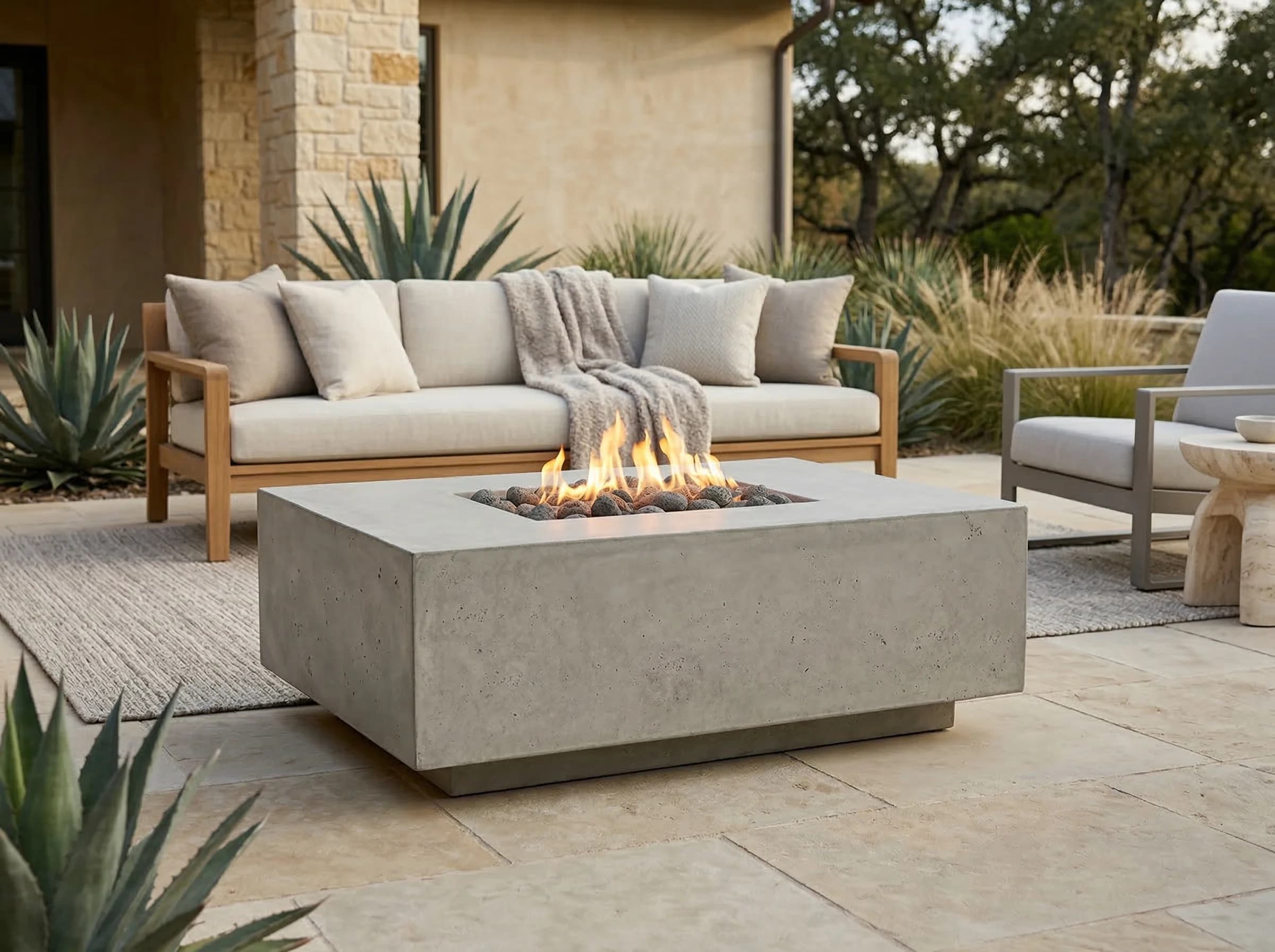
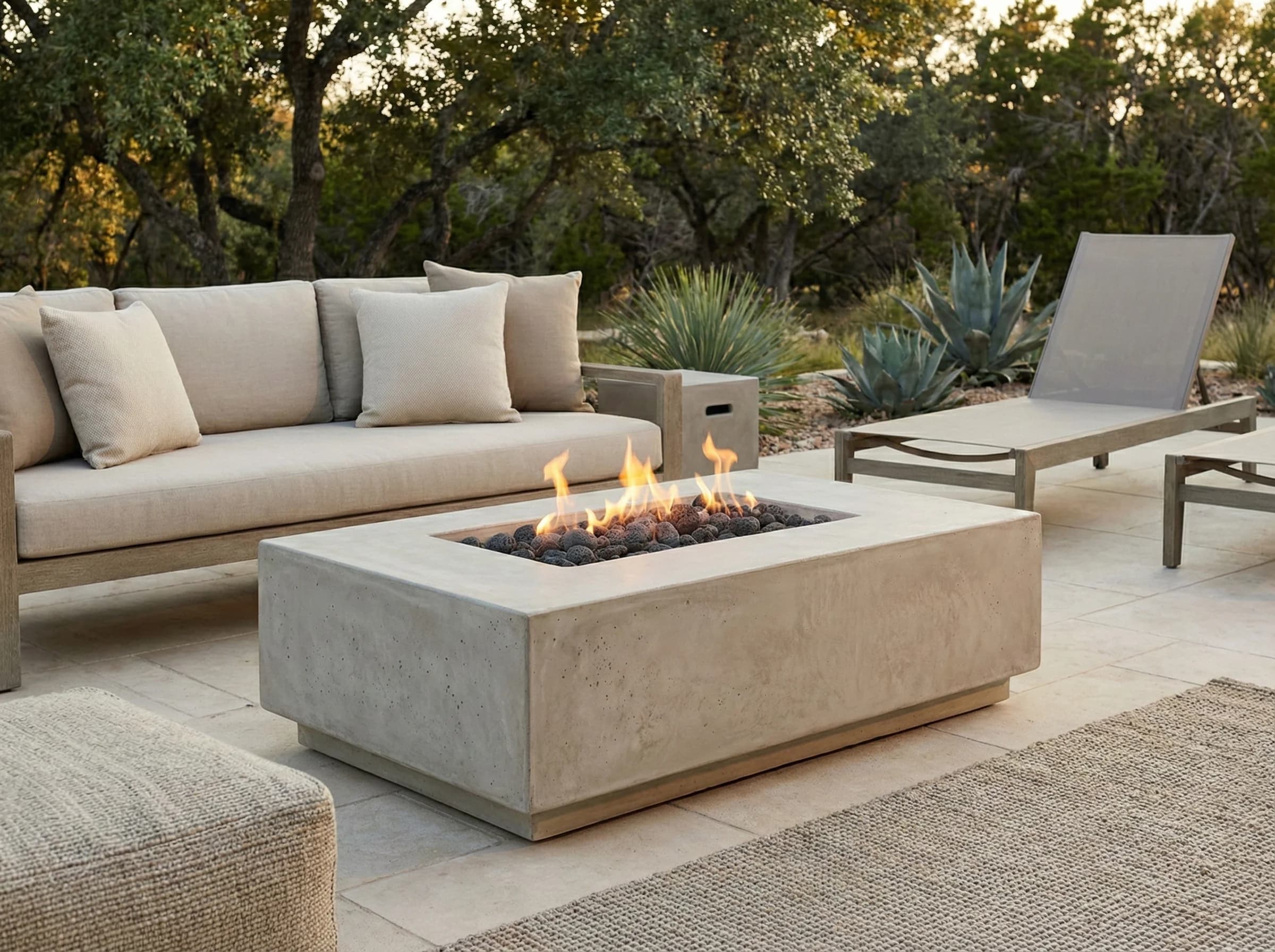
Updated October 2026 — a 20 lb propane tank lasts about 5 to 15 hours on a gas fire table, and the honest answer sits closer to 5 to 7 hours on the 65,000 BTU burner that most residential tables actually ship with. Below is the real math, per SKU, so you can stop guessing.
The question comes in two or three times a week on the sales line. Someone is cross-shopping a Prism Hardscapes Tavola against a competing table, the spec sheet lists 65,000 BTU, and they want to know what that actually means for a Saturday evening on the patio with the 20 lb tank from the hardware store. The AI-generated answers they are reading on Google disagree with each other by a factor of four.
We get it. The math is simple when you have it. Here is what you need to know, with the formula shown so you can run it against any burner on the market — not just the tables we carry at FirePits.com.
How Much Energy Is Actually In a 20 lb Propane Tank?
A standard 20 lb propane cylinder — the one that fits in a grill cradle or a fire-table base — holds about 4.6 US gallons of liquid propanewhen filled to the 80 percent fill rule that every certified refill station observes. The 80 percent floor is a safety margin for liquid-to-vapor expansion as the tank warms; it is why “20 lb” cylinders never actually hold 20 lb of propane and why you can only count on about 17 lb of fuel out of a brand-new fill.
Liquid propane carries roughly 91,500 BTU per gallonat a 60 degree Fahrenheit reference temperature. Multiply the two numbers and the answer is clean:
~421,000BTU per 20 lb tank
4.6 US gallons × 91,500 BTU per gallon = about 421,000 usable BTU per full fill.
That is the number every honest burn-time calculation starts from. The two most-cited competing numbers you will see online — 430,000 and 440,000 BTU — assume the tank is slightly over-filled or that you are measuring at a warmer reference temperature. The difference does not change the answer much. For planning, use 421,000.
What Is the Real Burn-Time Formula?
To find how long a 20 lb propane tank lasts on any fire table, run this:
Burn time (hours) = 421,000 ÷ table BTU per hour Then subtract 15 to 25 percent for wind, cold-tank pressure drop, ignition and regulator losses, and the real-world fact that a maxed-out burner rarely runs at its sticker spec.
That 15-to-25-percent haircut is the piece the single-paragraph answers on Google always skip. A new tank on a warm 70 degree evening, zero wind, a clean burner and a properly-sized regulator will come in near the theoretical maximum. A half-full tank on a 45 degree night with a 10 mph breeze across the patio will land at the bottom of the range. Both numbers are real. The one you actually experience depends on your weather, your tank, and whether you cleaned the burner this spring.
Burn Time Per BTU Tier — The Real Numbers
Every residential gas fire table on the market lives between 30,000 and 200,000 BTU. The table below is the honest answer across that range. We show the theoretical maximum (what the physics allows) and the real-world window we actually quote customers.
Burner rating
Theoretical max
Real-world range
Dim to 50%
30,000 BTU/hr
14.0 hr
11 - 12 hr
22 - 24 hr
40,000 BTU/hr
10.5 hr
8 - 9 hr
16 - 18 hr
45,000 BTU/hr
9.4 hr
7 - 8 hr
14 - 16 hr
50,000 BTU/hr
8.4 hr
6.5 - 7 hr
13 - 14 hr
65,000 BTU/hr
6.5 hr
5 - 5.5 hr
10 - 11 hr
80,000 BTU/hr
5.3 hr
4 - 4.5 hr
8 - 9 hr
90,000 BTU/hr
4.7 hr
3.5 - 4 hr
7 - 8 hr
100,000 BTU/hr
4.2 hr
3.2 - 3.5 hr
6.5 - 7 hr
160,000 BTU/hr
2.6 hr
2.0 - 2.2 hr
4 - 4.5 hr
190,000 BTU/hr
2.2 hr
1.8 - 1.9 hr
3.5 - 4 hr
20 lb propane tank (4.6 gal × 91,500 BTU/gal = ~421,000 BTU) at the burner ratings residential fire tables actually ship with.
Burn Time Per Fire Table We Actually Carry
Spec sheets abstract. Real tables don't. Here is the burn-time math on every gas fire table we ship at FirePits.com, from the smallest 45k bowl up to the commercial-grade Unity 72.
Table (SKU)
BTU/hr
Real burn time on a 20 lb LP tank
Outdoor Plus Coronado 48" rectangle
40,000
8 - 9 hr
Outdoor Plus Sedona 27" bowl
45,000
7 - 8 hr
Prism Hardscapes Piazza 39"
65,000
5 - 5.5 hr
Prism Hardscapes Tavola 3 (48")
65,000
5 - 5.5 hr
Prism Hardscapes Porto 58"
65,000
5 - 5.5 hr
Outdoor Plus Del Mar 48" table
65,000
5 - 5.5 hr
Outdoor Plus Cazo 36" fire+water bowl
65,000
5 - 5.5 hr
Outdoor Plus Regal 60" rectangle
65,000
5 - 5.5 hr
Outdoor Plus Coronado 84" rectangle
90,000
3.5 - 4 hr
Outdoor Plus Unity 60" Corten round
160,000
2.0 - 2.2 hr
Outdoor Plus Unity 72" round
190,000
1.8 - 1.9 hr
Real-world burn time at full flame, 70°F ambient, calm air, clean regulator and burner. Dim to half flame and double these numbers.
The pattern lands quickly. ThePrism Hardscapes Tavola 3 48-inch squareis our best-seller for a reason — the 65,000 BTU burner is the residential sweet spot, and a 5 hour burn window covers almost any shoulder-season evening with a single tank. TheOutdoor Plus Unity 72at 190,000 BTU is a different animal entirely. Beautiful piece. But if you run it on propane you are swapping tanks every two hours, and that gets old by the second dinner.
Why Do Spec-Sheet Hours Rarely Match What You See?
Four variables, in roughly the order they bite.
Wind. A steady 10 mph breeze across the burner pushes raw propane past the flame front before it combusts completely. Not only does the flame get pushed around, but the regulator opens wider trying to maintain pressure. Both effects shorten tank life. On an exposed patio we routinely see 15 to 20 percent shorter real-world burn times than the still-air math. A tempered-glass wind guard around the burner pan recovers most of that loss and is a cheap retrofit on almost every table we ship.
Ambient temperature.Propane in the tank is liquid. It has to vaporize at the top of the cylinder to feed the burner. Below about 40 degrees Fahrenheit the vaporization rate slows, the tank frost-rings up as it steals heat from the air to boil the liquid, and the regulator starves. In a Minnesota October this can take a 65k burner down to a 50k burner's effective output. That is the hidden cost of propane in a cold-climate install, and the reason we tell cold-weather customers to pair a propane table with aBromicpatio heater for the actual warmth, and let the fire table do ambience.
Tank fill state.That 4.6 gallon figure assumes a full tank. A “swap” cylinder from a hardware store exchange rack is usually filled to 15 lb, not 20 — the exchange companies cut the fill to roughly 75 percent of a true full to protect their margin and account for returned-partial inventory. Burn time on a swap tank is closer to 4.2 hr on a 65k burner, not 5.5. Refilling at a propane station — U-Haul, a hardware store with a bulk tank, most RV parks — gets you the full 80 percent fill and the real burn time. It is also usually cheaper per pound.
Burner condition. A clean brass burner with unobstructed ports hits its rated BTU. One that has been through two winters of insect nesting and a season of pollen will run anywhere from 10 to 30 percent lean. You feel it as a dim flame. You also pay for it as a stretched-looking burn time that is really just a weaker burn. A five-minute brush-out and a visual port check every spring is the single biggest thing you can do to protect both burn time and flame quality.
What If I Want Way More Runtime?
Three honest options, in order of what we actually recommend.
Dim the flame. Every table on this list ships with an adjustable key valve or electronic ignition control. Running the flame at 50 to 60 percent still reads as a real, full-looking flame — the human eye does not distinguish between a 35,000 BTU and a 65,000 BTU flame visually from six feet away. What you get is roughly double the burn time per tank. A 5-hour full-flame Tavola 3 turns into 10+ hours at half output. For long ambient evenings this is how we tell customers to run the table.
Bump up to a bigger tank. A 30 lb cylinder is physically similar to a 20 lb (12 inches taller, same diameter range) and holds about 7 gallons, roughly 640,000 BTU. On a 65k burner that is 10 hours wide open. A 40 lb or 100 lb cylinder goes further. The tradeoff is that most fire-table bases are sized for a 20 lb cradle, so a larger tank has to sit next to the table in a dedicated enclosure. Confirm clearance and local code — a few municipalities limit propane volume stored on a residential patio.
Convert to natural gas. If the table lives in one spot and you use it more than about 60 hours a year, natural gas pays back the install cost quickly and removes the burn-time ceiling entirely. We cover the full install-cost break-even math innatural gas vs propane fire pits. Short version: at 200 hours a year, NG costs about $156 annually in fuel, propane runs about $666 on tank exchanges, and a $1,800 line install pays back in roughly 3.5 years. Below 60 hours a year, propane almost always stays cheaper lifetime.
What Does a Full Evening Actually Look Like?
The planning rule we give customers: budget 2 to 3 hours of actual flame time per dinner. Guests arrive, the fire lights, people eat, the conversation shifts, somebody says it is time to go — that is the normal shape of a Saturday on a fire pit table. In my experience, a 65,000 BTU table on a 20 lb tank gets you two of those evenings on one fill, or one long weekend evening with the flame on full the entire time.
For a shoulder-season weekend at a lake house: carry two tanks. You will not use the second one most trips, and when you need it you will be glad it is there.
For a permanent install at a primary residence where the table lives on the same patio year-round: run the gas line. The one-time install cost is lower than most people assume, the burn time becomes irrelevant, and you remove the whole “is the tank empty?” moment from your evening. We watched one Austin client swap three tanks mid-dinner party last August — never again.
Our Picks For Each Use Case
Weekend-use propane, small patio. ThePrism Hardscapes Piazza 39. A 65k burner in a compact 39 inch square footprint. 5 hours of burn time per tank is one honest Saturday evening with no need to swap mid-conversation.
Larger entertaining patio, propane. TheOutdoor Plus Coronado 84at 90,000 BTU. 3.5 to 4 hours per tank wide open. Dim it to 60 percent for ambience and you will get through a full dinner party on a single fill.
Low BTU, maximum runtime. TheOutdoor Plus Sedona 27 bowlat 45,000 BTU gets you close to 8 hours a tank. For a weekend cabin where you cannot carry four cylinders, this is the right answer.
Commercial scale, 190k BTU. TheOutdoor Plus Unity 72on propane is doable but we would not recommend it as the primary plan. Spec the NG variant and run the line. Alternatively, run it off a 100 lb cylinder in a dedicated enclosure — that gets you past 10 hours a fill at 190k.
Three Numbers To Remember
If you take nothing else from this page: 421,000 BTU per tank, divided by your table's BTU per hour, minus 15 to 25 percent for the real world. That math holds for every gas fire table ever made, from a 30k decorative bowl to a 300k commercial centerpiece.
How long does a 20 lb propane tank last on a fire table?+
On a typical 65,000 BTU gas fire table — the burner size you will find on a Prism Hardscapes Tavola 3 or The Outdoor Plus Del Mar 48 — a full 20 lb tank runs about 6.5 hours wide open, closer to 5 hours in real weather. Dim the flame to half and you roughly double it. On a 190,000 BTU table like the Outdoor Plus Unity 72, the same tank is spent in about 2 hours.
What is the real burn-time formula for a 20 lb propane tank?+
A 20 lb propane cylinder holds about 4.6 gallons of liquid propane. Propane carries roughly 91,500 BTU per gallon, so a full tank is about 421,000 usable BTU. Divide 421,000 by the table's BTU-per-hour rating for the theoretical maximum. Shave 15 to 25 percent off that for real wind, cold tank pressure, and ignition efficiency.
Why do some sources say a 20 lb tank lasts 10 hours and others say 4?+
Because they are quoting different fire pit sizes without saying so. A 10-hour answer assumes a 40,000 BTU bowl; a 4-hour answer assumes a 90,000 BTU rectangle. Both can be right. The number you actually care about is burn time at your table's rated BTU per hour — that is what our per-SKU table below gives.
Does running the flame on low make the tank last longer?+
Yes, almost linearly. Most residential gas fire tables will throttle to roughly 40 to 50 percent of maximum output, which stretches a 20 lb tank from about 6.5 hours to 13 hours on a 65k BTU burner. The flame still reads as a real flame, just lower. For long ambient evenings this is how we tell customers to run their table.
How does cold weather affect burn time?+
Below about 40 degrees Fahrenheit, liquid propane struggles to vaporize fast enough to feed a full-rate burner, so the regulator starves and the flame drops. Felt burn time can shorten by 15 to 25 percent in sub-freezing conditions, and in true cold the tank frosts over and the pit cuts out. Natural gas has no such penalty — this is one of the hidden costs of propane in a cold-climate install.
Can I run a propane fire table off a larger tank than 20 lb?+
Yes, with a hose adapter. A 30 lb tank gives about 10 hours on a 65k burner, a 40 lb tank gives about 13, and a 100 lb cylinder gets you past 32 hours. Most fire-pit tables ship with an internal 20 lb cradle, so a larger tank has to sit beside the table rather than inside the base. Confirm clearance and local code before plumbing it in.
Should I switch to natural gas if burn time is annoying?+
If your table lives in one spot and you use it more than about 60 hours a year, yes — natural gas has no burn-time ceiling and the cost per hour is roughly a quarter of propane. See our deeper write-up on natural gas vs propane fire pits for the install-cost break-even math.
Ash — Ash writes the buying guides at FirePits.com — years of specifying fire features on residential installs, from urban patios to mountain properties.