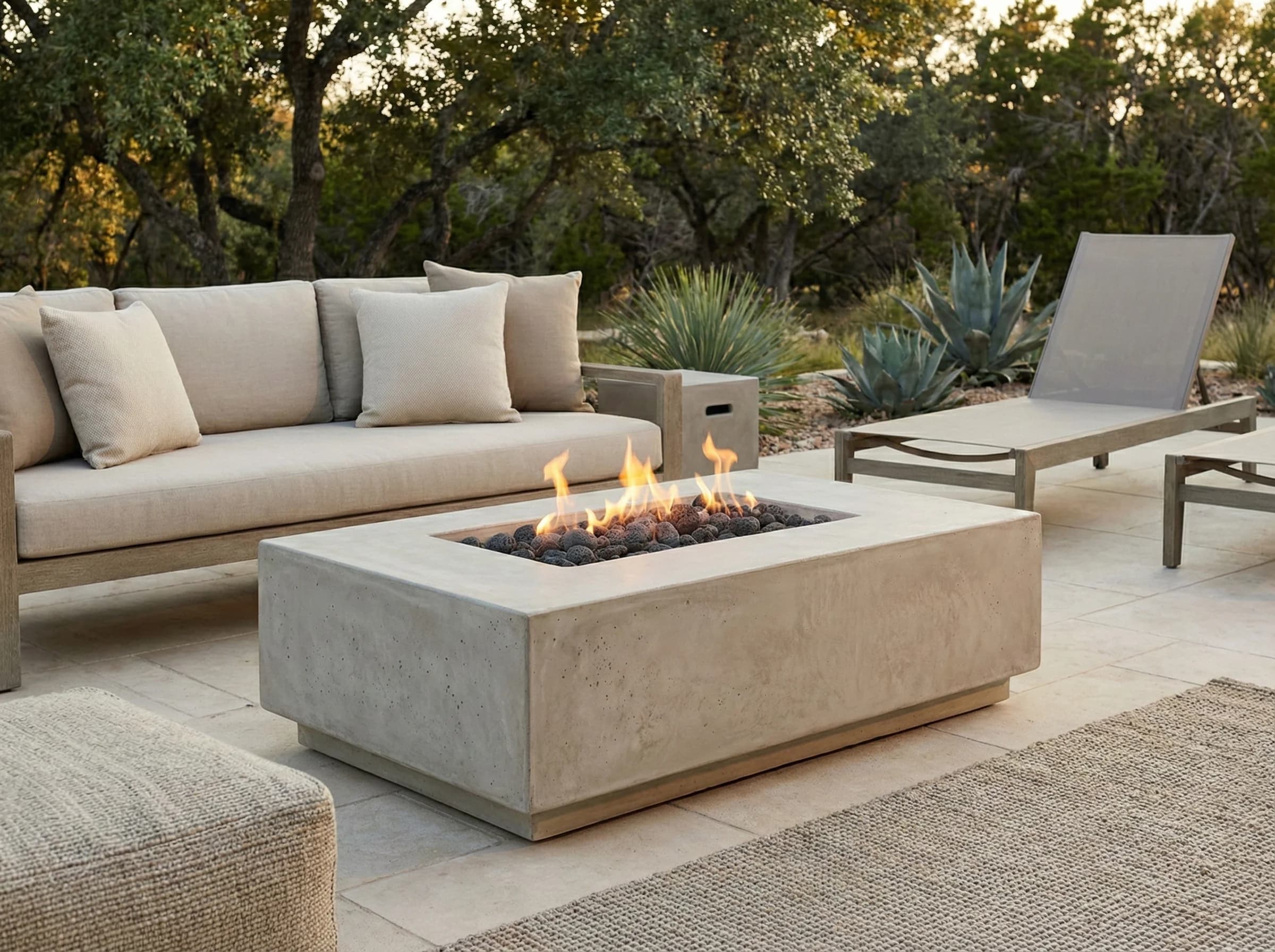
Prism Hardscapes vs The Outdoor Plus: Fire Tables Head to Head
By Ash · Published October 2026
Updated October 2026. These are the two concrete-and-metal fire-table brands we specify most often from the FirePits.com floor. Here is the head-to-head you cannot get from a brand website: build material, burner platform, finish count, lead time, warranty, price tiers, NG vs LP support, water-feature options, and the honest decision frame we walk every buyer through when both brands are on the shortlist.
Who are Prism Hardscapes and The Outdoor Plus?
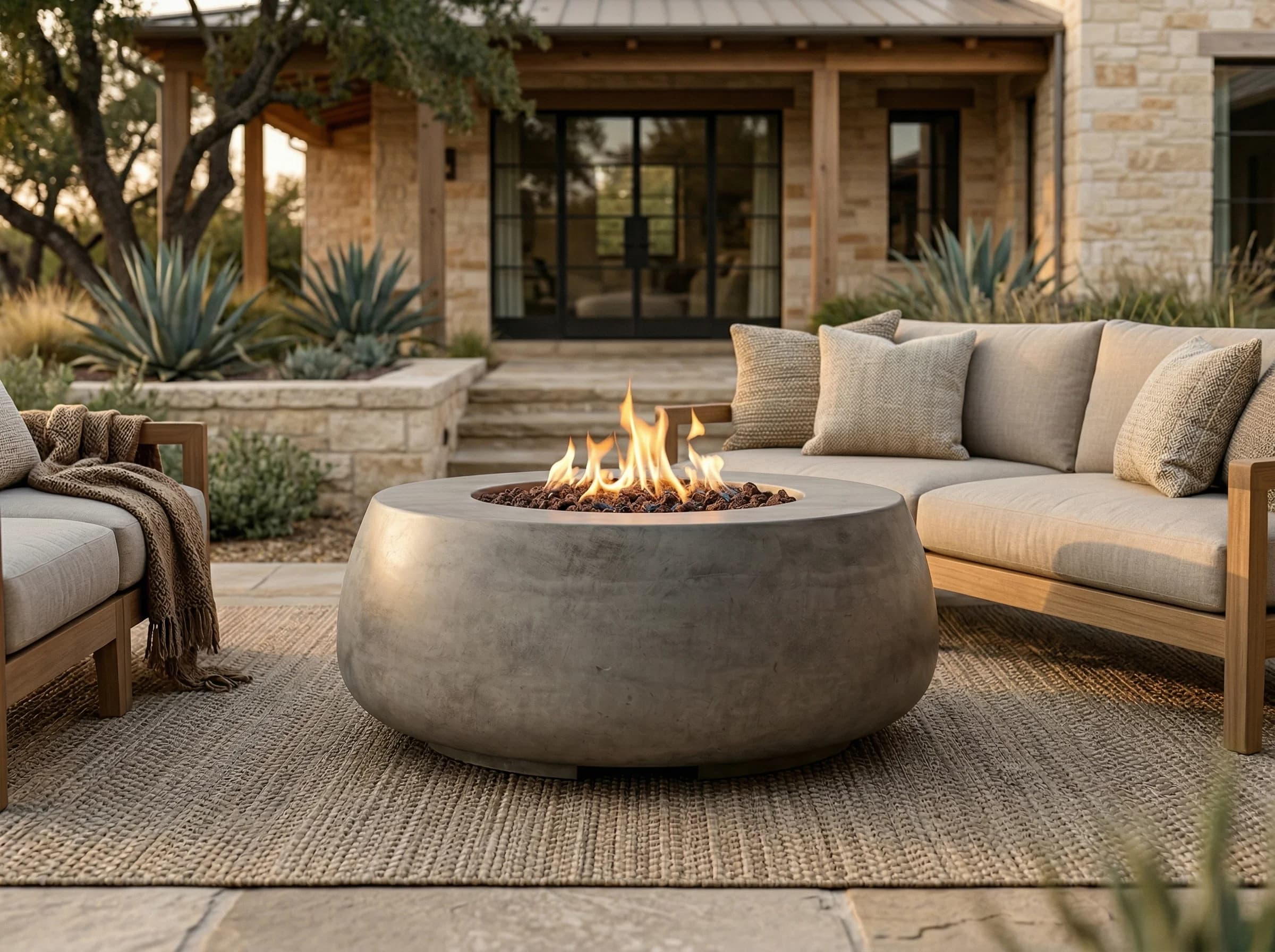
Prism Hardscapes is a California GFRC concrete fire-feature maker, hand-casting every piece at a single facility in Chino. The catalog is intentionally short — Dune, Tavola, Moderno, Cilindro, Fuego, Elevate, plus a handful of hospitality-scale pieces (Fairmont, Largo, Fuego 89). The brand reads as architectural first and consumer-catalog second. Walk into a design center and the Prism display is six fire features arranged like sculptures on a stone floor. The pitch is “this is the fire pit a landscape architect would spec.”
The Outdoor Plus is the deepest custom fire-feature catalog built in the United States. 1,907 live configurations in our system right now across five materials (stainless steel, hammered copper, corten weathering steel, powder-coated steel, GFRC concrete), dozens of silhouettes (Cazo, Maya, Sedona, Regal, Cabo, Unity, Coronado, Grand Colonial, and so on), four ignition tiers, and almost any size the customer wants. The brand reads as a configurator. You pick the shape, you pick the material, you pick the fuel, you pick the ignition, you pick the color inside the material family, and the factory builds that exact combination to order.
In our own stocking we move about 80 Prism SKUs and about 1,907 TOP SKUs through the catalog. That ratio tells you the structural difference between the two brands better than any marketing copy.
Head-to-head matrix: the eight variables that actually matter
These are the eight variables that come up in every real buying conversation when both brands are on the shortlist. Pulled from our dealer floor, from the TOP and Prism Hardscapes spec sheets, and from the installs we have put in the ground this year.
Build material. Prism Hardscapes = GFRC concrete only. Every piece in the catalog is hand-cast glass-fiber-reinforced concrete, no metal body options. The Outdoor Plus = stainless steel (304 and 316), hammered copper (16 gauge), corten weathering steel, powder-coated steel, GFRC concrete. Five material families and most silhouettes available in most materials.
Burner. This is the one most buyers miss: both brands use essentially the same stainless-steel brass-jet burner platform under the body. The flame you see on a 65,000 BTU Prism Dune is the same flame geometry you see on a 65,000 BTU TOP Cazo — the stainless H-burners and bullet jets come from the same engineering lineage. Where they differ is the control panel and ignition housing above the burner, not the burner itself.
Finish count. Prism: roughly six base concrete colors (Pebble, Natural, Charcoal, Cafe, Rustic, Ultra White), with limited custom tinting on larger orders. The Outdoor Plus: ten GFRC concrete colors in the concrete line alone, plus the full stainless/copper/corten/powder material families on top. Finish breadth is TOP's biggest category win.
Lead time. Prism: 1 to 3 weeks on stocked configurations, 4 to 8 weeks on custom colors. The Outdoor Plus: 2 to 4 weeks on volume configurations (Regal corten, Cazo powder-coated), 6 to 10 weeks on fully-custom builds (hammered copper, custom size, custom ignition).
Warranty. Both brands warranty the stainless burner for the life of the original owner. Both warranty the concrete or metal body for 3 years against manufacturing defects. Both exclude patina evolution (corten, copper) and natural concrete color variation. Operationally equivalent — neither brand is a warranty differentiator.
Price tiers. Prism: roughly $2,300 (Pentola 24) to $8,500 (Fairmont 72). The Outdoor Plus: roughly $1,400 (24-inch powder-coated Cazo) to $12,000 (72-inch hammered copper with Plug & Play). TOP has both a lower entry point and a higher ceiling.
NG vs LP support. Both brands build every SKU in either natural gas or liquid propane at the factory. Same BTU on either fuel. Same conversion kit cost ($150-$300) if a field conversion is later needed. No meaningful difference.
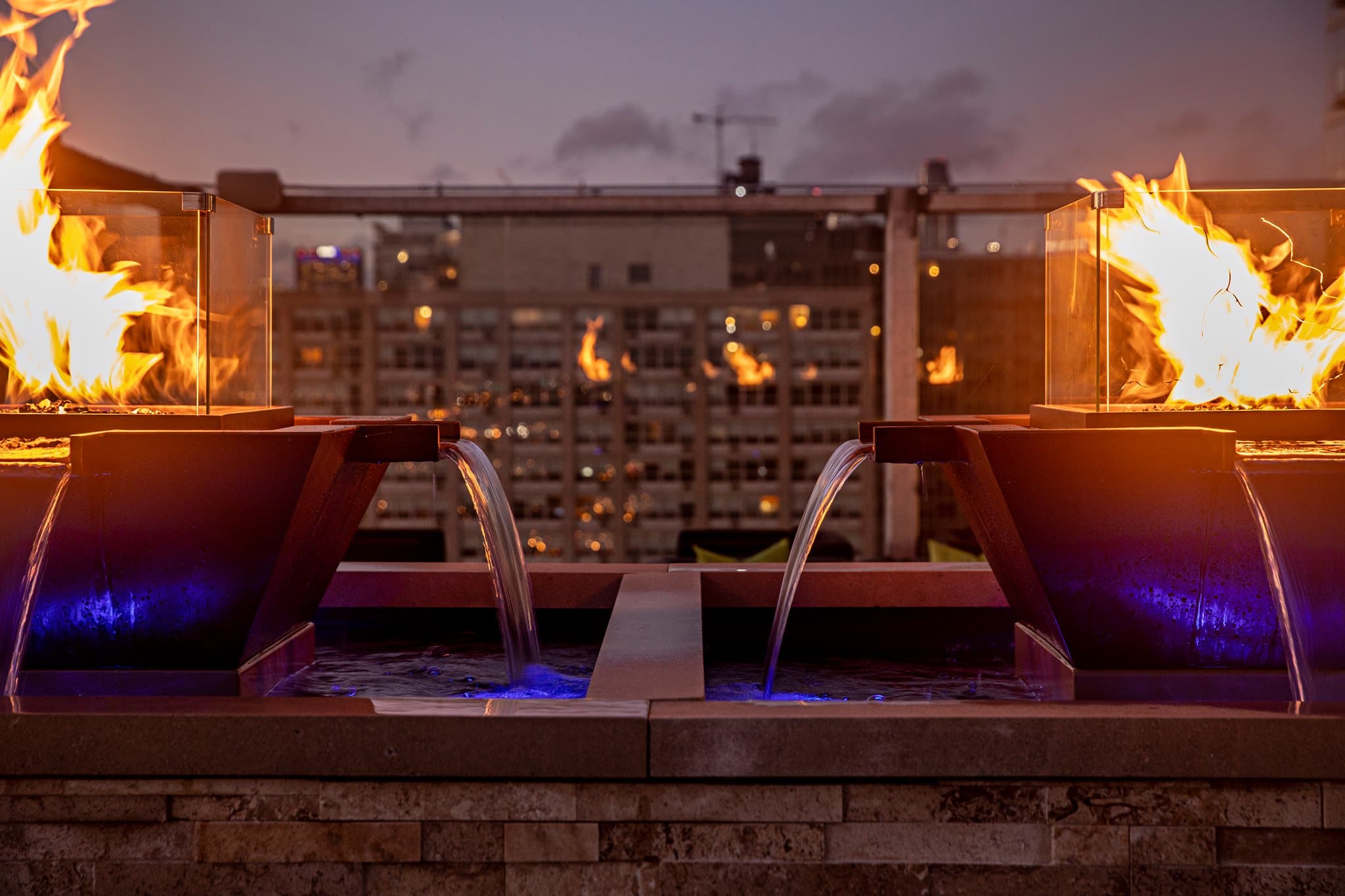
Water-feature option. Prism Hardscapes: no integrated fire-and-water SKUs. The Outdoor Plus: Maya 4-way fire-and-water bowls, Cazo fire-and-water bowls (36 and 42-inch), scupper walls, and spa-side fire-and-water scuppers across most materials. If water is part of the design brief, TOP is the only brand of these two that can deliver.
Where Prism Hardscapes beats The Outdoor Plus
The sculptural silhouette. This is the single biggest reason buyers pick Prism over TOP when both are on the table. A Prism Hardscapes Dune, Tavola, or Moderno piece reads as one carefully-finished architectural object. Hand-casting means the edges are softened the way a sculptor would soften them, not CNC-sharp the way a modular catalog system would deliver them. In a project where the landscape architect specified the fire feature as a design element — not just a utility — Prism wins on silhouette almost every time.
Short, legible catalog. Six silhouettes, a short color palette, decisions get made quickly. The Outdoor Plus's 1,907-SKU catalog is a feature when the buyer wants to customize and a bug when the buyer wants to be guided. In our dealer floor conversations, buyers who open with “just show me what you would put in my yard” converge on Prism faster than buyers who open with “what are my options.”
Faster lead time on stocked combinations. A Prism Dune 42 in Pebble gray with match-lit NG ships from inventory in a week. The equivalent TOP piece in GFRC gray is typically 4 to 6 weeks because every TOP configuration is build-to-order. On a fast-turn project where the fire feature is on the critical path, Prism's stocked-color program is the shorter chain.
Lower delivered price on apples-to-apples concrete. At the 36 to 48-inch concrete tier, Prism undercuts TOP by $300 to $600 at the same spec. The Dune 42 lands near $2,900 while a comparable TOP piece in GFRC concrete at 42 inches round lands around $3,300. Flip the comparison to 60-inch or above and TOP catches up because the TOP concrete line scales more linearly — but at the compact size, Prism holds a real price advantage.
Freeze-thaw stability as a design intent, not a workaround. Prism engineers the GFRC specifically for freeze-thaw cycling because the brand sells heavily into the Northeast and Mountain West landscape-architect channel. TOP's GFRC passes freeze-thaw testing too, but the TOP concrete line reads as one option among five materials, not as the primary engineering target. If the project is in Vermont, Minnesota, or Colorado, Prism is the safer long-term call on GFRC.
Where The Outdoor Plus beats Prism Hardscapes
Catalog breadth. 1,907 SKUs vs 80. If the project needs a 72-inch rectangular hammered copper fire pit with Plug & Play ignition and a wind guard in a specific color, Prism cannot build that and TOP can. The breadth matters most at the extremes — very large installations, specific material requests, atypical sizes.
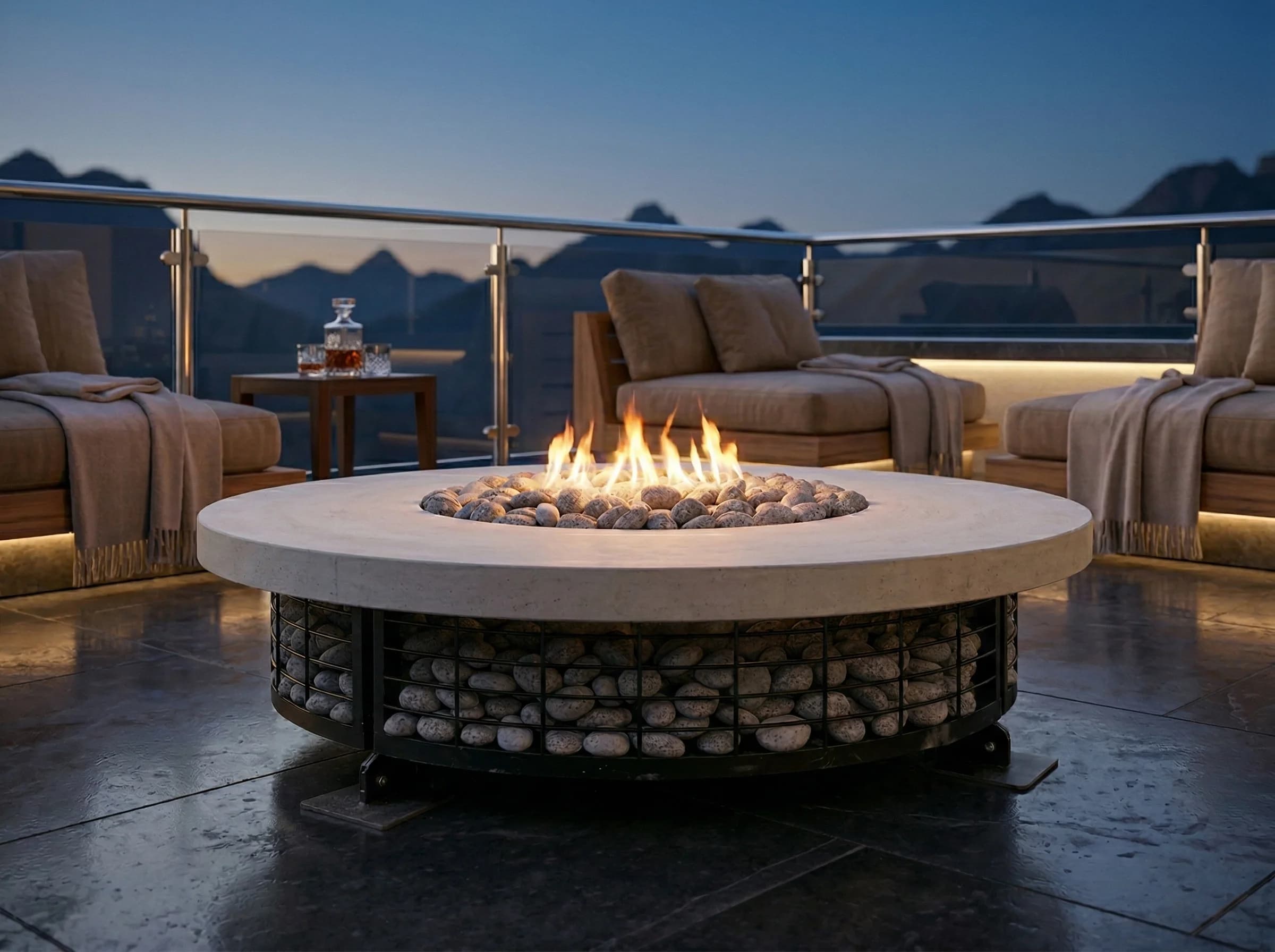
Material variety beyond concrete. Hammered copper, corten weathering steel, 304/316 stainless, powder-coated steel. These four material families are entirely outside Prism's catalog. On a modern-industrial project calling for a corten patina, or a pool-deck project calling for hammered copper to pair with a copper spa spillway, TOP is the only one of these two brands that can deliver.
Fire-and-water as a native category. This is TOP's clearest architectural win. The Maya 4-way, the Cazo fire-and-water, and the scupper walls combine fire and water as a single integrated feature with one pump, one burner, and independent controls. Prism does not build this. When the design brief says “fire feature that doubles as a water feature,” the shortlist collapses to TOP.
Deeper color and finish customization. Within the GFRC line alone, TOP builds ten colors (Black, Chestnut, Gray, Ash, Natural Gray, Limestone, Brown, Chocolate, Vanilla, and others). Prism's base palette is roughly six. Within corten or copper, TOP's custom-finish options are entirely outside Prism's catalog. For projects where the designer wants to match a specific paver tone or stone cladding, TOP's finish depth is the biggest tool.
Ignition options. TOP offers Match Lit, AWEIS (12V spark-to-pilot), Plug & Play (electronic ignition with remote), and FPPK (full-time thermopile pilot). Prism offers Match Lit and PH Ignite (their electronic ignition retrofit). For buyers who want remote start, auto-shutoff on flame-out, and a timer, TOP's Plug & Play system is the more mature product.
Higher ceiling on scale. If the project is a hospitality install, a resort fire pit, or a residential installation that calls for an 84 to 110-inch fire feature, TOP builds those (Grand Colonial 72, Coronado 84, Alberta 120). Prism's largest standard SKU is the Tavola 110 at 110 inches, which overlaps TOP's top end, but the full large-format catalog depth is TOP's. Resort and commercial jobs almost always land at TOP for the size options.
Pick Prism if, pick The Outdoor Plus if: the honest decision frame
Here is the frame we walk every real buyer through when both brands are on the shortlist and they are asking us to pick for them. Not marketing copy — the actual decision tree.
Pick Prism Hardscapes if the project is a residential patio, the design brief emphasizes architectural silhouette over configurability, GFRC concrete is the specified material, the size target is 36 to 60 inches, and the schedule rewards a 1 to 3 week lead time. The Dune 42, Tavola 42, and Moderno 5 cover roughly 70% of those briefs, and the Fuego 54 or Fairmont 72 cover the larger ones. If the buyer says “I want it to look like a sculpture, not like a product,” Prism wins.
Pick The Outdoor Plus if the project needs a non-concrete material (corten, copper, stainless), the design brief includes a water feature paired with the fire feature, the size target is above 66 inches or below 36 inches, the ignition requirement is remote-start electronic, or the finish specification is a particular color not in Prism's palette. Also pick TOP for anything commercial or hospitality where the install footprint requires a size or configuration Prism does not catalog.
Pick either, and the project is fine on a 42 to 54-inch GFRC concrete residential fire pit with match-lit NG and a stocked gray or chestnut color. The two brands converge here, both deliver a 15 to 20-year install, and the choice becomes aesthetic preference. In my experience the aesthetic argument tips to Prism for landscape-architect-led projects and tips to TOP for designer-and-builder-led projects, but reasonable people split either way.
Real install considerations across both brands
These show up on every install regardless of brand. Worth knowing before the gas fitter arrives.
Weight. GFRC concrete is lighter than cast concrete but still heavy. A Prism Dune 42 weighs about 300 pounds. A Prism Tavola 7 at 60 inches rectangular is about 650 pounds. The equivalent TOP pieces come in slightly lighter per-size because TOP's GFRC wall thickness is thinner, but a Cabo 66 corten is still 350+ pounds. Plan the delivery and placement before the hardscape is sealed — neither brand is a one-person placement job.
Gas-line sizing. A 65,000 BTU burner is the volume spec on both brands' most common pieces. If the line also feeds a built-in grill, a patio heater, and a side burner, verify the combined simultaneous draw does not exceed the line's capacity plus 20% headroom. We learned this the hard way at FirePits.com on a Lake Austin install where the undersized gas line fed a weak, flickering flame that never passed the post-install flame-height spec test. The gas fitter sized the line to the grill alone, forgot the fire pit, and the pit was underserved from day one.
Burner-tray drainage. Both brands' burner trays sit inside the vessel and collect rainwater if the pit is not covered off-season. Rainwater in the tray oxidizes the burner connections and corrodes the ignition module. Order the matching brand cover with the pit — a generic cover does not seal correctly at the lip, and the pit will fail in 5 years instead of 15.
Media. Both brands ship with lava rock or fire glass media. Lava rock is the default and reads correctly on corten, copper, and dark concrete. Fire glass (1/4-inch tempered chunks in black, bronze, or amber) reads correctly on light-concrete Prism finishes and on stainless or GFRC TOP finishes. We stock both media types for both brands — most buyers upgrade to fire glass at install time once they see it next to lava rock on the showroom floor.
Prism Hardscapes vs The Outdoor Plus: the one-line summary
Prism Hardscapes is the architectural fire-feature brand you pick when the design brief wants six carefully curated concrete silhouettes with a predictable aesthetic read. The Outdoor Plus is the configurable fire-feature catalog you pick when the design brief wants the exact material, size, finish, fuel, and ignition combination the project calls for, built to order. Both share the same stainless-steel burner engineering underneath. Both will deliver a 15 to 20-year install if the gas plumbing is sized correctly and the pit is covered off-season.
If you want help spec'ing either brand for your patio, the shortest path is to send us the patio dimensions, the material of the pavers, and a photo of the seating arrangement, and we will send back the two or three SKUs from each brand that fit. Both brands sit in the same showroom. We stock covers, conversion kits, and wind guards for both. Shop the full gas fire table catalog, the wider fire pit range, or the brand hubs for Prism Hardscapes and The Outdoor Plus.
Frequently Asked Questions
Is Prism Hardscapes better than The Outdoor Plus?+
Who makes the best GFRC concrete fire pit?+
What is the price difference between Prism Hardscapes and The Outdoor Plus?+
Does The Outdoor Plus make fire-and-water features?+
Which brand has better lead times?+
Can both brands run on natural gas and propane?+
Products & brands in this guide
Related reading
Ash — Ash writes the buying guides at FirePits.com — years of specifying fire features on residential installs, from urban patios to mountain properties.