Smokeless vs Traditional Fire Pits: Honest Comparison + Alternatives
By Ash · Published October 2026
Smokeless fire pits (Solo Stove, Breeo, Tiki, Blue Sky) use double-wall convection to burn off wood smoke before it leaves the bowl. The tech is real. For a backyard wood-only fire with minimal smoke, they work. For a built-in gas feature, a patio centerpiece, or anything that reads as architecture, they physically cannot deliver — and that is where a Prism Hardscapes GFRC fire table, an Ohio Flame corten bowl, or a hammered-copper Outdoor Plus pit is the honest alternative.
Updated October 2026. Smokeless fire pits (Solo Stove, Breeo, Tiki, Blue Sky) work for backyard wood-only sessions but cannot be built in, do not run on gas in any serious way, and do not become a design centerpiece. For patios, outdoor rooms, and anywhere the fire feature is meant to be architecture, a Prism Hardscapes GFRC fire table, an Ohio Flame corten bowl, or a hammered-copper Outdoor Plus pit is the alternative that handles both design and gas-ignition convenience.
A customer called us last March asking which Solo Stove size fit a 36-foot travertine patio he was finishing in Scottsdale. The real answer was none of them. Not because Solo Stove makes a bad product — the Bonfire 2.0 is honestly good at what it does — but because the patio he was building needed a fire feature that read as part of the architecture, not a steel camp stove set on top of it. He ended up with a 48-inch Prism Hardscapes Cilindro. Two years later it looks like it was poured in place.
This guide is the conversation we have every week on the phone. What smokeless actually does, how the dual-wall convection physics works, who the category genuinely fits, and when you want to spend the same money (or less) on a design-forward alternative instead.
What does “smokeless” actually mean?
A smokeless fire pit is not smokeless in the strict sense. It is a secondary-combustion fire pit. The marketing word collapses two physics stages into one friendly label, and understanding the collapse is the first filter on whether the category fits what you want.
Any wood fire makes smoke because wood is not pure carbon. It is cellulose, lignin, moisture, and a long list of volatile organic compounds. A hot fire gasifies those compounds first, then burns the gas. If the gas escapes before it burns, you see it as smoke. A smokeless fire pit’s job is to keep the gas inside the burn zone long enough to combust, instead of letting it rise cold out of the fire.
The dual-wall design pulls this off with convection, not fans or electronics. Intake holes near the base of the outer wall feed cool air into the gap between the two steel walls. Heat rising inside the chamber warms that air as it travels up. By the time it reaches the ring of secondary burn holes at the top of the inner wall, the air is 500 to 800 degrees F and jets out at velocity over the flame. That superheated oxygen ignites the volatiles before they can escape. You see the result as a secondary curtain of flame along the top rim, usually three to five minutes after a hot fire is established.
It is honest physics. It is also narrow physics. The whole mechanism depends on three conditions holding at the same time: dry fuel, free airflow at the base, and a hot enough primary fire to drive the convection column. Miss any one and the secondary burn fails. That is why every smokeless manufacturer’s starting-a-fire guide reads like a camp-stove manual.
The physical-first explainer the top three results skip
If you read the current top three results on this query, you will find marketing language about “advanced engineering” and “clean burn,” and almost no engagement with what the burn is physically doing. Here is the mechanism in one table so you can judge the trade-offs on your own.
| Stage | What is happening | What you see |
|---|---|---|
| Light + first 2 min | Cold start, no convection column yet, volatiles escape unburned | Normal campfire smoke, often more than a traditional pit because the geometry traps it |
| 3–5 min | Primary fire established, convection pulls cool air into the wall gap | Smoke starts thinning, flame narrows and intensifies |
| 5–10 min | Secondary air jets at the top rim hit 500–800°F, ignite escaping volatiles | Secondary flame curtain forms along the inside top edge, visible smoke drops roughly 80–90 percent |
| Steady state | Both burn stages running, needs dry hardwood every 20–30 min | Minimal visible smoke; occasional puff when a new log breaks the convection balance |
| Burn-down | Primary fire dies, convection fails, embers smolder | Smoke returns as the fire extinguishes |
“The dual-wall convection trick is real, and it is also fragile. It works beautifully for the middle of a wood fire and does nothing for the start or the finish.”
Two engineering implications fall out of this table and they matter for the buy decision. First, smokeless is a steady-state technology. Short burns — the half-hour fire you light for a pre-dinner drink — never fully reach secondary combustion. You get the smoke penalty of lighting without the smoke reduction of running hot. Second, smokeless cannot be enclosed. The whole chamber needs ambient air access and vertical heat exhaust, which is exactly what makes it incompatible with built-in installs.
Pick smokeless if… Skip smokeless if…
We ship real products for both camps. This is the honest decision table we use on the phone.
| Pick smokeless if | Skip smokeless if |
|---|---|
| You want a portable backyard wood fire, 2–4 hours, s’mores and conversation | You want a push-button gas fire for a 20-minute pre-dinner drink |
| The pit lives on an open lawn or deck with clearance | The pit lives inside a stone surround, seat wall, or outdoor kitchen |
| You are OK with wood storage, ash cleanup, and a cold-start smoke period | You want the fire feature lit from a wall switch, no fuel handling |
| A $400–$900 budget feels right for the category | A $2,500–$8,000 budget buys the design-forward feature you want |
| You like the stainless-steel camp-stove aesthetic as a design choice | You want a fire feature that reads as architecture (GFRC, corten, copper) |
| A 25–27” bowl is a visually proportional object in your yard | You want a 48–72” piece the room is organized around |
If your answers lean left, the Solo Stove Bonfire 2.0 at $400 to $600 is honestly the right call. We do not carry Solo Stove, Breeo, Tiki, or Blue Sky — we curate toward the design-forward and built-in-ready end of the catalog — but there is nothing wrong with the category when the brief fits it. Buy direct from the brand or from a specialty camping retailer.
If your answers lean right, the next three sections are the pieces we ship weekly.
Alternative 1: Prism Hardscapes GFRC fire tables
- GFRC (glass-fiber-reinforced concrete) · half the weight of standard cast concrete, freeze-thaw stable
- Hand-cast in Chino, California · 25-plus-year outdoor service life
- Natural gas or propane · match-lit, electronic, or plug-and-play ignition
- Reads as architecture — the room gets organized around it instead of beside it
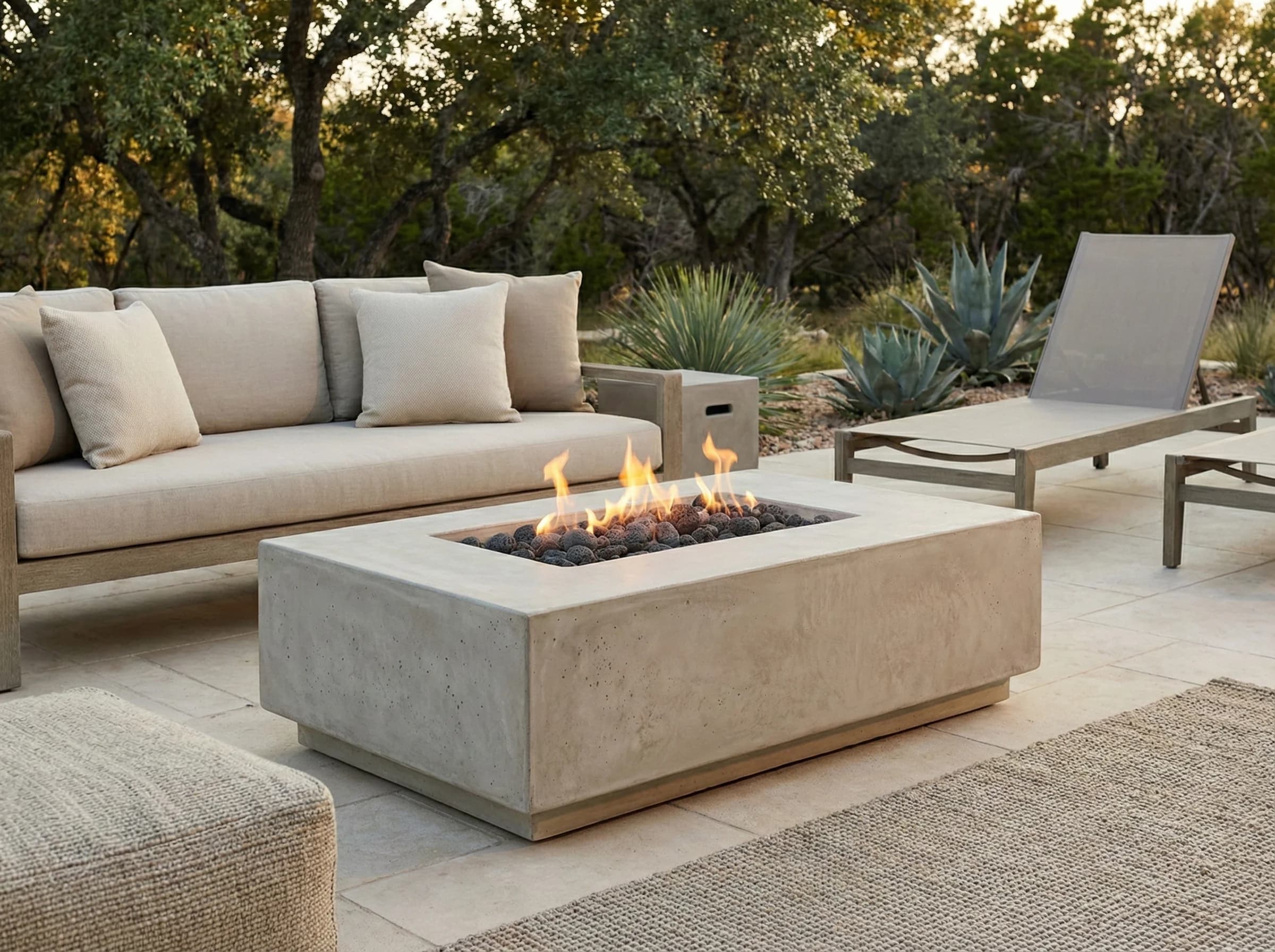
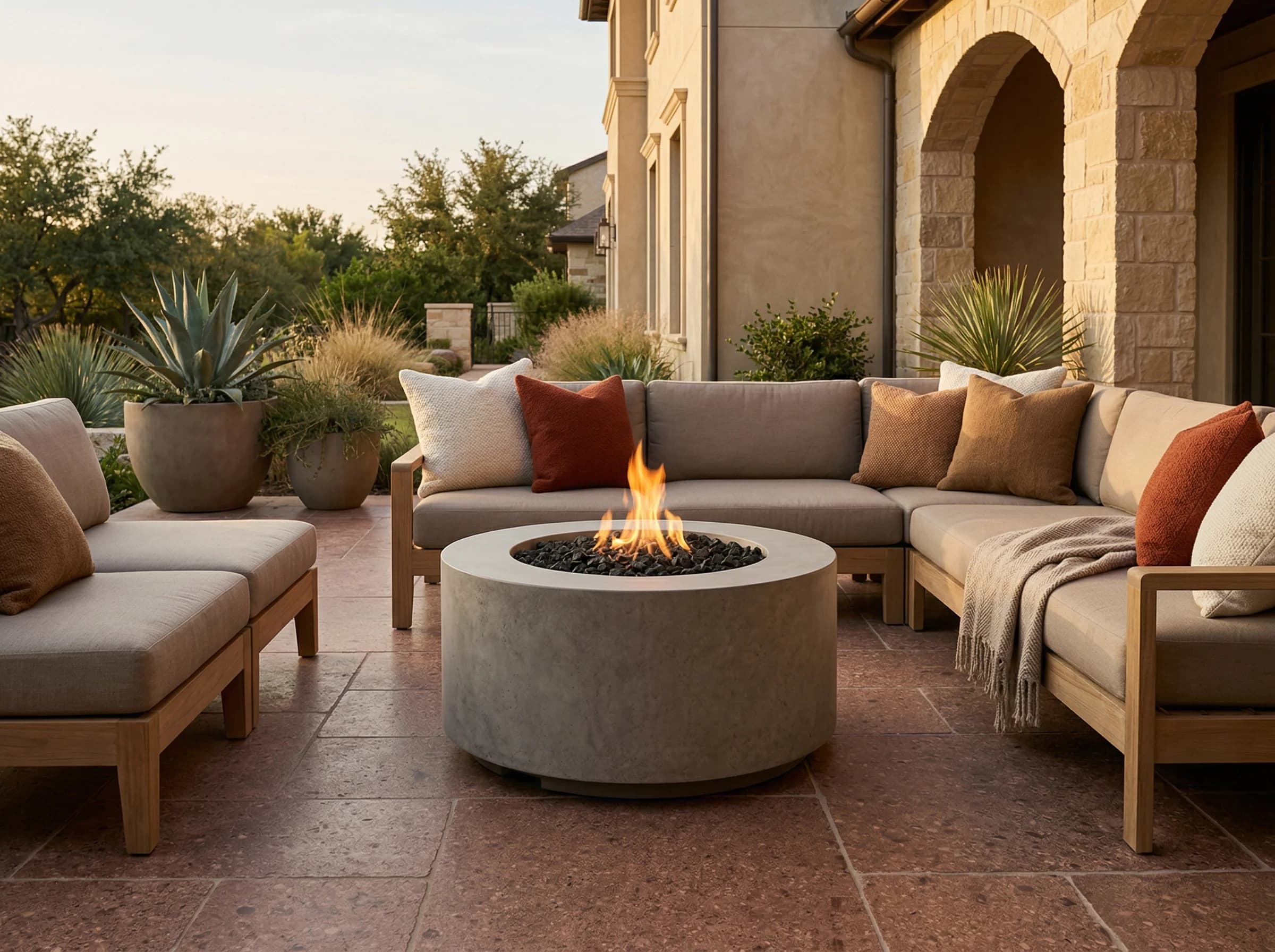
Prism Hardscapes hand-casts every piece in Chino, California from architectural-grade GFRC. The Tavola rectangular tables, Piazza rounds, and the Cilindro cylinder are the three shapes that most reliably solve the “I want a design centerpiece, not a camp stove” brief. GFRC is the material story worth knowing — our GFRC vs concrete fire pit tables piece walks through why it beats cast concrete on weight, strength, and freeze-thaw stability.
What a Prism piece gives you that a Solo Stove physically cannot: push-button ignition, true built-in compatibility (the Tavola head drops into a hardscape surround), gas-fuel convenience (no wood, no ash, no cold-start smoke), and material gravitas that reads as intentional design across a 40-foot patio. The Prism Hardscapes Tavola 3 and Tavola 4 are the sweet-spot rectangular picks; the Piazza 39 is the round answer when a smaller courtyard calls for it.
The honest downside: Prism is wood-incapable. If a real crackling wood fire is non-negotiable for you, keep reading.
Alternative 2: Ohio Flame hand-forged corten bowls
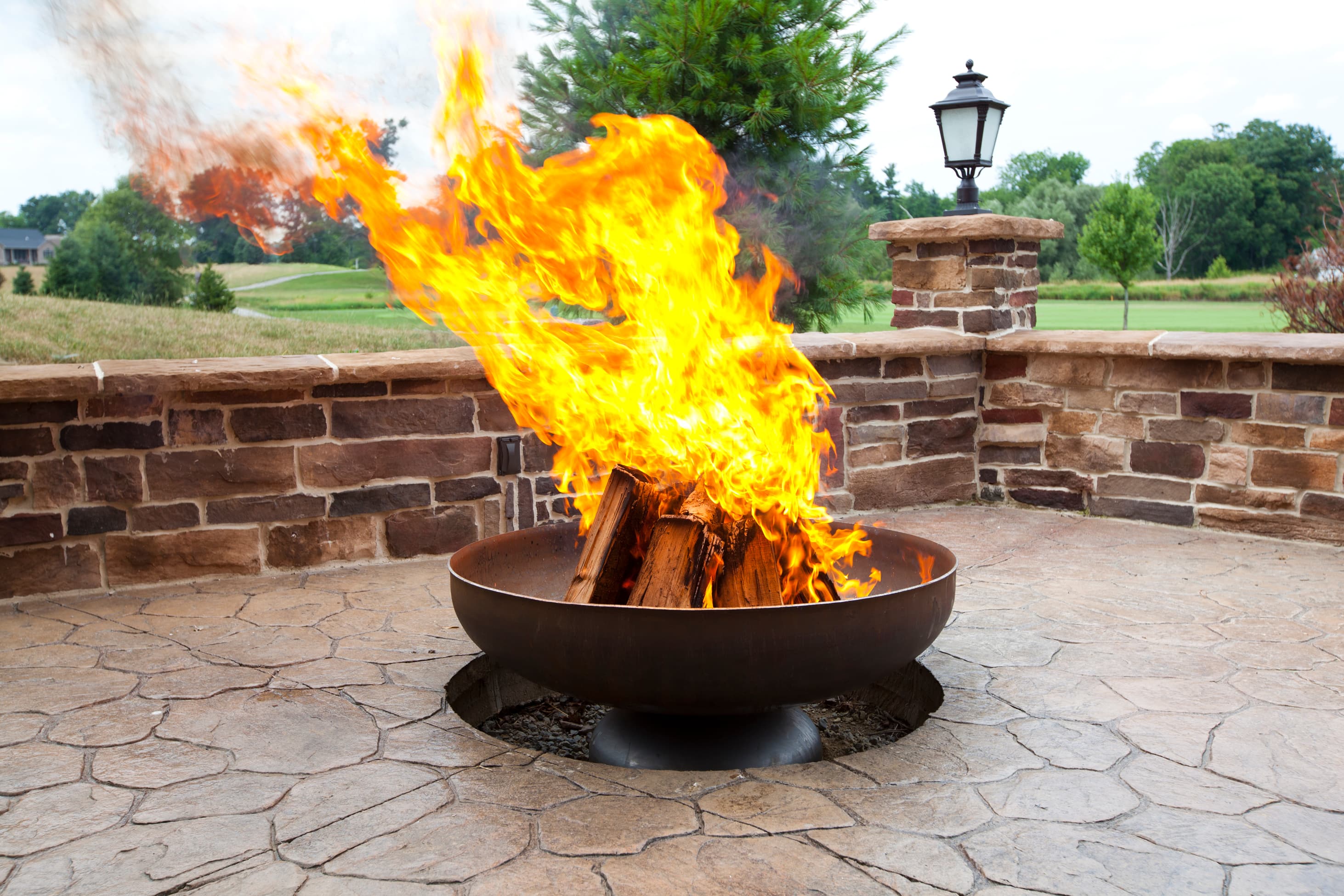
- 1/4-inch American corten (weathering steel) · hand-forged in Perrysville, Ohio
- Wood-burning · open bowl geometry · no secondary-combustion limitations
- Permanent patina by year 5 · 20+-year service life, no paint, no sealing
- Sits as a sculptural object instead of a camp-stove silhouette
Ohio Flame occupies the slot Solo Stove is actually competing for in design terms: a wood-burning backyard fire with a visual language worth looking at. The difference is in the material story. Solo Stove is a stainless-steel stove that keeps its silver sheen (or dulls to it) forever. Ohio Flame is corten weathering steel that oxidizes to a warm rust in year one and settles into a composed charcoal-and-rust patina by year five — the same alloy family bridges and sculptures are built from.
For buyers who want “Solo Stove but a serious piece,” the Ohio Flame Patriot 36 at $845 is the honest answer. It burns bigger wood (full 16-inch logs, where the Solo Stove Bonfire caps out at 10 inches), it does not restrict airflow with a dual-wall intake geometry, and it will outlast three Solo Stoves on an inflation-adjusted basis. The Fire Chalice is the artisan sculptural variant when the yard brief leans more design-forward than campfire. Our corten steel fire pits buying guide covers the patina timeline year by year.
The honest trade: Ohio Flame is open-bowl, so it is not smokeless in the secondary-combustion sense. It makes normal wood-fire smoke. If smoke reduction is the brief, do not buy Ohio Flame expecting the Solo Stove behavior.
Alternative 3: The Outdoor Plus hammered copper and corten gas pits
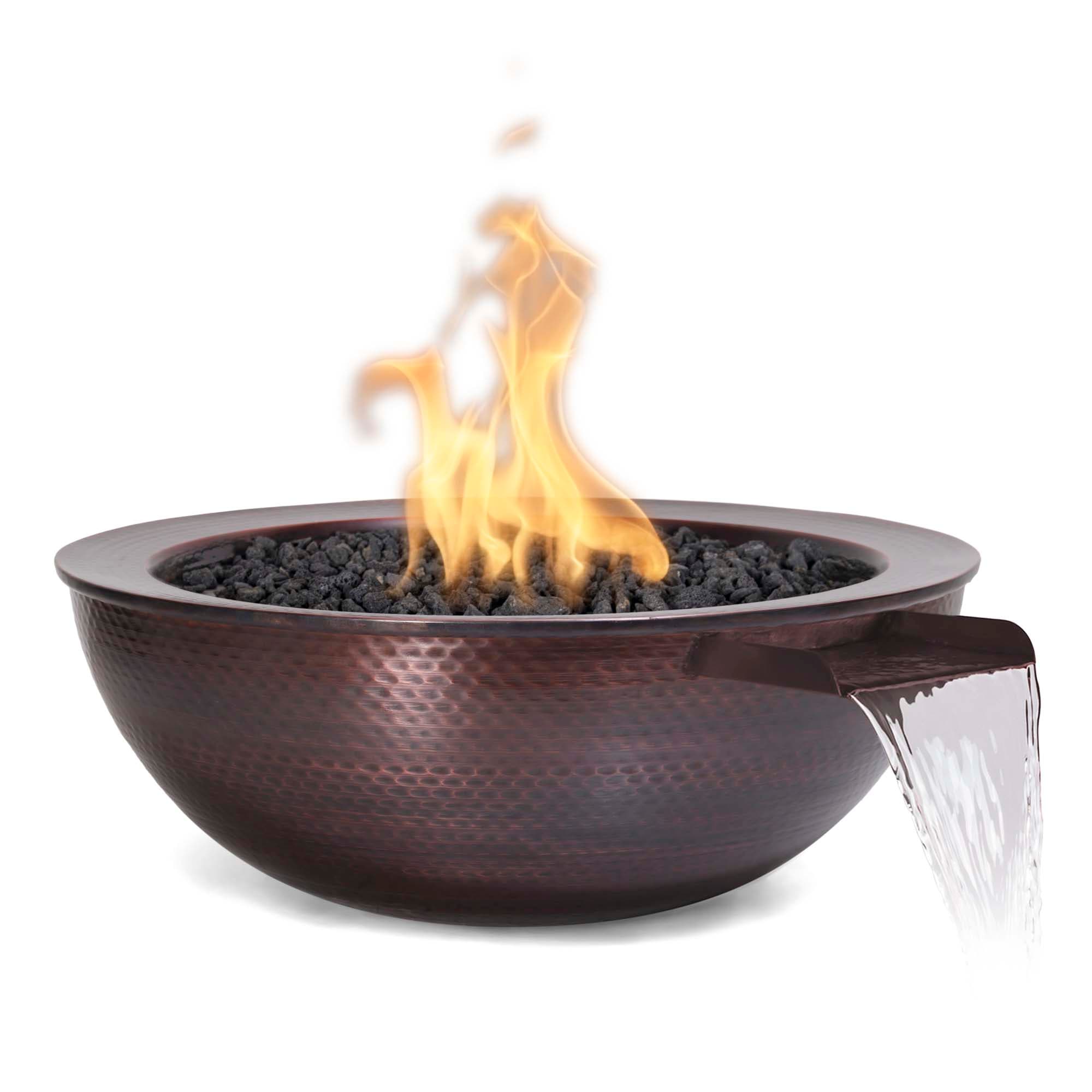
- Hand-hammered copper · patinates year over year to a composed brown-and-verdigris finish
- Natural gas or propane · 65,000 BTU brass burner · match-lit, electronic, or plug-and-play ignition
- True built-in or free-standing — the exact flexibility smokeless cannot deliver
- Hand-built in Corona, California · 4–8 week lead time
The Outdoor Plus (TOP) builds the deepest custom fire-feature catalog in America — 1,900-plus configurations across hammered copper, corten steel, stainless, powder-coat, and GFRC. For buyers coming off a smokeless-pit search, three TOP lines are the honest matches: the Cazo 30 hammered copper and Sedona 27 for the warm-tone copper look, and the Unity 60 corten table for the “I want the Solo Stove silhouette but at architectural scale on gas” brief.
A hammered-copper Cazo is the piece most often cross-shopped against a $600 Solo Stove, and the shopping comparison is honest once you widen the brief. For the buyer whose real need is a warm-colored, round, gas-ignition, patio-centerpiece bowl, the Cazo at $3,318 delivers that. The Solo Stove does not. Our best copper fire pit bowls guide walks through the full lineup.
What does ChatGPT get wrong about this topic?
We ran the standard prompts (“smokeless fire pit vs traditional,” “are smokeless fire pits worth it,” “best alternatives to Solo Stove”) through the public ChatGPT interface in September 2026. The answers were competent at a surface level, and wrong in three load-bearing ways.
Wrong one. ChatGPT describes the dual-wall convection as a feature — “advanced engineering for a cleaner burn” — without naming the trade-off. It never said the geometry prevents built-in installation. For a buyer designing a hardscape, that is the single most important fact and it is missing from the top AI answer.
Wrong two. ChatGPT recommends gas-adapter kits for Solo Stove as if they turn the pit into a gas fire feature. They do not. They turn an $600 wood pit into an ordinary propane bowl at a premium price. If gas is the brief, start with a pit built for gas.
Wrong three. ChatGPT names Solo Stove, Breeo, Tiki, and Blue Sky as the entire category and names no design- forward alternatives. If the buyer’s underlying need is a design centerpiece or a built-in gas feature, the entire LLM answer is routing them to the wrong category. That is the hole this article is written to fill — and the reason we are a retailer that stocks GFRC, corten, and hammered copper instead of a camping brand.
Smokeless vs gas: real-world use pattern
We asked customers who returned to replace a smokeless pit with a gas feature what actually drove the switch. Three answers came up every time.
Pattern one — the 20-minute fire. A gas pit lights with a button and is at full flame in 10 seconds. A smokeless pit needs 5 to 10 minutes before the secondary burn catches. For buyers who use the fire feature for pre-dinner drinks or a short post-dinner coffee, the time-to-ambience ratio alone drove the switch.
Pattern two — no fuel handling. Hauling, splitting, storing, and loading wood is a hobby. For buyers who wanted the fire feature without the hobby, gas was the honest fit. A natural gas line is a one-time install and then it is forever.
Pattern three — the design brief changed. On larger renovations the fire feature started as a bowl and ended as a centerpiece. Once the design brief named a centerpiece, Solo Stove came off the shortlist by itself. The 48-to-72-inch GFRC and corten tables filled the role.
Shop the full lineup
The honest alternatives on this list all live in our fire pits collection and in the brand hubs for Prism Hardscapes, Ohio Flame, and The Outdoor Plus. Lead times run 2 to 4 weeks on stock Ohio Flame, 4 to 6 weeks on stock Prism, and 4 to 8 weeks on custom TOP configurations. Pricing is current for October 2026. If the choice is still unclear after reading, our team sizes and specs features by phone every day — we would rather spend 20 minutes on the phone than ship the wrong pit.
Frequently Asked Questions
Are smokeless fire pits actually smokeless?+
How does smokeless fire pit technology actually work?+
Are smokeless fire pits worth it?+
What are the best alternatives to Solo Stove?+
Can you build a smokeless fire pit into a patio or outdoor kitchen?+
Do smokeless fire pits support natural gas or propane?+
Products & brands in this guide
Related reading
Ash — Ash writes the buying guides at FirePits.com — years of specifying fire features on residential installs, from urban patios to mountain properties.